
The biggest application modernization challenges in 2026 are legacy technical debt, data migration risks, security vulnerabilities, interoperability gaps, budget constraints, and skills shortages. Organizations that succeed treat modernization as a business strategy, not an IT project, using phased approaches like the strangler pattern, cloud-native architecture, and strong data governance to modernize without disrupting operations.
That’s the short answer. Here’s the reality behind it.
Legacy systems still consume the majority of public sector and enterprise IT budgets, money spent keeping old software alive instead of building what’s next. And while nearly every agency and enterprise has a modernization mandate in 2026, a large share of these initiatives stall, run over budget, or fail to deliver measurable value.
The gap between intention and outcome almost always comes down to the same ten challenges. This guide breaks down each one and the specific strategy that solves it.
What Is Application Modernization?
Application modernization is the process of updating legacy software, its code, architecture, infrastructure, and data to align with modern platforms such as cloud, microservices, APIs, and AI-enabled services. The goal is not just newer technology, but improved agility, security, scalability, and lower total cost of ownership.
Common modernization approaches include:
| Approach | What It Means | Best For |
|---|---|---|
| Rehost ("lift and shift") | Move the app to cloud infrastructure with minimal changes | Fast cloud migration, deadline-driven moves |
| Replatform | Move to cloud with targeted optimizations (managed databases, containers) | Balancing speed and long-term value |
| Refactor | Restructure code without changing external behavior | Reducing technical debt in valuable apps |
| Rearchitect | Redesign into microservices or event-driven architecture | Monoliths blocking agility and scale |
| Rebuild | Rewrite the application from scratch on a modern stack | Apps too brittle or costly to salvage |
| Replace | Retire the app in favor of SaaS or a commercial platform | Commodity functions with strong off-the-shelf options |
Most successful programs, especially in government, combine several of these across a portfolio rather than betting everything on one approach. We covered how agencies sequence this in How Federal Agencies Are Modernizing Legacy Systems Without Disrupting Operations.
The Top 10 Application Modernization Challenges in 2026
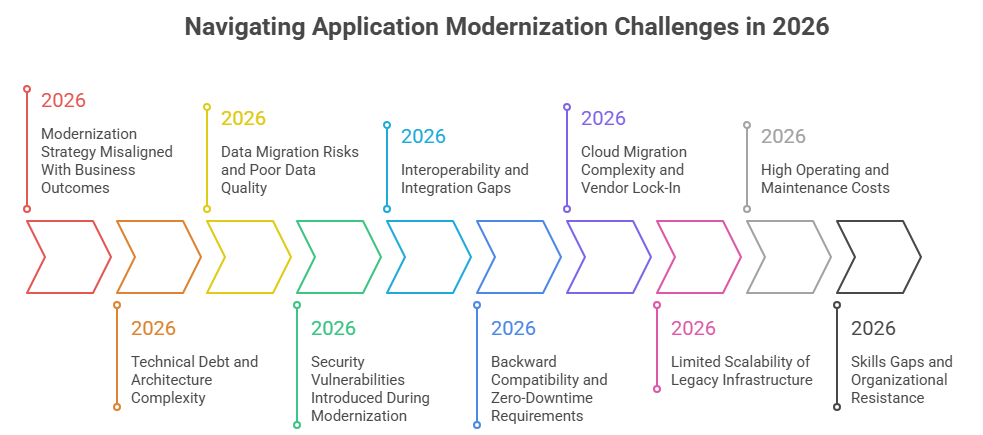
1. Modernization Strategy Misaligned With Business Outcomes
The most common failure mode isn’t technical; it’s strategic. Projects framed as “move X to the cloud” or “retire the mainframe” upgrade technology but miss the business value that justified the spend.
Warning signs include:
- No clear link between modernization tasks and outcomes like faster service delivery or lower cost per transaction
- Vague or missing KPIs, so nobody can prove success
- Siloed stakeholders: IT, finance, program offices each optimizing for different goals
How to solve it: Start with outcomes, not systems. Define 3–5 measurable targets (e.g., cut permit processing time 40%, reduce maintenance spend 30%) and force every architectural decision to trace back to one of them. Executive sponsorship is non-negotiable; modernization that lives only inside IT rarely survives its first budget cycle.
2. Technical Debt and Architecture Complexity
Years of patches, bolt-on features, and undocumented fixes leave legacy applications with tangled, monolithic codebases where a small change in one module breaks three others. Nearly half of organizations consistently rate legacy complexity as their single biggest modernization obstacle.
The costs show up as:
- Frequent bugs and outages under load
- Ballooning maintenance effort that crowds out innovation
- Inability to adopt new capabilities including AI because the architecture can’t support them
How to solve it: Don’t try to fix everything at once. Map the portfolio, score applications by business value versus technical health, and refactor incrementally. Break monoliths into microservices where it pays off, document hidden business logic before the people who understand it retire, and use automated code analysis tools (increasingly AI-assisted in 2026) to identify the riskiest debt first.
3. Data Migration Risks and Poor Data Quality
Data is where modernization projects quietly fail. Legacy systems often trap decades of records in outdated formats, inconsistent schemas, and poorly governed stores. Migrate it carelessly, and you face:
- Data loss or corruption during transfer
- Inconsistent schemas that break downstream reporting and integrations
- Sensitive citizen or customer data exposed if unencrypted in transit
How to solve it: Treat data as a first-class workstream with its own plan, owner, and testing budget. Map data dependencies before touching anything, run reconciliation checks (record counts, checksums, sample audits) before every cutover, and encrypt data in transit and at rest. For public sector programs, align migration controls with your records retention obligations; see our guide on digital records management and FOIA compliance.
4. Security Vulnerabilities Introduced During Modernization
Modernization temporarily expands your attack surface: new APIs, hybrid connections between old and new systems, and unfamiliar cloud configurations all create openings. Legacy systems frequently carry unpatched vulnerabilities and lack modern controls like MFA, and government agencies remain prime targets for ransomware and credential attacks.
How to solve it: Shift security left. Build threat modeling, static/dynamic code analysis, and automated vulnerability scanning into the modernization pipeline itself rather than auditing at the end. Apply least-privilege access to every new integration, and design new architecture around zero trust principles from day one. Our breakdown of Zero Trust Architecture for Government explains why perimeter-based security no longer holds. Agencies procuring cloud solutions should also verify vendor compliance through frameworks like GovRAMP or FedRAMP.
5. Interoperability and Integration Gaps
Modern operations run on APIs, cloud services, and real-time data exchange. Legacy applications often predate all three, which produces data silos, manual re-entry, and brittle point-to-point connections. Typical gaps include:
- No API layer, or middleware that vendors stopped supporting years ago
- Incompatible data formats and protocols
- No native support for cloud or hybrid integration
How to solve it: Wrap before you replace. Expose critical legacy functions through modern REST or event-driven APIs so new systems can consume them immediately, then modernize behind the API at your own pace. An integration platform (iPaaS) or API gateway gives you one governed layer instead of dozens of fragile custom connectors.
6. Backward Compatibility and Zero-Downtime Requirements
Governments and enterprises can’t pause operations to modernize. Residents still need to pay utility bills, file permits, and request services while systems change underneath them. Compatibility pressure comes from:
- User-facing workflows that staff and citizens depend on daily
- Old libraries, databases, and file formats that can’t be swapped overnight
- Mission-critical integrations hard-wired to legacy behavior
How to solve it: Use the strangler fig pattern: route traffic through a facade and replace legacy modules one at a time while the overall service keeps running. Run old and new systems in parallel during transition windows, and invest in user training so adoption doesn’t lag behind deployment. Ignoring this is how projects end in expensive rollbacks.
7. Cloud Migration Complexity and Vendor Lock-In
Cloud is the destination for most modernization programs, but the path is rarely simple. Agencies wrestle with workload placement, egress costs, compliance boundaries, and the strategic question of committing to one provider versus several a tradeoff we analyze in Multi-Cloud vs. Single-Cloud for Government.
How to solve it: Match the migration approach to each workload instead of forcing one pattern portfolio-wide. Containerize where portability matters, use managed services where operational simplicity matters more, and negotiate exit provisions into cloud contracts. For a full picture of the tradeoffs public agencies face, see Cloud Adoption in the Public Sector: Benefits and Challenges.
8. Limited Scalability of Legacy Infrastructure
Applications on fixed on-premises hardware can’t absorb demand spikes tax deadlines, enrollment periods, emergency events. Symptoms include overprovisioned hardware wasting budget most of the year, then crashes exactly when usage peaks.
How to solve it: Adopt cloud-native elasticity: auto-scaling groups, containers orchestrated with Kubernetes, and managed services that flex with demand. Design for horizontal scale (more instances) rather than vertical scale (bigger servers), so capacity becomes a dial instead of a procurement cycle.
9. High Operating and Maintenance Costs
Aging systems drain budgets through expensive licensing renewals, emergency patches, and specialized staff retained solely to keep legacy platforms alive. Every dollar spent on upkeep is a dollar not spent on new capability.
How to solve it: Build a TCO baseline before modernizing so savings are provable, not anecdotal. Retire redundant applications outright (portfolio rationalization typically finds 10–20% of apps nobody would miss), shift routine operations to managed services, and automate monitoring, patching, and deployment through modern DevOps pipelines.
10. Skills Gaps and Organizational Resistance
Even a perfect technical plan fails without people. In 2026, the squeeze comes from both directions: experts in COBOL, mainframes, and legacy databases are retiring, while cloud, DevOps, and AI engineering talent remains fiercely competitive, especially against private sector salaries. Meanwhile, teams comfortable with existing processes may quietly resist change.
How to solve it: Pair every modernization phase with a workforce plan. Upskill internal staff through cloud certifications and hands-on rotation, cultivate change champions inside each department, and fill immediate gaps through IT staff augmentation rather than waiting months for permanent hires; we cover why this works especially well for public sector timelines in Top Benefits of Using IT Staffing for Public Sector Projects. And don’t overlook retention: keeping the IT talent you already have is cheaper than replacing it.
How AI Is Changing Application Modernization in 2026
The newest variable in modernization isn’t a challenge; it’s an accelerant. AI-assisted tools now analyze legacy codebases, document undocumented business logic, translate legacy languages toward modern stacks, and generate test coverage that would take human teams months. Agencies are also modernizing for AI: legacy architectures simply can’t support the chatbots, predictive services, and agentic workflows citizens increasingly expect.
Two implications for IT leaders:
- Modernization is now an AI-readiness project: Clean APIs, governed data, and cloud infrastructure are prerequisites for everything covered in How Government Agencies Can Implement AI.
- AI reduces modernization risk itself, but only with human oversight on code translation and security review.
Application Modernization Challenges vs. Solutions: Quick Reference
| Challenge | Primary Solution |
|---|---|
| Strategy misalignment | Outcome-based KPIs with executive sponsorship |
| Technical debt | Portfolio scoring + incremental refactoring |
| Data migration risk | Dedicated data workstream with reconciliation testing |
| Security vulnerabilities | Shift-left security + zero trust architecture |
| Interoperability gaps | API facade layer / iPaaS |
| Backward compatibility | Strangler fig pattern + parallel running |
| Cloud complexity | Workload-by-workload migration strategy |
| Limited scalability | Containers + auto-scaling cloud-native design |
| High maintenance costs | Portfolio rationalization + managed services |
| Skills gaps | Upskilling + staff augmentation partners |
Final Thoughts: Turn Modernization Challenges Into Advantages
Application modernization in 2026 is no longer optional; legacy systems now block AI adoption, strain budgets, and expand security risk with every year of delay. But the organizations that succeed share one trait: they treat modernization as a continuous, outcome-driven program, not a one-time project.
Tackle strategy alignment, technical debt, data governance, and workforce readiness early, and every challenge on this list becomes a competitive advantage: faster service delivery, stronger security, and infrastructure ready for what’s next.
Ready to modernize without the risk? App Maisters Government helps federal, state, and local agencies modernize legacy applications with proven, phased approaches from cloud consulting to full application development. Explore our client success stories or contact our team for a modernization assessment.
Bridging these gaps means exposing key services via modern APIs, adopting integration platforms, or using Enterprise Service Buses (ESBs). A strong integration architecture lets old and new systems share data seamlessly. This interoperability jumpstarts digital initiatives and boosts organizational agility.
Frequently Asked Questions
What are the biggest challenges of application modernization?
The biggest application modernization challenges are technical debt in legacy code, data migration risk, security vulnerabilities introduced during transition, interoperability gaps between old and new systems, high costs, and shortages of cloud and legacy skills. Strategy misalignment: modernizing technology without defined business outcomes is the most common root cause of failed projects.
Why do application modernization projects fail?
Most modernization projects fail for organizational reasons rather than technical ones: unclear business objectives, no measurable KPIs, insufficient executive sponsorship, and underestimating data migration complexity. Attempting a “big bang” replacement instead of a phased approach is another leading cause of budget overruns and rollbacks.
What is the strangler fig pattern in application modernization?
The strangler fig pattern is an incremental modernization strategy where new functionality is built around a legacy system, and traffic is gradually rerouted to new components until the old system can be safely retired. It allows organizations to modernize without downtime and reduces risk compared to full rewrites.
How long does application modernization take?
Timelines vary by scope: a single application rehost can take weeks, while modernizing a portfolio of interconnected legacy systems typically takes 12–36 months. Phased approaches deliver usable improvements within the first 3–6 months, which helps sustain funding and stakeholder support.
How much does legacy application modernization cost?
Costs depend on the approach: rehosting is the least expensive, while rearchitecting or rebuilding costs significantly more but delivers greater long-term savings. Organizations should weigh modernization cost against the total cost of ownership of legacy systems, which often consumes the majority of IT budgets in maintenance, licensing, and specialized staffing.
Why is application modernization important for government agencies?
Government agencies rely on legacy systems that are increasingly expensive to maintain, vulnerable to cyberattacks, and unable to support modern citizen services like online portals, mobile apps, and AI chatbots. Modernization reduces operating costs, strengthens security compliance, and enables the digital services residents now expect.
Should you rehost, refactor, or rebuild a legacy application?
Choose based on business value and technical health: rehost low-change applications for quick cloud wins, refactor high-value applications weighed down by technical debt, and rebuild or replace applications that are too brittle to salvage. Most organizations use a mix of all three across their portfolio rather than a single approach.