
In May 2021, a ransomware attack on the Colonial Pipeline brought nearly half of the U.S. East Coast’s fuel supply to a halt. The breach began not with a sophisticated exploit, but with a single compromised password, one that granted access through an unmonitored VPN portal. The castle walls stood tall. But the attacker was already inside.
This is the defining paradox of modern government cybersecurity services the most catastrophic breaches rarely come from brute force. They exploit trust trusted credentials, trusted network zones, and trusted internal users. And they expose a brutal truth:
For government agencies managing sensitive citizen data, critical national infrastructure, and classified intelligence, this is not an abstract concern. It is an existential operational risk.
Zero trust architecture government deployments represent the most important cybersecurity paradigm shift of this decade. This guide breaks down why the old model is failing, what zero trust actually means in practice, and how government entities can implement it effectively in 2026 and beyond.
Key Challenges Facing Government Security Teams
| Challenge | Real-World Impact |
|---|---|
| Remote & Hybrid Workforce | Government employees access classified systems from home networks and personal devices all outside the traditional perimeter. |
| Cloud Migration | Over 70% of U.S. federal agencies have migrated workloads to multi-cloud environments, dissolving any meaningful network boundary. |
| Third-Party Vendor Access | Contractors and supply-chain partners hold privileged access to sensitive systems creating invisible attack surfaces. |
| Insider Threats | The 2023 Pentagon Discord leaks were perpetrated by an insider with legitimate access. Perimeter security offers zero protection here. |
| Legacy Infrastructure | Many agencies still run decades-old systems with no native authentication controls. |
| AI-Powered Attacks | Adversarial AI enables real-time phishing and credential stuffing at scales no human team can monitor manually. |
The top cyber threats government agencies face are less about what’s outside the firewall and far more about what’s happening inside it.
What Is Zero Trust Architecture and Why Government Needs It Now
Zero Trust is built on one foundational principle:
In May 2021, Executive Order 14028 explicitly required all federal agencies to develop zero trust plans reinforced by OMB guidance (M-22-09). For government entities, federal government security compliance now effectively means zero trust compliance.
The CISA Zero Trust Maturity Model (ZTMM) provides a roadmap across five pillars:
| Pillar | What Government Must Do |
|---|---|
| Identity | Every user must be authenticated via MFA and risk-based Conditional Access. Phishing-resistant hardware keys (FIDO2/PIV) are required for privileged accounts. |
| Devices | All endpoints must meet security posture requirements before network access is granted. MDM/EDR enforcement is non-negotiable. |
| Networks | Micro-segmentation replaces flat network architectures. Lateral movement is contained; east-west traffic is monitored and policy-controlled. |
| Applications | Apps are accessed via identity-aware proxies. No implicit trust based on network location. |
| Data | Data is classified, labeled, and encrypted. Access is governed by least-privilege and dynamic policy, not static role assignments. |
Emerging Tech Trends Powering Zero Trust in Government (2026)
1. AI-Driven Continuous Authentication
Traditional MFA is no longer sufficient against sophisticated cybersecurity AI threats in 2026, including deepfake voice attacks and AI-assisted credential theft. AI-powered behavioral biometrics now continuously verify users based on typing patterns, mouse behavior, and session activity.
2. Identity Threat Detection and Response (ITDR)
Platforms like CrowdStrike Falcon Identity and Microsoft Entra ID Protection use ML models to detect credential stuffing, token theft, and lateral movement in real time. For government agencies, this is becoming a compliance baseline.
3. Zero Trust Network Access (ZTNA) Replacing VPNs
ZTNA solutions (Zscaler, Palo Alto Prisma Access, Cloudflare Access) provide application-specific access based on identity and device posture with no implicit network-layer trust. The U.S. DoD’s JWCC cloud contract includes ZTNA as a core component.
4. Sovereign Cloud and FedRAMP-Authorized Platforms
FedRAMP High-authorized zero trust platforms, including Microsoft Azure Government, AWS GovCloud, and Google Workspace for Government, are the de facto deployment environments for federal zero trust workloads in 2026.
5. Automated Security Policy Orchestration
AI-powered policy engines like SailPoint IdentityNow and Saviynt dynamically adjust access rights based on role changes, behavioral signals, and compliance requirements with full audit trails for federal oversight.
Step-by-Step: Implementing Zero Trust in a Government Environment
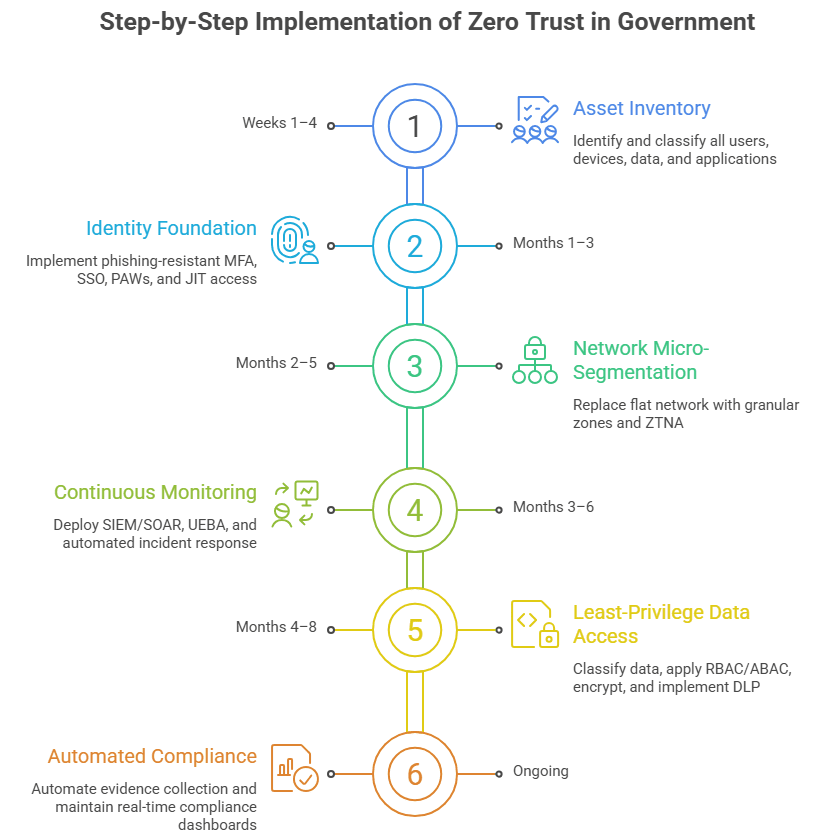
Step 1: Inventory and Classify All Assets (Weeks 1–4)
- All user accounts, including service accounts and shared credentials
- All devices accessing government systems (managed and unmanaged)
- All data types, sensitivity classifications, and storage locations
- All application dependencies, APIs, and third-party integrations
Step 2: Establish a Strong Identity Foundation (Months 1–3)
- Phishing-resistant MFA (FIDO2, PIV/CAC cards) for all privileged users
- Single Sign-On (SSO) with centralized identity governance
- Privileged Access Workstations (PAWs) for administrative roles
- Just-in-Time (JIT) access provisioning for sensitive systems
Step 3: Implement Network Micro-Segmentation (Months 2–5)
Replace flat network architecture with granular segmentation. Define security zones by data sensitivity. Deploy ZTNA to replace legacy VPN access.
Step 4: Deploy Continuous Monitoring and Analytics (Months 3–6)
- SIEM/SOAR platforms (Microsoft Sentinel, Splunk SOAR) with government-specific threat intelligence
- User and Entity Behavior Analytics (UEBA) to detect anomalous activity
- Automated incident response playbooks for common threat scenarios
Step 5: Enforce Least-Privilege Data Access (Months 4–8)
Classify all data using a tiered sensitivity framework (CUI taxonomy). Apply RBAC/ABAC controls. Encrypt all data at rest and in transit. Implement DLP on all endpoints and cloud workloads.
Step 6: Automate Compliance Reporting (Ongoing)
Automate evidence collection for FISMA, FedRAMP, NIST 800-53, and CMMC audits. Use GRC platforms (ServiceNow GRC, Archer) to maintain real-time compliance dashboards.
Real-World Use Cases
Case Study 1: U.S. Department of Defense
The DoD’s 2022 Zero Trust Strategy set a target of full zero trust maturity across all components by FY2027. Early implementations in the Army and Air Force demonstrated 40–60% reductions in lateral movement opportunities following micro-segmentation deployments.
Case Study 2: CISA Shields Up Program
Following the SolarWinds supply chain attack, agencies using CISA’s behavioral analytics tooling detected credential-based intrusion attempts an average of 18 days earlier than those relying on perimeter controls alone.
Case Study 3: UK Government Digital Service
After migrating behind Cloudflare’s Zero Trust platform, the UK’s GDS achieved 99.98% application availability, a 70% reduction in remote access help desk tickets, and full compliance with UK Government Security Classifications for 12,000+ civil servants.
Best Practices & Expert Tips
- Start with identity, not network: Most breaches begin with compromised credentials. Identity is your highest-leverage investment.
- Adopt an “assume breach” mindset: Design systems as if attackers are already inside. Limit blast radius through segmentation and least-privilege.
- Instrument everything: Zero trust without telemetry is blind. Full logging and behavioral analytics are non-negotiable.
- Make compliance continuous, not periodic: Automated compliance monitoring reduces audit costs by 35–50%.
- Train humans alongside deploying technology: Mandatory phishing simulation training should accompany every zero trust rollout.
- Partner with FedRAMP-authorized vendors: Non-authorized tools create compliance gaps regardless of their technical capabilities.
Common Mistakes to Avoid
| ❌ Mistake | ✅ What to Do Instead |
|---|---|
| Treating zero trust as a single product purchase | It's an architecture, not a product. Require an integrated strategy. |
| Skipping the asset inventory phase | You cannot protect what you cannot see. Inventory is the foundation. |
| Implementing MFA without phishing resistance | SMS-based MFA is bypassable. Mandate FIDO2 or hardware tokens for privileged access. |
| Neglecting service accounts and non-human identities | Automated pipelines are frequent attack vectors. Apply zero trust to all identities. |
| Setting and forgetting access policies | Automate quarterly access reviews to catch orphaned privileges. |
| Underestimating change management | Without user training, shadow IT workarounds will defeat the purpose. |
Conclusion & Future Outlook
The perimeter is gone. The Colonial Pipeline attack, the SolarWinds breach, and the Pentagon Discord leak weren’t failures of firewalls. They were failures of trust.
Implementing zero trust architecture government-wide is no longer optional. It is a federal mandate, an operational imperative, and a public trust issue.
Looking ahead to 2027 and beyond:
- Autonomous Threat Response: AI-driven SOAR will contain breaches within minutes, reducing dwell time from 197 days to under 60 minutes.
- Quantum-Safe Cryptography: NIST’s post-quantum standards are finalized. Migration planning must begin now.
- AI-Augmented Policy Management: LLMs will help security architects write and audit zero trust policies at machine speed.
- Cross-Agency Zero Trust Federations: Interoperability frameworks will enable secure, seamless inter-agency collaboration without perimeter compromise.
App Maisters Government delivers specialized government cybersecurity services purpose-built for public sector organizations. From zero trust architecture government strategy through deployment, their federal security architects help agencies close the gap between mandate and implementation.
Frequently Asked Questions
What is Zero Trust Architecture and why does the government need it?
Zero Trust Architecture is a cybersecurity framework based on “never trust, always verify.” Every user, device, and application must be continuously verified regardless of location. Government agencies need it because insider threats, cloud breaches, and AI-powered attacks have made traditional perimeter-based security obsolete. It is now a federal mandate under Executive Order 14028.
Is Zero Trust Architecture a federal compliance requirement for government agencies?
Yes. Executive Order 14028 and OMB Memorandum M-22-09 require all federal civilian agencies to implement zero trust. CISA’s Zero Trust Maturity Model (ZTMM) provides the compliance roadmap across five pillars: Identity, Devices, Networks, Applications, and Data. Non-compliance is no longer an option for agencies subject to federal government security compliance standards.
What are the biggest cyber threats facing government agencies in 2026?
The top cyber threats government agencies face include AI-powered phishing, ransomware on critical infrastructure, supply chain attacks, insider threats, and identity-based credential theft. Nation-state actors are increasingly using cybersecurity AI threats 2026 techniques deepfakes, automated exploitation, and adversarial AI to bypass traditional defenses faster than ever before.
How long does it take a government agency to implement Zero Trust Architecture?
A full implementation typically takes 12 to 36 months depending on agency size and legacy infrastructure. However, early wins come fast deploying MFA and identity hardening in the first 90 days alone can reduce credential-based breach risk by over 90%. A phased approach is always recommended over a big-bang deployment.
What tools are used to implement Zero Trust in government environments?
Common FedRAMP-authorized tools include Microsoft Azure Government and Entra ID for identity management, Zscaler or Cloudflare for ZTNA, CrowdStrike Falcon for endpoint and identity threat detection, Microsoft Sentinel or Splunk for SIEM/SOAR, and SailPoint for identity governance. All platforms must be FedRAMP authorized; non-compliant tools create serious regulatory gaps regardless of their technical strength.
How is AI changing cybersecurity for government agencies?
AI is reshaping government cybersecurity services on both sides. Attackers use AI to automate phishing, generate deepfakes, and crack credentials at scale. Defenders use AI for real-time anomaly detection, behavioral authentication, and automated threat response. By 2027, AI-driven SOAR platforms are expected to reduce breach containment time from 197 days to under 60 minutes for zero trust-mature agencies.