If your team is still manually sorting resumes and chasing interview schedules by email, you already know how much time recruitment eats up. An ai powered hiring platform changes that by automating the repetitive parts of hiring sourcing, screening, scheduling, and communication so recruiters can focus on people, not paperwork. This guide breaks down the top 10 benefits and shows exactly how these platforms help HR teams hire faster and smarter.
What Is an AI-Powered Hiring Platform?
An AI-powered hiring platform is recruitment software that uses artificial intelligence including machine learning, natural language processing, and predictive analytics to automate candidate sourcing, resume screening, interview scheduling, and hiring decisions, reducing manual work and shortening time-to-hire.
Why Traditional Hiring Is Too Slow?
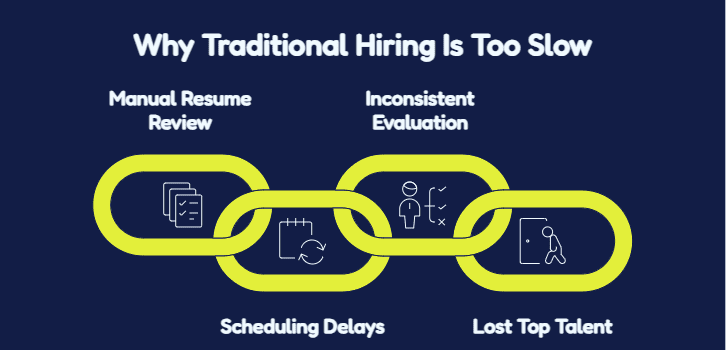
Manual recruitment processes involve slow resume reviews, scheduling delays, and inconsistent candidate evaluation, which extend time-to-hire and increase costs. This affects HR directors, recruiters, and hiring managers across every industry, especially in high-volume or enterprise hiring environments.
Hiring the right person shouldn’t take two months. But for most companies, it does.
What’s happening:
- Recruiters manually review hundreds of resumes per role
- Interview scheduling bounces back and forth over email
- Candidate evaluation varies from recruiter to recruiter
- Top candidates accept other offers while your process drags on
Why it happens: Legacy applicant tracking systems (ATS) were built to store data, not to make decisions. Screening, shortlisting, and scheduling are still done manually in most organizations, which creates bottlenecks at every stage.
Who it affects: HR Directors, Talent Acquisition Managers, Corporate Recruiters, and CHROs especially teams handling high application volumes or scaling enterprise hiring.
The data backs this up. The average U.S. hiring process now takes roughly 42 days from job opening to accepted offer, according to SHRM’s 2025 Benchmarking Report. That’s six weeks of lost productivity for every open role. Meanwhile, talent acquisition professionals using generative AI report a 20% reduction in overall workload, equivalent to saving one full workday per week, according to LinkedIn’s Future of Recruiting 2025 report showing just how much time AI can recover.
How AI Recruitment Platforms Fix This.
An AI recruitment platform solves slow, inconsistent hiring by automating resume screening, candidate matching, scheduling, and communication using machine learning models trained on job requirements and historical hiring data, reducing time to hire while keeping recruiters in control of final decisions.
An AI recruitment platform doesn’t replace recruiters; it removes the repetitive tasks, slowing them down. Here’s the typical automated workflow:
- Job posting & sourcing: AI distributes listings and sources candidates from multiple channels automatically
- Resume screening: Machine learning models rank candidates against job criteria in seconds
- Candidate matching: Predictive scoring highlights the best fit applicants
- Interview scheduling: Self-service calendars eliminate email back and forth
- Candidate communication: Chatbots answer FAQs and send status updates 24/7
- Bias auditing: Structured, criteria-based scoring reduces subjective judgment
- Human review & final decision: Recruiters and hiring managers make the final call
Top 10 Benefits of Using an AI-Powered Hiring Platform.
1. Faster Time-to-Hire
AI screens and ranks candidates in minutes instead of days, directly cutting the weeks-long delays typical of manual review.
2. Reduced Cost-Per-Hire
Automating sourcing and screening lowers the administrative hours and agency dependency that drive up recruitment spend.
3. Higher-Quality Candidate Matches
Predictive analytics evaluate skills, experience, and role fit more consistently than manual resume scanning.
4. Reduced Unconscious Bias
Structured, criteria-based scoring focuses on qualifications rather than subjective impressions, supporting fairer shortlists.
5. Improved Candidate Experience
AI chatbots provide instant answers and status updates, keeping candidates engaged instead of left waiting in silence.
6. Scalable for Enterprise Hiring Volumes
An enterprise ai recruitment platform can process thousands of applications simultaneously impossible to do manually at the same speed or accuracy.
7. Data-Driven Hiring Decisions
Dashboards and analytics give HR leaders visibility into pipeline health, bottlenecks, and hiring forecasts in real time.
8. Seamless Integration with Existing HR Tech
Modern AI talent acquisition platform solutions connect with your existing ATS, HRIS, and calendar tools, avoiding disruptive rip-and-replace projects.
9. Stronger Employer Branding
Fast, transparent, and respectful communication reflects well on your company and improves offer acceptance rates.
10. Better Long-Term Retention
Improved role-fit matching at the hiring stage correlates with employees who are more likely to stay and succeed.
Real-World and Hypothetical Examples
Real-world example: Unilever used AI-powered video interviews and predictive analytics to process over 250,000 applications annually for its Future Leaders programme, narrowing the pool to 350 shortlisted candidates before final human review.
Hypothetical example: Imagine a mid-sized enterprise HR team receiving 3,000 applications for 15 open roles each quarter. Without automation, two recruiters might spend three weeks manually screening resumes. With an AI-powered hiring platform, that same screening could be reduced to a few days, freeing recruiters to focus on interviews and candidate relationships instead of paperwork.
Best Practices for Implementing an AI-Powered Hiring Platform
- Start with a pilot role or department before rolling out company-wide
- Keep humans in the final decision loop use AI for shortlisting, not final selection
- Audit AI outputs regularly for demographic disparities and bias
- Integrate with your existing ATS/HRIS instead of replacing your entire stack at once
- Train recruiters on how to interpret AI scoring and recommendations
- Communicate transparently with candidates about AI use in the process, per local regulations
Quick Checklist Before You Launch:
- Defined clear job criteria and scoring weights
- Reviewed compliance requirements (e.g., NYC Local Law 144)
- Set up bias-audit reporting
- Trained hiring managers on the new workflow
- Integrated the platform with existing HR systems
- Established a human-review checkpoint before offers
Comparison: Traditional Hiring vs. AI-Powered Hiring Platform
| Factor | Traditional Hiring | AI-Powered Hiring Platform |
|---|---|---|
| Time-to-hire | ~42 days average | Significantly faster, often reduced by 33–50% |
| Resume screening | Manual, hours per batch | Automated, minutes per batch |
| Scheduling | Email back-and-forth | Self-service, automated |
| Bias risk | Higher, subjective | Reduced with structured, auditable scoring |
| Scalability | Limited by headcount | Scales to enterprise volumes |
| Candidate communication | Delayed, inconsistent | Instant, 24/7 via chatbot |
Key Takeaways
- An ai powered hiring platform automates screening, scheduling, and communication to cut time-to-hire
- Enterprise teams benefit most from scalability and integration with existing HR systems
- Structured AI scoring can help reduce unconscious bias, but human oversight is still essential
- Faster, more transparent hiring improves candidate experience and employer brand
- Start with a pilot, audit regularly, and keep recruiters in the decision loop
Conclusion.
Recruitment doesn’t have to take six weeks and dozens of manual hours per hire. An AI-powered hiring platform brings speed, consistency, and data-driven decision-making to every stage of recruitment from sourcing to offer. For HR leaders managing high-volume or enterprise hiring, this isn’t just a nice-to-have; it’s becoming the standard.
If you’re ready to see how automated, AI-driven recruitment could work for your team, explore the AI-Powered Hiring Platform and book a free demo to see faster hiring in action.
Frequently Asked Questions
What is an AI-powered hiring platform?
An AI-powered hiring platform is recruitment software that uses artificial intelligence to automate resume screening, candidate matching, interview scheduling, and communication. It helps HR teams evaluate applicants faster and more consistently while reducing manual administrative work throughout the hiring process.
How does AI reduce time-to-hire?
AI reduces time-to-hire by automating slow manual steps like resume review and interview scheduling. Instead of recruiters spending days sorting applications, AI models screen and rank candidates in minutes, letting teams move qualified applicants to interviews much faster.
Is AI recruitment software suitable for enterprise companies?
Yes. Enterprise AI recruitment platforms are built to handle high application volumes across multiple roles and locations simultaneously. They integrate with existing ATS and HRIS systems, making them well-suited for large-scale, ongoing recruitment needs.
Does AI hiring eliminate the need for recruiters?
No. AI hiring platforms are designed to support recruiters, not replace them. AI handles repetitive screening and scheduling tasks, while recruiters and hiring managers retain control over interviews and final hiring decisions.
Can AI hiring platforms reduce bias?
AI platforms can reduce bias by using structured, criteria-based scoring instead of subjective judgment. However, bias reduction depends on regular auditing of AI outputs and transparent, well-designed scoring criteria set by the organization.
What should HR teams look for in an AI recruitment platform?
Look for integration with existing HR systems, transparent and auditable scoring, scalability for your hiring volume, strong candidate communication tools, and compliance support for applicable AI hiring regulations.