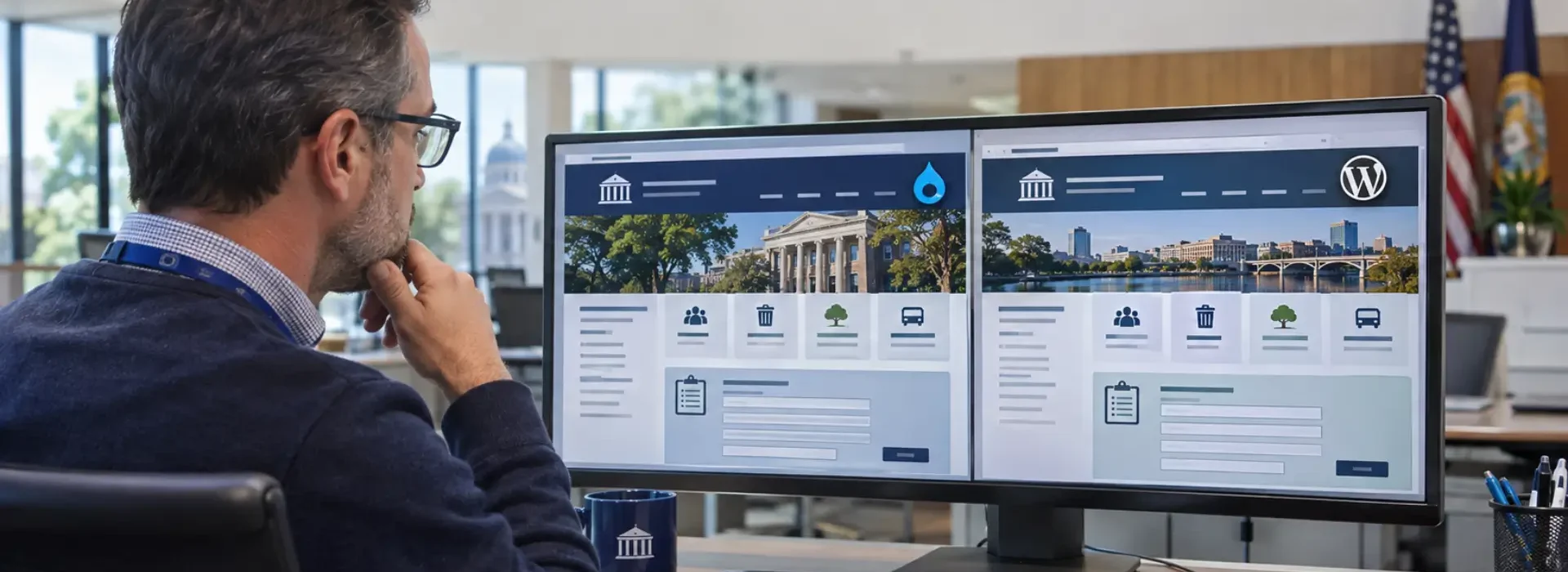
A resident trying to renew a permit does not care which content management system powers the website. They care whether the form works, their information stays protected, and they can complete the task without calling an office.
For government teams, however, the CMS decision shapes years of maintenance, accessibility work, and public-service delivery.
Drupal is often the stronger fit for complex content structures, multilingual publishing, and multiple approval stages. WordPress is often a practical choice for straightforward public-information websites with simpler editorial needs. Neither platform automatically delivers security, accessibility, or lower lifetime cost.
The right choice depends on your agency’s workflows, operating capacity, and five-year budget.
Drupal vs. WordPress: A Government Website Comparison
These are planning judgments, not limits on what either platform can achieve through customization.
| Decision factor | Drupal | WordPress |
|---|---|---|
| Publishing governance | Core Workflows and Content Moderation support configurable review stages | Core roles support common publishing needs; advanced approvals may require extensions |
| Multilingual content | Core modules support language and translation management | Typically implemented through plugins, services, or custom architecture |
| Accessibility | Strong foundations; finished website still requires testing | Accessible implementation is possible; themes, plugins, and content require testing |
| Security operations | Assess core, contributed modules, custom code, and hosting | Assess core, plugins, themes, custom code, and hosting |
| Cost pressure | Specialized implementation and upgrade effort | Extension management and customization can increase operating costs |
| Likely fit | Complex, coordinated public-sector publishing | Focused websites with simpler publishing requirements |
Drupal supports keeping a published page live while a separate revision moves through review, alongside four core multilingual modules. WordPress provides roles and capabilities for controlling user actions. These differences support the fit assessment above.
1. Security: Compare Operational Controls, Not Reputations
“Is Drupal more secure than WordPress?” is an incomplete procurement question.
The more useful question is: Which implementation can our agency consistently patch, monitor, and recover?
Where Drupal can help
Drupal’s configurable permissions and moderation workflows can support separation between authors, reviewers, and publishers. That matters when public-health guidance, ordinances, or emergency information requires approval.
Drupal also identifies contributed projects covered by its security advisory policy. Agencies should verify coverage for every proposed module rather than assume all extensions receive the same oversight.
What WordPress requires
WordPress can support government publishing, but the proposed plugin and theme stack deserves close review. Ask what each extension does, who maintains it, and how it will be replaced if support ends.
WordPress’s official hardening guidance emphasizes trusted software sources, limited access, updates, backups, logging, and monitoring. A managed hosting contract should clearly identify which responsibilities belong to the provider and which remain with the agency.
Require the same baseline for both
Include these requirements in the statement of work:
- Single sign-on and multifactor authentication for privileged access.
- An approved inventory of modules, plugins, themes, and dependencies.
- Risk-based patch deadlines, including emergency remediation.
- Staging tests, rollback procedures, and restricted production access.
- Centralized logs, vulnerability monitoring, and incident escalation.
- Tested backup restoration with agreed recovery objectives.
Keep sensitive submissions in appropriately secured systems, with defined retention and access controls. A public CMS should not become an unplanned repository for identity documents or confidential case records.
A government cybersecurity assessment can help identify these requirements before procurement.
Lifecycle warning: Drupal 10 reaches end of life on December 9, 2026. A new proposal centered on that version needs a credible upgrade plan and explicit funding. A platform name alone tells you little without its supported version and dependencies.
2. Accessibility: Neither CMS Makes a Website Compliant
A website can use an accessible theme and still prevent someone from submitting a permit application.
The barrier might be an unlabeled field, inaccessible calendar, confusing error message, or untagged PDF. These problems must be evaluated across the complete service journey.
Start with the correct government requirements
For covered federal ICT, the Revised Section 508 Standards incorporate WCAG 2.0 Level A and AA requirements, alongside other applicable provisions.
For state and local government web content and mobile apps, DOJ’s ADA Title II rule establishes WCAG 2.1 AA as the technical standard, subject to specified exceptions. Following the 2026 deadline extension:
- Entities with populations of 50,000 or more generally have until April 26, 2027.
- Entities with populations below 50,000 and special district governments generally have until April 26, 2028.
Existing ADA obligations continue; the extension does not suspend them. Population calculations follow DOJ guidance.
WCAG 2.2 AA can be specified as a forward-looking project target, but agencies should distinguish that contractual target from the standard incorporated into the applicable rule.
Evaluate the completed implementation
Drupal core targets WCAG 2.2 AA, but Drupal explicitly states that configuration, contributed projects, custom code, and content affect the accessibility of a finished site.
WordPress updated its accessibility-ready theme requirements in May 2026. Its announcement also explains why a theme cannot establish conformance for all the content placed within it.
For either platform, require:
- Accessible templates and reusable components.
- Automated checks plus manual keyboard and screen-reader testing.
- Testing of forms, errors, uploads, search, and third-party integrations.
- Document remediation and accessible content-authoring guidance.
- Documented defects, remediation ownership, and regression checks.
Practical example: During a benefits application test, ask a keyboard-only user to identify an error, correct the field, upload a document, and confirm submission. A homepage audit cannot establish whether that journey works.
3. Total Cost: Calculate Five Years, Not Just Launch
Drupal and WordPress are open-source platforms. That does not make implementation, hosting, support, or ongoing compliance free.
Use a consistent model:
Five-year TCO = discovery and build + migration + five years of operations + planned upgrades + transition costs.
Request equivalent scope in every bid:
| Cost category | What agencies should include |
|---|---|
| Discovery and development | Research, content modeling, design, configuration, integrations |
| Migration | Content cleanup, document inventory, redirects, metadata, validation |
| Operations | Hosting, monitoring, backups, patching, licenses, internal staff time |
| Accessibility | Initial assessment, remediation, training, recurring testing |
| Lifecycle changes | Major upgrades, dependency replacement, integration changes |
| Exit and handover | Data exports, code access, documentation, vendor transition |
Why the lowest launch price can lose
Consider two hypothetical bids for the same scope:
- Bid A: $80,000 initially + $40,000 annually for five years + $30,000 in planned upgrades = $310,000.
- Bid B: $120,000 initially + $28,000 annually for five years + $20,000 in planned upgrades = $280,000.
Bid B costs $40,000 more initially but $30,000 less over five years.
These are illustrative calculations, not Drupal or WordPress pricing benchmarks. Assume equivalent coverage and no inflation or discounting. Add separately any costs omitted from the bids.
WordPress may offer an economical starting point when requirements fit standard publishing patterns. Drupal may justify greater configuration effort when its core capabilities reduce custom workflow development. Existing staff expertise can change either outcome.
Ask bidders to explain the cost of each requirement, not simply quote a CMS package.
4. Which Platform Fits Your Agency’s Actual Work?
Consider Drupal for coordinated publishing
Imagine a state agency publishing service information across several languages and departments. Pages require departmental review, legal approval, and controlled publication.
Drupal’s core translation and moderation capabilities make it a strong candidate. Validate the exact workflow in a prototype, including permissions, translated revisions, and emergency publishing.
Consider WordPress for focused information delivery
A small municipal department may mainly publish meeting notices, service pages, news, and contact information.
WordPress is worth evaluating when those needs can be met with a controlled theme, approved extensions, and a simple review process. Demonstrate the editor experience and maintenance procedure before committing.
Evaluate architecture separately for transactional services
A permit portal or benefits application may need case management, payments, identity verification, and protected records.
The CMS can publish service guidance while integrated applications handle transactions. Compare the entire architecture rather than assume either CMS should manage every function.
For broader replacement projects, plan a phased modernization approach that preserves access to essential services during migration.
5. Plan for AI Search and Future Integrations
AI-assisted search and citizen-support tools make content governance even more valuable.
Whichever CMS you choose, organize service pages around explicit eligibility rules, required documents, fees, deadlines, and next steps. Assign content owners and review dates. Use descriptive headings, canonical URLs, and relevant structured data that matches visible content.
If an AI assistant retrieves website information, require source links, permission-aware retrieval, freshness checks, and escalation when an answer is uncertain. Publishing a page should not automatically authorize every document to enter an AI knowledge base.
Headless architecture can support multiple channels, but it also introduces a separate frontend to secure, test, and maintain. Require a demonstrated need before accepting that additional cost.
Questions to Resolve Before Awarding a Contract
Ask shortlisted vendors to demonstrate the same scenarios:
- An author edits a live page without publishing prematurely.
- A resident completes a priority task using assistive technology.
- A security update is tested, deployed, and rolled back.
- An emergency notice remains available during a traffic surge.
- Content, files, and configuration can be handed to another provider.
Score evidence from these demonstrations alongside the five-year cost proposal. The best government CMS is the one your agency can govern and sustain.
Build Around Public Service Outcomes
Choose Drupal when complex publishing requirements justify its capabilities. Choose WordPress when a simpler implementation meets the agency’s needs with fewer operating demands. In both cases, fund security, accessibility, content governance, and lifecycle maintenance from the start.
App Maisters Government provides government website development services, including WordPress and Drupal CMS implementation, accessibility, integrations, and ongoing support. Start with a requirements assessment to identify the platform and architecture that fit your agency’s services, staffing, and long-term budget.
Frequently Asked Questions
Is Drupal or WordPress better for government websites?
Drupal is often a better fit for complex government websites requiring structured content, multilingual publishing, and multiple approval stages. WordPress is often suitable for public-information websites with simpler publishing needs. The right choice depends on the agency’s requirements, staff expertise, integrations, and long-term maintenance budget.
Is Drupal more secure than WordPress for government use?
Neither platform is automatically more secure in every implementation. Security depends on supported software versions, extension quality, access controls, hosting, and timely updates. Agencies should evaluate the proposed architecture and require documented patching, monitoring, incident response, and backup recovery procedures.
Are Drupal and WordPress government websites accessible by default?
No. Both platforms provide foundations for accessible development, but neither guarantees that a completed website meets accessibility requirements. Themes, modules, plugins, custom code, documents, and third-party tools can introduce barriers. Agencies should require automated checks, manual testing, and ongoing content accessibility reviews.
Which costs less for a government website: Drupal or WordPress?
WordPress may cost less initially when requirements fit standard publishing features. Drupal may offer better value when its built-in capabilities reduce the need for custom workflows or translation extensions. Compare five-year costs, including development, migration, hosting, maintenance, accessibility testing, upgrades, and internal staff time.
Can Drupal and WordPress integrate with government service portals?
Yes. Both can integrate with external systems through APIs and appropriate extensions or custom development. Common integrations include identity providers, permit systems, payment services, and citizen-support tools. Agencies should define authentication, data protection, accessibility, and maintenance responsibilities across the complete service journey.
What should agencies include in a Drupal or WordPress website RFP?
A government CMS RFP should define publishing workflows, accessibility acceptance criteria, security controls, integrations, migration scope, performance targets, and support expectations. Request a five-year cost breakdown and demonstrations of priority tasks. Also specify ownership, documentation, export capabilities, and vendor transition requirements.