
The federal government loses an estimated $2 billion annually due to IT workforce turnover. In 2025, the U.S. Office of Personnel Management reported that nearly 30% of federal IT positions experienced turnover a rate nearly double that of the private sector. Behind every vacancy is a cascading failure: delayed projects, security vulnerabilities, and citizens waiting longer for services that should be seamless.
This isn’t a budget problem. It’s a strategy problem.
Agencies already investing in government IT services and infrastructure still hemorrhage their best technologists to tech giants and startups offering equity, flexibility, and modern toolchains. The question isn’t whether government can afford to retain top IT talent; it’s whether it can afford not to.
Key Challenges Driving IT Talent Loss in Government
Understanding why technologists leave is the first step to making them stay. The pain points are specific and addressable:
| Challenge | Impact |
|---|---|
| Compensation Gaps (20–40% Below Market) | Direct competition loss to private sector. |
| Outdated Legacy Systems | Engineers feel their skills stagnate. |
| Bureaucratic Hiring/Promotion Cycles | High performers seek faster growth elsewhere. |
| Limited Remote/Hybrid Flexibility | Work-life balance expectations unmet. |
| Unclear Career Progression Paths | Ambiguity drives early exits. |
| Security Clearance Delays (Avg. 200+ Days) | Candidates accept competing offers mid-process. |
The gap isn’t just financial. A 2024 Deloitte Government Human Capital report found that 64% of departing federal IT workers cited “lack of modern tools” as a primary reason, outranking pay in some cohorts. That’s both a warning and an opportunity.
Emerging Tech Trends Reshaping Government IT Workforce Strategy
The agencies winning the talent war in 2026 aren’t just paying more; they’re working smarter. Here’s what’s changing:
AI-Powered Workforce Planning: Agencies like the Department of Veterans Affairs are deploying AI tools to predict attrition 6–12 months in advance, flagging at-risk employees based on engagement signals, promotion timelines, and workload patterns. This shifts HR from reactive to predictive.
Cloud-First Modernization as a Retention Tool: Transitioning to AWS GovCloud, Microsoft Azure Government, or Google Public Sector isn’t just an infrastructure play; it’s a talent strategy. Engineers want to work on modern stacks. Agencies that modernize their government IT infrastructure roles simultaneously make the work more compelling and the skills more transferable (in both directions).
Skills-Based Hiring Replacing Degree Requirements: OPM’s 2024 directive pushed agencies toward competency-based assessments over rigid degree requirements. This opens the talent pool and signals to candidates that performance, not paper, drives advancement.
Pay Banding and Market-Based Compensation: A growing number of agencies are piloting pay banding models outside the GS scale for cybersecurity, AI/ML, and cloud engineering roles, matching or approaching private sector benchmarks for mission-critical positions.
Step-by-Step: A Modern IT Talent Retention Framework
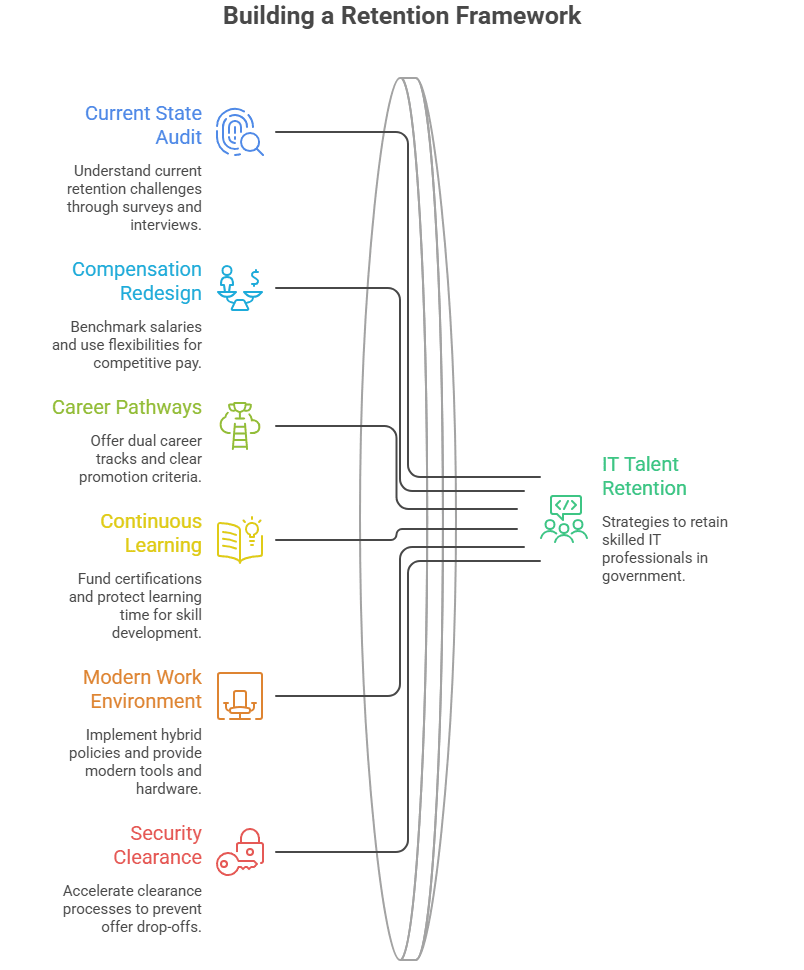
Step 1: Audit Your Current State
Before investing in retention programs, map reality. Conduct anonymous pulse surveys, exit interview analysis, and skills gap assessments. Understand why people leave and why they stay. Most agencies skip this step and throw programs at the wrong problems.
Step 2: Redesign Compensation Using Market Data
Work with your government IT staffing consulting partner to benchmark roles against current market rates. Use excepted service authorities (Schedule A, B), Title 5 flexibilities, or direct-hire authority to move faster and pay competitively for hard-to-fill roles like zero-trust architects, DevSecOps engineers, and AI/ML specialists.
Step 3: Build Modern Career Pathways
Create dual-track career ladders: a technical individual contributor (IC) path alongside the traditional management track. Too many skilled engineers are forced into management to advance and both they and the agency lose. Define clear promotion criteria, skills milestones, and rotational opportunities across agencies.
Step 4: Invest in Continuous Learning
Partner with platforms like Coursera Government, Pluralsight Government, or internal academies (like the VA’s Digital Service Academy) to fund certifications in AWS, Kubernetes, cybersecurity frameworks, and AI/ML. Make learning time protected not squeezed between deliverables.
Step 5: Modernize the Work Environment
Implement hybrid-first policies with defined in-office requirements based on role, not default bureaucratic preference. Provide government-issued modern hardware, collaboration tools (Slack Government, Microsoft Teams GCC), and access to current-generation development environments. IT talent will not tolerate working on 10-year-old laptops with VDI that freezes every 20 minutes.
Step 6: Accelerate Security Clearance Timelines
Work proactively with your security office to begin reciprocity processing early and leverage Continuous Vetting (CV) programs where available. Long clearance delays are one of the most preventable causes of offer drop-off in IT talent retention government efforts.
Step 7: Create Psychological Safety and Mission Connection
Government technologists who stay long-term almost universally cite mission alignment as the reason. Build programs that connect engineers directly to the citizen impact of their work whether it’s a veteran getting benefits faster, a disaster survivor reaching FEMA more easily, or a small business navigating federal procurement. Mission is your competitive moat.
Real-World Use Cases
Case Study: USDS Talent Model: The U.S. Digital Service pioneered a “tour of duty” model, bringing in private-sector technologists for 2–4 year stints with defined projects, modern tooling, and clear missions. Retention within the tour period exceeds 85%, and many convert to permanent roles. The model demonstrates that flexibility + mission + modern tools is a powerful combination.
Case Study: DHS Cyber Talent Management System (CTMS): Launched in 2021 and scaled by 2024, DHS’s CTMS removed cybersecurity roles from the GS pay scale entirely, enabling market-rate salaries and faster hiring. The result: a 40% reduction in time-to-hire for cyber roles and measurably higher offer acceptance rates. This is the template for applying IT staffing public sector benefits at scale.
Case Study: DoD Software Factories: The Army Software Factory in Austin and the Air Force’s Kessel Run operate like tech startups embedded in military commands using Agile, DevSecOps, modern cloud infrastructure, and self-managing teams. Voluntary attrition in these units runs well below agency averages because the environment mirrors what top engineers want.
Best Practices & Expert Tips for Government IT Leaders
Engage a Specialized Government IT Staffing Consulting Partner: General staffing firms don’t understand security clearances, OPM regulations, or the nuances of Title 5 vs. excepted service hiring. A partner like App Maisters Government brings deep expertise in government IT workforce strategies from sourcing cleared talent to designing retention incentive structures that comply with federal compensation rules.
Use Stay Interviews, Not Just Exit Interviews: Ask your best performers what would make them leave before they decide to. Stay interviews surface flight risks and unmet needs that surveys miss. Conduct them quarterly for high-performers in critical government IT infrastructure roles.
Recognize and Reward Publicly: Federal culture historically underinvests in recognition. Create formal programs, innovation awards, peer nominations, and leadership shoutouts in all-hands meetings that make top performers feel seen. This costs almost nothing and pays outsized retention dividends.
Build Alumni Networks: Technologists who leave government often return if they left on good terms and stayed connected. Alumni programs create a pipeline of experienced professionals who already have clearances and agency knowledge. Several agencies have formalized “boomerang hiring” programs with measurable success.
Common Mistakes to Avoid
Mistake #1: One-Size-Fits-All Retention Programs: A cybersecurity analyst fresh out of college has different needs than a 15-year cloud architect. Generic retention programs fail both. Segment your approach by role, career stage, and individual motivation.
Mistake #2: Treating Compensation as the Only Lever: Raising pay without addressing work environment, career growth, and mission connection produces short-term retention and long-term churn. The research is clear: once compensation crosses a “fair enough” threshold, other factors dominate satisfaction.
Mistake #3: Ignoring Middle Management: Most retention programs target frontline employees. But poor manager relationships are the #1 driver of voluntary departures across all sectors. Invest in training IT managers in coaching, feedback delivery, and career development conversations, not just project management.
Mistake #4: Underutilizing Hiring Flexibilities: Many agencies leave powerful hiring tools unused direct-hire authority, Schedule A appointments, student loan repayment programs (up to $10,000/year per employee), and recruitment/retention incentive pay. Work with HR and your government IT staffing consulting partners to fully leverage these tools.
Conclusion: The Future of Government IT Talent Belongs to Bold Agencies
The agencies that will win the government IT talent war over the next decade aren’t waiting for congressional action on pay reform or hoping attrition stabilizes on its own. They’re acting now, modernizing infrastructure, building real career pathways, deploying predictive AI workforce tools, and partnering with specialized consultants who understand the unique intersection of public sector regulations and tech talent dynamics.
Government IT services are not just a support function they are the connective tissue of a modern democracy. When those systems fail or stagnate because talent has walked out the door, real people bear the consequences.
The tools to fix this exist. The talent exists. What’s needed is intentional strategy, agency courage, and the right partners to execute.
What’s next in this space: Expect to see AI-driven career navigation tools embedded inside agency HRIS platforms by 2027, enabling real-time skill gap identification and personalized development recommendations. Autonomous clearance processing, powered by continuous vetting and ML risk models, will cut clearance timelines by 60%+ removing one of the biggest hiring friction points in government IT workforce strategies. And as hybrid work normalizes, agencies that build outcome-based performance cultures (vs. presence-based ones) will see measurable advantages in both recruitment and retention.
App Maisters Government specializes in government IT staffing consulting, talent retention frameworks, and full-lifecycle government IT services for federal, state, and local agencies. From sourcing cleared cybersecurity professionals to designing workforce modernization roadmaps, we bridge the gap between bureaucratic hiring constraints and 21st-century talent expectations.
Frequently Asked Questions
Why is it so hard for government agencies to retain IT talent compared to the private sector?
Government salaries run 20–40% below market, promotions move slowly, and most agencies still run on legacy systems that skilled engineers find frustrating. Only 15% of government organizations say their retention and career development plans for digital professionals are actually effective. Until agencies modernize both their tools and their talent strategies, the private sector will keep winning the hiring competition.
What is the biggest non-salary factor driving IT professionals to leave government jobs?
Flexibility. Agencies offering hybrid or remote work had three times higher retention among digital talent and over 60% of public-sector IT employees rank remote work as their number one job satisfaction factor, outranking salary, promotion, and retirement benefits. Rigid return-to-office mandates without role-based justification remain one of the fastest ways to lose top performers.
How much does IT turnover actually cost a government agency?
Each IT departure costs up to 150–200% of the employee’s annual salary once you factor in lost productivity, rehiring, and onboarding. For a GS-13 engineer earning $120,000, that’s up to $240,000 per exit. A structured retention program costs a fraction of that making investment in government IT workforce strategies a clear financial decision, not just an HR one.
How is the current federal workforce environment affecting IT talent pipelines in 2026?
It’s creating a critical gap. Nearly 20,200 federal employees left IT roles since January 2025, while agencies made only about 2,300 new IT hires in the same period. Departures are outpacing hiring nearly 8-to-1. Agencies that don’t act now face a knowledge deficit that will take years to reverse.
What hiring flexibilities can government agencies use to compete for IT talent faster?
Several powerful tools go underused: direct-hire authority, pay banding outside the GS scale for cyber and AI roles, student loan repayment (up to $10,000/year), and recruitment incentive pay. Organizations that move candidates from interest to offer in days rather than weeks will win the talent competition. A specialized government IT staffing consulting partner helps agencies activate these flexibilities quickly and compliantly.
Do higher salaries alone solve the government IT retention problem?
No. 19.5% of employers gave pay raises specifically to prevent employees from leaving and it didn’t work. Compensation matters, but culture, career growth, modern tooling, and workload balance matter just as much. The agencies winning at IT talent retention government-wide combine competitive pay with mission clarity, flexible work, and real development opportunities not salary bumps alone.