
Every year, hundreds of state, county, and municipal agencies release website RFPs and a striking number of those projects go over budget, miss legal deadlines, or launch with accessibility gaps that trigger complaints within months. The problem rarely starts with the vendor. It starts with the RFP itself.
Procurement officers, IT directors, and communications leads are often asked to write technical specifications for a domain that moves faster than internal policy can keep up with: AI-driven content tools, evolving ADA case law, cloud security mandates, and residents who now expect a government site to feel as intuitive as any consumer app. When an RFP is vague on these points, agencies end up evaluating apples-to-oranges proposals, negotiating scope creep mid-contract, or worse signing with a vendor who can build a website but can’t sustain a compliant, secure, resident-facing digital service for the next five to ten years.
This guide breaks down exactly what a modern government website RFP needs to include, why each requirement matters right now, and how to avoid the mistakes that quietly derail public-sector digital projects.
The Compliance Clock Is Now a Procurement Issue
Accessibility used to be a “best practice” line item. It’s now a hard deadline with legal teeth. The Department of Justice’s Title II rule under the ADA requires state and local governments to meet WCAG 2.1 Level AA across websites, mobile apps, and digital documents. After an interim extension issued in April 2026, the enforceable dates now stand at April 26, 2027 for entities serving populations of 50,000 or more, and April 26, 2028 for smaller entities and special districts.
That timeline changes how an RFP should be written. Agencies can no longer treat accessibility as a checkbox (“site should be accessible”) the RFP needs to specify the standard, the audit methodology, and ongoing monitoring, because automated scanners alone catch a fraction of real-world barriers. Building and procuring ADA-compliant government websites now requires vendors who can document conformance, not just claim it.
What's Actually Changing in Government Web Procurement
A few shifts are reshaping how agencies should scope their RFPs this year:
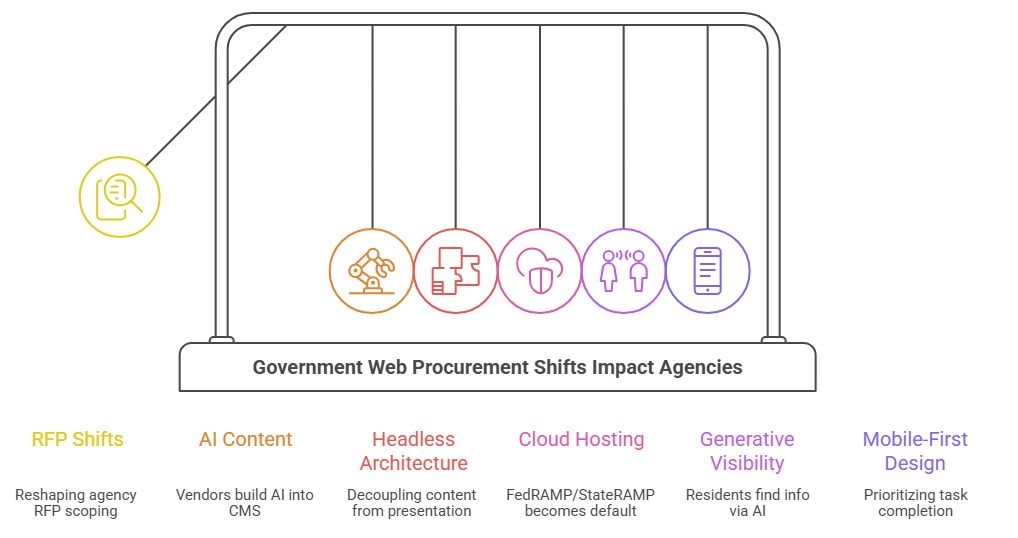
- AI-assisted content operations: Vendors are increasingly building AI-powered search, chat-based service navigation, and auto-summarization directly into a government content management system, reducing the burden on small comms teams.
- Headless and API-first architecture: More agencies are decoupling content from presentation, allowing a single content backend to feed a website, mobile app, and kiosk system simultaneously.
- Cloud-native, security-hardened hosting: FedRAMP- and StateRAMP-aligned hosting is becoming a default expectation, not a premium add-on, especially for agencies handling permits, payments, or personal data.
- Generative-engine visibility: Residents increasingly find government information through AI assistants and answer engines, not just search results. Structured data, clear service pages, and machine-readable content are now part of how findable a service actually is.
- Mobile-first, plain-language design: Reflecting broader municipal website design trends, agencies are prioritizing task completion (pay a bill, renew a license, report an issue) over static informational pages.
An RFP that ignores these shifts risks locking an agency into a five-year contract built on a two-generations-old approach to public-sector web delivery.
The Core Government Website RFP Checklist: Requirements Every Agency Should Include
Below is a practical breakdown organized by the category. Use it as a working checklist when drafting or reviewing an RFP.
| Category | Must-Include Requirements |
|---|---|
| Accessibility & Compliance | WCAG 2.1 AA conformance methodology, manual + automated audit process, VPAT documentation, ongoing monitoring cadence, Section 508 alignment |
| Content Management | Non-technical editing workflows, role-based permissions, multi-department publishing, version control, translation/multilingual support |
| Security & Hosting | FedRAMP/StateRAMP alignment, data encryption standards, DDoS protection, backup/disaster recovery SLAs, incident response protocol |
| UX & Design | Mobile-first responsive design, plain-language content standards, service-task navigation, resident feedback mechanisms |
| SEO & Discoverability | Structured data/schema markup, clean URL architecture, page speed benchmarks, AI/answer-engine readability |
| Integrations | Payment processing, permitting/licensing platforms, GIS mapping, 311/CRM systems, calendar and meeting/agenda tools |
| Support & Maintenance | Defined SLAs, response-time guarantees, training for staff, documented escalation path |
| Budget & Timeline | Fixed-fee vs. time-and-materials clarity, milestone-based payment schedule, change-order process |
| Vendor Qualifications | Prior government-sector experience, references from comparable agencies, staff certifications, data ownership terms |
1. Define Accessibility as a Deliverable, Not a Feature
Require vendors to submit their WCAG 2.1 AA testing methodology as part of the proposal not just a compliance statement. Ask specifically how they combine automated scanning with manual and assistive-technology testing, since automated tools alone are known to miss the majority of real accessibility barriers. Also require a plan for ongoing monitoring post-launch, since content changes can reintroduce violations.
2. Specify the Content Management Experience, Not Just the Platform Name
Naming a CMS platform in an RFP isn’t enough. Specify what non-technical staff across departments need to be able to do independently: publish updates, manage forms, control page permissions, and maintain a consistent design system without developer support. A well-scoped government content management system requirement should include training deliverables and documentation, not just software licensing.
3. Lock Down Security and Data Ownership Early
Require hosting environments aligned with FedRAMP or StateRAMP where applicable, clear encryption-in-transit and at-rest standards, and an explicit clause on data ownership agencies should always retain full ownership of their content, resident data, and analytics, regardless of vendor relationship changes.
4. Ask for Measurable UX and Performance Benchmarks
Instead of vague language like “modern, user-friendly design,” require specific benchmarks: page load times under a defined threshold, mobile responsiveness testing across devices, and task-completion testing for high-traffic services like bill pay or permit applications.
5. Build in SEO and AI-Discoverability From Day One
Residents are searching for services through both traditional search engines and AI assistants. RFPs should require structured data implementation, semantic HTML, and content organized around clear service intents not just keyword-stuffed landing pages. This is also where government website development services vendors should demonstrate real technical depth, since discoverability failures often trace back to poor information architecture rather than content quality.
6. Require Integration Compatibility Upfront
List every existing system the new site must connect to payment gateways, permitting software, GIS platforms, 311 systems and require vendors to confirm integration experience with those specific tools, not just “API capability” in general terms.
A Case-Style Example: What Happens Without This Checklist
A mid-sized county government issued an RFP focused almost entirely on visual design and page count. The winning vendor delivered a visually polished site but it lacked structured accessibility testing, used a CMS that required developer support for basic content edits, and had no defined SLA for post-launch support. Within eight months, the county faced an accessibility complaint, was paying hourly emergency fees for routine content changes, and had to issue a second RFP just to fix CMS usability. A tightly scoped checklist upfront covering accessibility methodology, CMS training, and support SLAs would have prevented all three failures at a fraction of the eventual cost.
Common Mistakes Agencies Make in Website RFPs
- Treating accessibility as a one-time deliverable instead of an ongoing compliance requirement with monitoring.
- Under-specifying the CMS requirements, leading to a platform that looks good in a demo but frustrates staff daily.
- Skipping data ownership and portability clauses, which can trap agencies with a vendor even when service quality drops.
- Omitting SLAs, leaving response times and support expectations informal and unenforceable.
- Focusing only on launch, not lifecycle no plan for content governance, security patching, or redesign cadence years down the line.
- Ignoring mobile and low-bandwidth users, despite a large share of resident traffic coming from mobile devices, particularly for service-related tasks.
Expert Recommendations for Procurement Teams
- Require a proposal section specifically addressing WCAG conformance methodology vague accessibility statements should be treated as a red flag.
- Ask for case studies from comparable agencies, not just enterprise clients, since public-sector procurement, budget cycles, and compliance needs differ meaningfully from private industry.
- Build change-order and scope-clarification language into the RFP itself, so mid-project cost creep has a defined process rather than becoming a negotiation each time.
- Score proposals on lifecycle value training, support responsiveness, and long-term content governance not just upfront cost or visual design.
The Road Ahead for Government Digital Services
As AI-assisted service delivery, stricter accessibility enforcement, and rising resident expectations converge, government website RFPs will need to evolve from static design briefs into living technical specifications. Agencies that build clear, measurable requirements today around accessibility, content governance, security, and discoverability will be far better positioned to select vendors who can deliver not just a launch-day website, but a sustainable digital service for years to come.
About App Maisters Government: For agencies looking to translate this checklist into a working RFP or evaluate vendor proposals with confidence, App Maisters Government specializes in building secure, ADA-compliant, and resident-first digital experiences for public-sector clients. From accessible CMS implementation to ongoing compliance monitoring and support, App Maisters Government works directly with agencies to close the gap between what an RFP promises and what actually gets delivered.
Frequently Asked Questions
What should be included in a government website RFP?
At minimum: WCAG 2.1 AA accessibility requirements and audit methodology, CMS training and content-governance expectations, hosting/security standards (FedRAMP or StateRAMP alignment), defined SLAs for support, integration requirements for existing systems (payments, permitting, GIS), and a milestone-based budget structure. Vague, feature-list-only RFPs are the leading cause of scope disputes after award.
Does a government website legally have to be ADA compliant?
Yes. Under the DOJ’s Title II rule, state and local governments must meet WCAG 2.1 Level AA across websites, mobile apps, and digital documents. Following an April 2026 extension, the enforceable deadlines are April 26, 2027 for entities serving 50,000+ residents, and April 26, 2028 for smaller entities and special districts.
How much does a government website redesign typically cost?
Costs vary widely by scope, but most mid-sized municipal or county projects range from the low tens of thousands for a template-based rebuild to well into six figures for a custom, fully integrated platform with CMS training, accessibility auditing, and multi-department publishing workflows. RFPs should require milestone-based pricing rather than a single lump sum to keep costs transparent.
What's the difference between an RFP and an RFQ for a government website project?
An RFQ (Request for Qualifications) is typically used first to screen vendors based on experience, certifications, and past performance, narrowing the field before formal proposals are invited. The RFP then asks the shortlisted vendors for detailed technical approach, timeline, and pricing. Smaller agencies often skip the RFQ step and go straight to RFP.
What's the best CMS for a government website?
here’s no single “best” platform the right choice depends on staff technical skill, multi-department publishing needs, and integration requirements. What matters more than the platform name is whether it supports non-technical content editing, role-based permissions, and accessible-by-default templates. RFPs should specify these functional requirements rather than mandating a specific product.
How long does a government website RFP process usually take?
From RFP release to vendor selection, most agencies should budget 8–14 weeks, factoring in a public comment/question period, proposal review, and often a finalist presentation. Development and launch timelines after award typically add another 4–9 months depending on integration complexity and content migration scope.