
Here’s a problem that keeps federal CIOs up at night: you’ve migrated to the cloud, but what if that one provider goes down, gets compromised, or locks you into pricing you can’t escape?
Government agencies face a uniquely high-stakes version of a question every enterprise is wrestling with in 2025: should you go all-in with one cloud provider, or distribute your workloads across multiple platforms?
The stakes for government are different from the private sector. An outage at a bank costs money. An outage at a defense or health agency can cost lives, compromise national security, or disrupt services that millions of citizens depend on. The wrong cloud strategy doesn’t just hurt the bottom line; it erodes public trust.
At the same time, multi-cloud comes with its own complexity tax: more vendors, more governance overhead, more integration challenges, and a bigger demand for skilled cloud professionals who understand both technical architecture and federal compliance frameworks.
This article cuts through the noise. We’ll define both strategies, compare them head-to-head, examine real government use cases, and give you a practical roadmap, whether you’re just beginning your cloud journey or optimizing an existing multi-cloud environment.
What Is a Multi-Cloud Strategy for Government?
A multi-cloud strategy for government means deliberately using cloud services from two or more authorized providers to run different workloads, applications, or data environments. Rather than consolidating all IT onto one platform like AWS GovCloud or Azure Government, agencies distribute workloads based on each provider’s strengths, compliance certifications, cost profile, and mission alignment.
This is distinct from a hybrid cloud model, which combines on-premises infrastructure with cloud services. Multi-cloud is purely cloud-to-cloud and in a government context, every provider must hold the appropriate FedRAMP authorization level (Low, Moderate, or High) matching the data sensitivity of the workload being hosted.
Key Entities in the Government Multi-Cloud Ecosystem
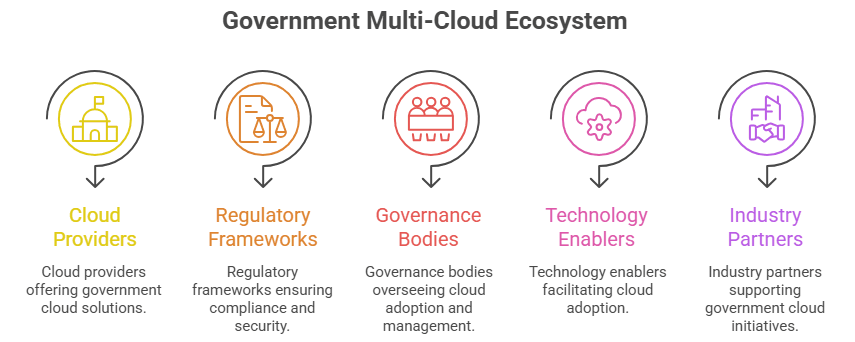
- Cloud Providers: Amazon Web Services (AWS) GovCloud, Microsoft Azure Government, Google Cloud (FedRAMP High authorized), Oracle Cloud Infrastructure (OCI), IBM Cloud for Government
- Regulatory Frameworks: FedRAMP, FISMA, NIST SP 800-53, NIST SP 800-37 (RMF), CJIS, ITAR, CMMC
- Governance Bodies: OMB (Office of Management and Budget), GSA (General Services Administration), FedRAMP Board, JAB, CISA
- Technology Enablers: Kubernetes, Terraform, cloud-native security tools, Zero Trust Architecture (ZTA), SIEM platforms
- Industry Partners: Booz Allen Hamilton, Leidos, SAIC, Deloitte Federal, App Maisters Government
Multi-Cloud vs. Hybrid Cloud vs. Single Cloud:
| Model | Definition | Common Gov Use Case |
|---|---|---|
| Single Cloud | All workloads on one CSP | Smaller agencies with limited IT staff |
| Hybrid Cloud | On-prem infrastructure + one or more clouds | Agencies with legacy systems in transition |
| Multi-Cloud | Two or more cloud providers, no on-prem dependency | Large agencies with diverse mission needs |
| Hybrid Multi-Cloud | On-prem + multiple cloud providers | DoD, IC agencies, complex federal environments |
Single Cloud for Government: The Case For and Against
Single cloud offers simplicity one vendor, one contract, one support relationship, one compliance boundary. For smaller agencies or those early in their cloud journey, this coherence reduces management overhead and allows teams to build deep expertise in one platform.
Advantages of Single Cloud
- Streamlined management: One console, one support contract, one set of APIs to learn.
- Lower initial complexity: Easier to govern, monitor, and secure a single environment.
- Deeper platform integration: Native tooling (e.g., AWS Lambda, Azure DevOps) works seamlessly across workloads.
- Cost visibility: Spending is easier to track and optimize with one provider’s billing model.
- Faster FedRAMP compliance: Only one authorization boundary to manage.
Risks of Single Cloud for Government
Despite the convenience, a single cloud creates critical vulnerabilities for government agencies:
- Vendor lock-in: Proprietary formats, APIs, and pricing structures make switching providers costly and slow.
- Single point of failure: A regional outage at one provider can take down all agency services simultaneously.
- Negotiating leverage lost: Without competition, agencies lose the ability to drive down costs.
- Mission-fit limitations: No single provider excels at everything. AI/ML, analytics, storage, and networking have different best-in-class options.
- Cybersecurity concentration risk: A breach affecting the provider affects all agency workloads simultaneously.
Multi-Cloud Strategy for Government: The Case For and Against
A multi-cloud strategy is the direction most federal agencies are heading and for good reason. According to the 2024 Nutanix Enterprise Cloud Index, exclusive reliance on on-premises or single private cloud is expected to decline from 27% to just 5% within the next one to three years among federal agencies.
Key Benefits of Multi-Cloud for Government
1. Resilience and Continuity of Operations (COOP)
Distributing workloads across providers means no single failure brings the agency down. If AWS experiences a regional outage, critical workloads can failover to Azure Government or GCP. For agencies like FEMA, HHS, or DoD, continuity isn’t optional.
2. Elimination of Vendor Lock-In
Using multiple cloud service providers gives agencies greater leverage in vendor negotiations, helping to control costs and reduce the risk of vendor lock-in. Agencies can optimize spending by selecting the most cost-effective provider for each specific service or capability.
3. Best-of-Breed Capability Selection
Different cloud providers lead in different capability areas:
| Capability | Best-Fit Provider (Gov) |
|---|---|
| AI/ML at Scale | Google Cloud (Vertex AI, BigQuery) |
| Enterprise Integration | Microsoft Azure Government (M365, Teams) |
| Big Data & Storage | AWS GovCloud (S3, Redshift) |
| Regulated Workloads | Oracle Cloud Infrastructure (OCI) |
| Hybrid Edge Computing | IBM Cloud for Government |
4. Improved Security Posture
Paradoxically, well-implemented multi-cloud can be more secure than single cloud. Distributing sensitive data across isolated environments reduces blast radius in the event of a breach. Coupled with Zero Trust Architecture (ZTA) now mandatory under Executive Order 14028 agencies can implement micro-segmentation across providers.
5. Regulatory Compliance Flexibility
Federal agencies can work only with FedRAMP-authorized cloud service providers. The sensitivity level of an agency’s data determines how many components or what parts of the cloud they can use. Public-facing data managed by a civilian agency may have many cloud options, while an agency managing highly sensitive data (e.g., DHS, FBI, DoD) has more restricted choices. Multi-cloud allows agencies to match each workload to the right FedRAMP impact level and provider.
Challenges of Multi-Cloud for Government
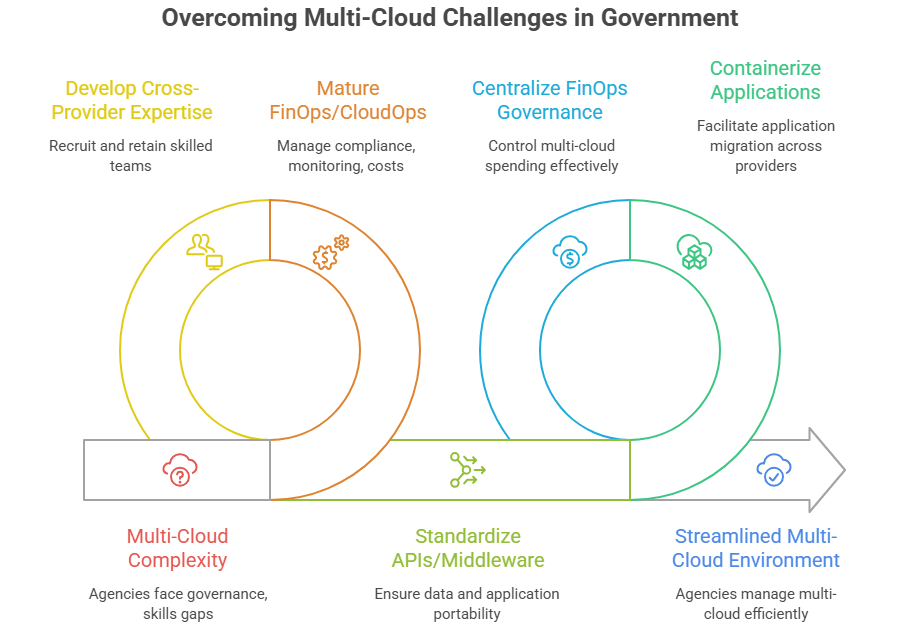
Multi-cloud isn’t a silver bullet. It introduces real complexity that agencies must address head-on:
- Governance overhead: Managing compliance, monitoring, and cost visibility across multiple platforms requires mature FinOps and CloudOps practices.
- Skills gap: Teams need expertise across providers, which is difficult to recruit and retain in government.
- Interoperability challenges: Data and application portability across providers requires containerization (e.g., Kubernetes), standardized APIs, and robust integration of middleware.
- Application migration complexity: 83% of federal respondents cite application migration as a moderate to significant challenge. However, over 70% of federal agencies moved at least one application to a different IT environment in the past year, primarily to improve security posture, meet regulatory requirements, or outsource IT management.
- Cost sprawl: Without centralized FinOps governance, multi-cloud spending can spiral quickly.
Multi-Cloud vs. Single Cloud: Head-to-Head Risk Comparison
| Risk Factor | Single Cloud | Multi-Cloud |
|---|---|---|
| Vendor lock-in | 🔴 High risk | 🟢 Low risk |
| Single point of failure | 🔴 High risk | 🟢 Low risk |
| Cybersecurity breach impact | 🔴 High blast radius | 🟡 Reduced (if architected well) |
| Compliance complexity | 🟢 Lower | 🔴 Higher |
| Operational overhead | 🟢 Lower | 🔴 Higher |
| Cost optimization | 🟡 Moderate | 🟢 Higher potential |
| Mission-fit capability | 🟡 Limited | 🟢 Best-of-breed |
| Disaster recovery | 🔴 Single-provider dependent | 🟢 Cross-provider failover |
| AI/Innovation access | 🟡 Limited to one roadmap | 🟢 Access to multiple AI ecosystems |
| Talent requirements | 🟢 Narrower skill set | 🔴 Broader expertise required |
Multi-cloud wins on resilience, cost optimization, and capability flexibility. Single cloud wins on simplicity and lower governance overhead. The right choice depends on agency size, mission complexity, and IT maturity.
Federal Cloud Modernization: What the Data Says
The numbers tell a clear story about where government cloud strategy is headed.
Key Government Cloud Statistics (2024–2025)
- The global government cloud market is projected to reach USD 75 billion by 2026, growing at a CAGR of 17% from 2023. More than 92% of central governments have adopted at least one major cloud service for core IT workloads. Public-sector spending on cloud computing grew by 28% year-over-year between 2024 and 2025.
- The 2024 Enterprise Cloud Index from Nutanix shows that exclusive use of on-premises data centers or private cloud is expected to decline from 27% today to just 5% within the next one to three years. Reliance on hybrid cloud, combining private infrastructure with a single cloud is forecast to decline from 60% to 35% in the same period.
- 29% of cloud decision-makers in government indicate that modernizing core applications is among their most likely initiatives for the next 12 months. 55% of government cloud decision-makers indicate that their organization has adopted distributed cloud-native databases.
- From July 2019 to April 2023, the 24 Chief Financial Officers Act agencies increased the number of FedRAMP authorizations by about 60%. However, nine agencies reported they were using cloud services that were not FedRAMP authorized.
- Government agencies report an average 30% cost reduction after migrating legacy workloads to the cloud. Operational efficiency improved by 45% for departments implementing cloud automation tools.
- According to Flexera’s 2024 State of the Cloud Report, 87% of enterprises use a multi-cloud strategy. The average organization uses 2.6 public and 2.7 private clouds. 69% of enterprises actively avoid vendor lock-in by using multiple cloud providers.
- Multi-cloud transformation strategies are adopted by 66% of global enterprises for resilience and flexibility. Average enterprises manage 3.2 cloud providers as part of their transformation strategy.
FedRAMP: The Non-Negotiable Foundation of Government Cloud
Every cloud strategy for U.S. federal agencies must be built on FedRAMP compliance. This is not optional, regardless of whether an agency chooses single cloud or multi-cloud.
What Is FedRAMP?
The Federal Risk and Authorization Management Program is a government-wide program that provides a standardized approach to security assessment, authorization, and continuous monitoring of cloud products and services. FedRAMP empowers agencies to use modern cloud technologies, with emphasis on security and protection of federal information, and helps accelerate the adoption of secure cloud solutions.
FedRAMP Impact Levels
| Impact Level | Data Sensitivity | Example Use Cases |
|---|---|---|
| Low | Non-sensitive, public-facing data | Public websites, open datasets |
| Moderate | Controlled Unclassified Information (CUI) | Benefits systems, HR data |
| High | Law enforcement, financial, health data | FBI, HHS, financial systems |
FedRAMP and Multi-Cloud
In a multi-cloud environment, each cloud service provider and each individual cloud service offering (CSO) must hold the appropriate FedRAMP authorization for the data it processes. FedRAMP authorization can be leveraged by multiple agencies. When a CSP has a FedRAMP authorization at a specific impact level, agencies are required to assume that the security assessment in the authorization package is sufficient for granting their own authorization to operate at that same or lower impact level.
The “do once, use many times” model of FedRAMP is a significant enabler of multi-cloud strategy agencies don’t need to re-authorize each provider from scratch.
Multicloud Fast-Tracking Tips for Government Agencies
Getting to multi-cloud faster doesn’t mean cutting corners on compliance or security. These proven strategies accelerate the journey without creating technical debt.
7 Multicloud Fast-Tracking Tips
- Start with use cases, not providers: Define which workloads, data types, and mission functions you’re moving first. Select providers based on best fit, not brand preference.
- Leverage FedRAMP Marketplace: The GSA FedRAMP Marketplace lists hundreds of pre-authorized CSPs and cloud service offerings. Selecting from this list eliminates months of authorization overhead.
- Containerize before you migrate: 84% of federal organizations have containerized at least some applications, enabling cloud portability. However, 16% have yet to adopt containers, which is significantly higher than the 5% global public sector average. Containerization (Kubernetes, Docker) enables workload portability across providers, critical for true multi-cloud flexibility.
- Adopt a Zero Trust posture from day one: Don’t bolt on security after migration. ZTA, including Identity and Access Management (IAM), micro-segmentation, and least-privilege access, must be embedded into multi-cloud architecture from the start.
- Implement unified cloud management platforms: Tools like AWS Control Tower, Azure Arc, Google Anthos, or third-party platforms like HashiCorp Terraform and Palo Alto Prisma Cloud enable centralized governance across providers.
- Build a FinOps practice in parallel: Multi-cloud cost sprawl is real. Establish cloud cost governance, tagging standards, and spending alerts before migration, not after.
- Partner with a multi-cloud consulting firm with federal experience: Government cloud has unique compliance, procurement, and operational requirements that general-purpose consultants often miss. Firms like App Maisters Government specialize in FedRAMP-compliant multi-cloud architecture and implementation for federal agencies.
Cloud Adoption Benefits for Government: Beyond Cost Savings
Cost reduction is the most commonly cited cloud benefit, but it’s far from the only one and government; mission impact often matters more than dollar savings.
The Full Spectrum of Cloud Adoption Benefits
Operational Benefits
- Scalability: Rapidly scale compute for peak demand (e.g., tax filing season for IRS, disaster response for FEMA)
- Speed of deployment: Cloud-native development reduces time-to-deploy from months to days or hours
- Reduced hardware procurement cycles: Cloud-based resource management systems have shortened procurement cycles by 25%.
Mission Benefits
- Improved citizen services: Over 68% of government services are now digitally accessible through cloud-based platforms. Citizen engagement via cloud-hosted portals and apps grew 48% in 2024–2025.
- AI enablement: AI is being used to analyze and reverse-engineer decades-old code, making it easier for agencies to transition legacy applications to modern cloud environments. AI-powered tools can predict potential failures, detect anomalies, and enhance security protocols, ensuring greater operational efficiency and reliability.
- Data sharing and interoperability: Cloud platforms enable cross-agency data sharing that legacy on-premises systems simply cannot support.
Financial Benefits
- Average 30% cost reduction after migrating legacy workloads (DataStackHub, 2025)
- Reduced long-term hardware procurement and data center maintenance costs
- Competitive pricing leverage with multiple vendors in multi-cloud environments
Security Benefits
- Cloud-based threat detection and monitoring available 24/7
- Automatic security patching and updates from authorized CSPs
- Zero Trust and encryption capabilities native to modern cloud platforms
- Global government cybersecurity spending on cloud security tools grew 31% between 2024 and 2025.
Real-World Government Multi-Cloud Use Cases
Case Study 1: The Department of Defense (DoD) Multi-Cloud Approach
The DoD’s JWCC (Joint Warfighting Cloud Capability) contract awarded in 2022 to AWS, Azure, Google Cloud, and Oracle is the most prominent example of deliberate government multi-cloud strategy. Rather than selecting a single provider (as the earlier JEDI contract attempted), DoD explicitly chose multiple providers to avoid single-point-of-failure risk and ensure different mission systems could leverage best-fit capabilities. This approach gives DoD components the flexibility to match workloads to providers based on classification level, latency requirements, and operational context.
Case Study 2: HHS and the Pandemic Response
During COVID-19, the Department of Health and Human Services leveraged multi-cloud architecture to manage unprecedented data volumes across CDC reporting systems, vaccine distribution databases, and public-facing dashboards. The ability to scale across providers was critical when single-provider capacity limits became a bottleneck.
Case Study 3: State Government Multi-Cloud Maturity
State governments have seen cloud adoption conversation go from “cloud-first” to “cloud-smart” and now to “cloud modernization.” States had multiple cloud instances built up over time, and multicloud administration became a priority. “When it comes to getting to the cloud, hybrid and multicloud environments are the new normal,” according to the NASCIO report.
Expert Insights: What Industry Leaders Say About Government Multi-Cloud
Emerging Trends in Federal Cloud Strategy
1. AI as a Cloud Modernization Driver
In a 2023 survey by Rackspace Technology, 90% of global IT professionals said AI is a primary driver of cloud modernization. For government, AI workloads often require GPU-optimized infrastructure that only specific providers or regions can deliver, making multi-cloud a prerequisite for serious AI adoption.
2. Data Standardization as the Next Frontier
Richard Crowe of Booz Allen Hamilton emphasizes that as agencies continue their cloud journey, they must prioritize data standardization to enable seamless integration between systems: “Standardized data is critical to unlocking the full potential of AI and cloud. Without it, you’re going to run into major challenges when trying to share information across agencies or leverage AI-driven insights.”
3. Sovereign Cloud and Data Residency
Europe’s sovereign cloud initiatives have expanded by 33% since 2024. Asian-Pacific governments increased public-sector cloud budgets by 29% in 2025. The concept of sovereign cloud, where data never leaves national jurisdiction, is influencing federal strategy globally and increasingly affects how U.S. agencies think about cloud placement for highly sensitive workloads.
4. FedRAMP 20x Modernization
In 2024, FedRAMP launched a major modernization initiative called “FedRAMP 20x,” aimed at transforming the program into a streamlined, automation-driven compliance framework that accelerates secure cloud adoption while minimizing bureaucracy. This initiative will directly accelerate multi-cloud adoption by reducing the time and cost of authorizing multiple providers.
Common Mistakes Government Agencies Make With Cloud Strategy
Avoiding these pitfalls can save agencies years of technical debt and millions of dollars:
- Going multi-cloud by accident, not by design: Many agencies end up with multiple cloud providers through organic growth, mergers of departments, or shadow IT without a coordinated governance strategy. This creates sprawl, compliance gaps, and wasted spend.
- Skipping the use-case analysis: An agency shouldn’t pursue a multi-cloud strategy just for the sake of it. While powerful, multi-cloud architectures add significant complexity to any digital modernization effort. The smarter approach is to start with clear, well-defined use cases, then evaluate whether a single-cloud or multi-cloud environment best supports those needs.
- Neglecting to containerize legacy applications: Migrating monolithic legacy apps without modernization to cloud-native or containerized architectures creates technical debt that defeats multi-cloud portability goals.
- Treating FedRAMP authorization as a one-time event: Continuous monitoring is a core FedRAMP requirement. Agencies that treat authorization as a checkbox and neglect ongoing monitoring face compliance violations and security gaps.
- Underestimating the skills gap: Multi-cloud requires professionals fluent in multiple platforms and federal compliance frameworks simultaneously. Failure to invest in training or strategic consulting partnerships leads to poor architecture decisions.
- No centralized FinOps strategy: Without unified cost visibility, multi-cloud budgets quickly spiral. Agencies need cross-cloud tagging, budget alerts, and FinOps governance before migrations begin.
- Ignoring data interoperability: Moving data is harder than moving compute. Agencies that don’t plan for data portability, APIs, and cross-cloud data pipelines find themselves with siloed environments that undermine the benefits of multi-cloud.
Step-by-Step Action Plan: Government Multi-Cloud Adoption Roadmap
🟢 Beginner Roadmap (0–6 Months): Foundation
- Assess current state: Inventory all existing systems, cloud services, data types, and FedRAMP authorization status.
- Define use cases: Identify 3–5 priority workloads and determine which cloud model (single, hybrid, multi) best fits each.
- Conduct FedRAMP gap analysis: Ensure all current and planned cloud services have appropriate FedRAMP authorizations.
- Establish governance: Create a Cloud Center of Excellence (CCoE) or designate a Cloud Program Manager.
- Select initial providers: Start with one or two FedRAMP-authorized providers matching your highest-priority use cases.
🔵 Intermediate Roadmap (6–18 Months): Migration and Modernization
- Containerize priority applications: Move target workloads to a container-based architecture before cloud migration.
- Implement Zero Trust Architecture: Deploy IAM, multi-factor authentication, and network micro-segmentation across all cloud environments.
- Migrate priority workloads: Execute phased migrations, starting with lower-risk workloads to build confidence and skills.
- Establish FinOps governance: Deploy cloud cost management tools and establish tagging and reporting standards.
- Integrate cloud monitoring and SIEM: Deploy centralized security monitoring across all cloud environments.
🔴 Advanced Roadmap (18–36 Months): Optimization and Innovation
- Optimize workload placement: Continuously evaluate which provider delivers the best performance and cost for each workload.
- Enable cross-cloud AI/ML pipelines: Deploy AI workloads on best-fit providers; establish cross-cloud data pipelines for unified analytics.
- Automate compliance monitoring: Implement automated FedRAMP continuous monitoring tools (OSCAL, cloud-native CSPM tools).
- Adopt cloud-native services: Refactor remaining legacy workloads to cloud-native architectures for full agility benefits.
- Build multi-cloud resilience testing: Regularly test failover scenarios across providers; validate COOP plans.
Multi-Cloud Consulting for Government: Why Expertise Matters
Implementing a multi-cloud strategy in a government context is fundamentally different from doing so in the private sector. The compliance requirements are stricter, the procurement rules are more complex, the security mandates are more demanding, and the stakes in terms of mission continuity and public trust are higher.
App Maisters Government provides specialized multi-cloud consulting services designed specifically for federal, state, and local government agencies. With deep expertise in FedRAMP compliance, NIST frameworks, Zero Trust implementation, and cloud-native modernization, App Maisters Government helps agencies:
- Design FedRAMP-compliant multi-cloud architectures
- Select and integrate the right cloud providers for each mission need
- Accelerate cloud adoption without compromising security
- Build sustainable governance and FinOps frameworks
- Bridge the skills gap with expert cloud engineering and advisory services
Conclusion: Which Cloud Strategy Actually Reduces Government Risk?
After examining the data, the expert perspectives, the compliance requirements, and real-world government use cases, the answer is clear: for most federal agencies with diverse, mission-critical workloads, a well-governed multi-cloud strategy reduces more risk than single cloud.
Single cloud is not wrong it’s the right starting point for smaller agencies or those early in their cloud journey. But as agencies scale, mature, and take on more complex missions, the risks of single-provider dependence vendor lock-in, single points of failure, limited capability access outweigh the simplicity benefits.
The key insight from this analysis: multi-cloud should be a deliberate strategic choice, not an accident. Agencies that rush into multi-cloud without defined use cases, governance structures, and FedRAMP compliance plans will create complexity without gaining the corresponding resilience and cost benefits.
The agencies winning at cloud modernization in 2025 share three characteristics: they defined their use cases before selecting providers, they built Zero Trust security from day one, and they partnered with experts who understand both cloud architecture and federal compliance requirements.
Frequently Asked Questions
What is a multi-cloud strategy in government?
A multi-cloud strategy for government means using two or more FedRAMP-authorized cloud service providers, such as AWS GovCloud, Azure Government, and Google Cloud, to run different agency workloads. Rather than relying on a single provider, agencies distribute systems and data based on each platform’s strengths, security profile, and cost efficiency. This approach reduces vendor lock-in, eliminates single points of failure, and enables best-fit capability selection for diverse mission requirements.
How is multi-cloud different from hybrid cloud for federal agencies?
Hybrid cloud combines on-premises infrastructure with one or more cloud providers, and is often a transition state for agencies modernizing legacy systems. Multi-cloud refers specifically to using multiple cloud providers, potentially with or without on-premises components. Many federal agencies operate in a “hybrid multi-cloud” environment, maintaining some on-premises systems while distributing cloud workloads across multiple authorized providers. The distinction matters for compliance scoping, data residency planning, and governance design.
Is FedRAMP required for all cloud services in a multi-cloud environment?
Yes. All in-scope cloud service offerings used by federal agencies must be FedRAMP authorized at the appropriate impact level (Low, Moderate, or High). In a multi-cloud environment, each cloud provider and each individual service used to process, store, or transmit federal data must have a valid FedRAMP authorization. The FedRAMP “do once, use many times” model means agencies can leverage existing authorizations, so they don’t need to re-authorize each provider independently.
What are the biggest risks of staying with a single cloud provider?
The primary risks of single-cloud reliance for government agencies include: vendor lock-in (expensive and time-consuming to switch providers), single point of failure (a provider outage can take down all agency services), concentration of cybersecurity risk (a breach affects all workloads simultaneously), lost negotiating leverage, and limited access to best-of-breed capabilities. For mission-critical agencies, these risks often outweigh the simplicity advantages of a single-cloud approach.
How long does it take to implement a multi-cloud strategy for a federal agency?
A phased multi-cloud implementation typically spans 18–36 months for a mid-to-large federal agency. Foundation work, including use-case analysis, FedRAMP gap assessment, and governance setup, takes roughly 0–6 months. Migrations and Zero Trust implementation require 6–18 months. Full optimization, AI integration, and automated compliance monitoring extend from 18–36 months. Timelines vary significantly based on agency size, legacy system complexity, and the availability of skilled cloud resources and consulting support.
Does multi-cloud cost more than single cloud for government agencies?
Multi-cloud has higher initial governance and management costs due to increased complexity, skill requirements, and tooling needs. However, over time, multi-cloud typically reduces total cloud spend by enabling competitive vendor negotiations, best-fit pricing per workload, and eliminating vendor lock-in premium costs. Government agencies that implement strong FinOps governance alongside their multi-cloud strategy report significant cost optimization. The break-even point varies but is typically reached within 2–3 years of implementation for large agencies.
What cloud providers are FedRAMP authorized for high-impact workloads?
As of 2025, major cloud providers with FedRAMP High authorizations include AWS GovCloud (US), Microsoft Azure Government, Google Cloud (Assured Workloads), and Oracle Cloud Infrastructure (OCI). Each provider has specific services within their FedRAMP High boundary. Agencies should consult the official FedRAMP Marketplace at fedramp.gov to verify which specific services, not just providers, hold appropriate authorizations for their planned workloads.