
Many local governments have open data portals filled with spreadsheets, PDFs, GIS files, and technical labels that ordinary residents cannot interpret. A citizen searching for neighborhood crime trends, school capacity, road repairs, permit activity, or municipal spending often encounters outdated datasets, unexplained columns, inaccessible charts, and files requiring specialist software.
An effective open data portal solves a public problem. It helps residents answer questions, complete tasks, understand government performance, and participate in decisions. It also gives government employees, researchers, businesses, journalists, and civic developers reliable data they can reuse.
The central challenge is therefore not “How many datasets can we publish?” It is “How easily can people turn our data into an answer or action?”
Why Many Government Open Data Portals Go Unused
Traditional open data initiatives often prioritize compliance and dataset volume over usability. Departments export available files, add brief descriptions, and consider the work complete. The resulting portal becomes a digital warehouse rather than a public service.
Common barriers include:
- Datasets organized by internal department names instead of citizen needs.
- Technical titles such as “PW_SR_Closed_FY26” rather than “Resolved Street and Sidewalk Requests.”
- Missing definitions, geographic coverage, update schedules, and data-quality notes.
- PDF reports without CSV, JSON, API, or accessible HTML alternatives.
- Dashboards that show totals but do not provide the underlying data.
- Inconsistent addresses, dates, school names, categories, and geographic boundaries.
- Limited mobile usability and poor support for screen readers or keyboard navigation.
- No feedback mechanism for requesting data or reporting an error.
These problems affect more than municipal transparency. Education technology leaders and school district administrators face similar challenges when publishing attendance trends, enrollment projections, facility conditions, transportation performance, budget allocations, or program outcomes. Families need understandable information, while administrators must protect student privacy and prevent the identification of individuals in small demographic groups.
A useful portal must balance transparency, privacy, accessibility, accuracy, and operational sustainability.
What Does a Citizen-Centered Open Data Portal Provide?
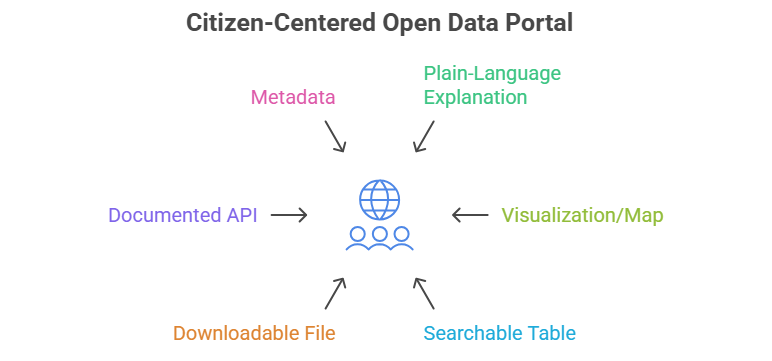
A citizen-centered open data portal gives people multiple ways to access the same information:
- A plain-language explanation for residents.
- A visualization or map for quick interpretation.
- A searchable table for nontechnical users.
- A downloadable open-format file for analysts.
- A documented API for developers and automated systems.
- Metadata describing ownership, quality, coverage, and update frequency.
This layered approach matters because citizens do not all use data in the same way. A parent may want to view school construction projects on a map, while a researcher needs the complete dataset and a software company needs an API.
Open formats are fundamental because the public must be able to analyze data independently and not merely view the government’s interpretation of it. Data.gov identifies CSV, JSON, XML, and web APIs as common mechanisms for publishing reusable data, while its current catalog guidance supports standardized descriptions for datasets and data services.
The Open Data Trends Shaping 2026
1. Natural-Language and AI-Assisted Search
Modern portals are beginning to support questions such as:
- “Which neighborhoods had the most unresolved pothole requests?”
- “How has library attendance changed since 2023?”
- “Which schools are operating above building capacity?”
- “Where are pedestrian accidents increasing?”
A carefully governed AI assistant can translate these questions into catalog searches, filters, or database queries. It can explain unfamiliar fields and summarize results in plain language.
However, the AI should retrieve information from approved datasets, identify the source and reporting period, expose the filters used, and link to the underlying records. It must not invent missing statistics or present an interpretation as an official conclusion.
2. Cloud-Native Data Pipelines
Manual spreadsheet uploads quickly become stale. Leading portals use automated extract-transform-load pipelines to retrieve data from permitting, finance, 311, GIS, transportation, asset-management, and education systems.
A practical architecture includes:
- Source-system connectors or secure data feeds.
- Validation and privacy checks.
- A governed cloud data lakehouse or warehouse.
- Automated transformation and de-identification.
- A searchable metadata catalog.
- Public APIs, downloads, maps, and dashboards.
- Monitoring for failed updates, schema changes, and unusual values.
This turns publication into a repeatable operational process instead of a periodic data-cleaning project.
3. Machine-Readable Metadata
Data must be understandable to search engines, AI systems, and other government catalogs. The W3C’s DCAT Version 3 standard supports interoperable descriptions of datasets, catalogs, and data services. DCAT-US 3.0 further distinguishes APIs as first-class “DataService” resources and introduces clearer mandatory, recommended, and optional metadata requirements.
Every dataset should identify:
- A clear title and description.
- Publishing department and accountable data steward.
- Geographic and time coverage.
- Update frequency and last successful refresh.
- Field definitions and units.
- License and permitted uses.
- Privacy or suppression methodology.
- Available formats and API endpoints.
- Known limitations and quality status.
This structured context also improves generative-engine visibility because AI systems can interpret what the dataset represents, how current it is, and whether it supports a particular question.
4. Data Products Organized Around Community Needs
The best portals are shifting from catalog-first design to use-case-first design. Instead of asking visitors to understand departmental structures, they organize information around topics such as:
- Public safety.
- Streets and transportation.
- Housing and development.
- Schools and youth services.
- Budgets and procurement.
- Environment and utilities.
- Parks and community facilities.
This is one of the most important local government innovation elements: start with the resident’s question and connect it to the appropriate data, service, dashboard, or API.
A Seven-Step Plan for Building a Useful Open Data Portal
| Step | Recommended action | Practical outcome |
|---|---|---|
| 1. Research demand | Analyze website searches, public-record requests, 311 inquiries, meeting comments, and help-desk questions. Interview residents, educators, journalists, nonprofits, and businesses. | A ranked list of questions the portal must answer. |
| 2. Build a data inventory | Document systems, owners, fields, update cycles, quality issues, privacy classification, and publication authority. | Visibility into what can be released safely and sustainably. |
| 3. Select high-value datasets | Prioritize information with strong public demand and operational importance, such as budgets, permits, service requests, transit, school facilities, and capital projects. | A focused initial release rather than an unusable mass upload. |
| 4. Standardize and automate | Create shared definitions, data contracts, validation rules, identifiers, and scheduled cloud pipelines. | Consistent data that remains current without repeated manual work. |
| 5. Design for multiple users | Provide plain-language summaries, filters, accessible charts, maps, downloads, APIs, and data dictionaries. | Useful experiences for residents, analysts, and developers. |
| 6. Protect privacy and security | Remove direct identifiers, evaluate re-identification risk, suppress small counts where appropriate, and complete legal and security reviews. | Transparency without exposing residents or students. |
| 7. Measure and improve | Monitor successful searches, downloads, API usage, freshness, accessibility, user feedback, and task completion. | Evidence of public value and a roadmap for continuous improvement. |
For education data, districts should use interoperable standards where appropriate. The Ed-Fi Data Standard, for example, provides a consistent structure for exchanging K–12 information among secure systems. Public release remains a separate governance decision: student-level data must be properly de-identified, and districts must evaluate whether combined fields or small subgroups could reveal an individual.
Practical Use Cases That Demonstrate Public Value
Turning 311 Data Into Neighborhood Intelligence
San Francisco publishes 311 cases dating back to July 2008, including location information, through a dataset updated nightly. Residents and community organizations can examine recurring service problems, while government teams can identify demand patterns and response bottlenecks.
The important lesson is not simply that records are available. The dataset includes update information and can support maps, summaries, downloadable analysis, and external applications.
Connecting Transportation Data to Daily Decisions
New York City publishes transportation datasets alongside public dashboards for traffic volumes, bike facilities, parking regulations, bridge conditions, pedestrian activity, and other services. Its parking-regulation data supports a public block-level search tool and is updated daily.
This model connects raw data to an actual citizen task instead of expecting every visitor to analyze a spreadsheet.
Helping Communities Understand School Infrastructure
An education-focused portal can combine de-identified enrollment, building capacity, accessibility, facility conditions, capital improvements, and transportation indicators. Parents can understand planned investments, administrators can identify pressure points, and community members can participate more effectively in budget discussions.
The portal should present aggregated information, describe the methodology, disclose data limitations, and avoid publishing student-level records or vulnerable subgroup results.
Accessibility Must Be Built Into the Portal
Open data is not genuinely open if residents with disabilities cannot use it.
Portals should provide keyboard-accessible controls, descriptive chart labels, sufficient color contrast, structured headings, accessible tables, text alternatives, captions, responsive layouts, and downloadable formats that work with assistive technologies. Maps and visualizations should include equivalent tabular or textual information.
The Department of Justice requires state and local government web content and mobile applications to meet WCAG 2.1 Level AA, subject to the rule’s provisions and exceptions. Following an April 2026 interim final rule, current compliance dates are April 26, 2027, for entities serving populations of 50,000 or more, and April 26, 2028, for smaller entities and special district governments. Independent school districts use the applicable Census-based population measure.
Accessibility testing must combine automated tools with manual review and testing by people who use assistive technology.
How to Measure Whether Citizens Actually Use the Data
Dataset count is an output, not a success measure. A stronger performance framework tracks:
- Percentage of priority datasets refreshed on schedule.
- Search success and zero-result search rates.
- Dataset views, downloads, API calls, and repeat users.
- Dashboard task-completion rates.
- Accessibility defects and remediation time.
- Public error reports and correction turnaround.
- Number of datasets reused in applications, research, journalism, or policy analysis.
- Reduction in repetitive public-record and information requests.
- Engagement across neighborhoods, languages, devices, and accessibility needs.
These measures allow government open data analytics services to reveal both portal performance and unmet community demand.
Common Mistakes and How to Avoid Them
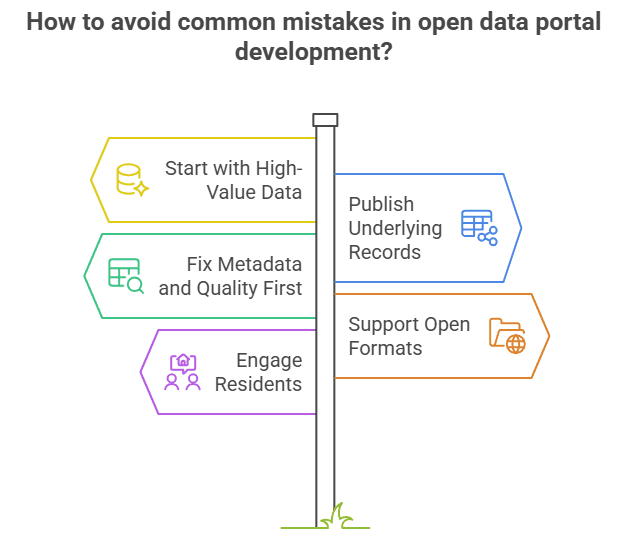
Do not launch hundreds of unmaintained datasets. Begin with high-value data and assign an accountable owner to every release.
Do not treat a dashboard as open data. Publish the underlying machine-readable records and definitions.
Do not add generative AI before fixing metadata and quality. AI makes well-governed data easier to use; it also makes inconsistent data easier to misunderstand.
Do not depend exclusively on proprietary formats. Support open downloads, standards-based metadata, and documented APIs to reduce vendor lock-in.
Finally, do not design the portal without residents. Sustainable local government community engagement should include usability sessions, multilingual research, accessibility testing, data-request workflows, and public reporting on requested improvements.
The Future of Local Government Open Data
The next generation of state and local government digital solutions will move beyond static catalogs. Open data portals will become intelligent public-information layers connecting datasets, digital services, maps, automated alerts, resident portals, and AI assistants.
The governments that succeed will not be those publishing the most files. They will be those that provide trustworthy answers, protect privacy, maintain accessibility, and demonstrate how data improves daily life.
How App Maisters Government Can Help
App Maisters Government helps federal, state, local, K–12, and higher-education organizations develop secure and scalable digital solutions across artificial intelligence, cloud, web, mobility, cybersecurity, and BI and analytics. Its teams can support open-data strategy, automated cloud pipelines, accessible citizen portals, interactive dashboards, API development, AI-assisted discovery, and integration with resident-service platforms. This end-to-end approach helps agencies transform fragmented public information into governed, understandable, and action-oriented digital experiences.
Frequently Asked Questions
What is a local government open data portal?
A local government open data portal is a public digital platform where municipalities, counties, school districts, and other agencies publish datasets about budgets, permits, transportation, public safety, infrastructure, schools, and community services. Effective portals provide searchable information, accessible dashboards, open-format downloads, and APIs.
What types of data should local governments publish first?
Governments should prioritize high-demand and high-value datasets, including budgets, expenditures, contracts, permits, 311 requests, road projects, public transportation, crime statistics, property information, school facilities, and capital improvement projects. Website searches, public-record requests, and resident feedback help identify the most useful datasets.
How can AI improve government open data portals?
AI enables residents to search data using everyday language, receive plain-language explanations, identify trends, and locate relevant datasets more quickly. AI-generated answers should remain connected to approved datasets, cite their sources, show reporting periods, and never replace official records.
How can governments protect privacy while publishing open data?
Agencies should remove direct identifiers, evaluate re-identification risks, suppress small population counts, aggregate sensitive information, and apply role-based governance and approval workflows. School districts must also follow FERPA requirements and properly de-identify student information before public release.
How can local governments make open data portals accessible?
Open data portals should support keyboard navigation, screen readers, sufficient color contrast, accessible tables, descriptive chart labels, text alternatives, responsive mobile layouts, and accessible downloads. State and local government digital content must meet applicable ADA requirements, including WCAG 2.1 Level AA.
How should governments measure the success of an open data portal?
Success should be measured through search completion rates, dataset freshness, downloads, API usage, repeat visitors, accessibility performance, public feedback, external data reuse, and reductions in repetitive information or public-record requests. The number of published datasets alone does not demonstrate meaningful citizen value.