
Walk into almost any school today and you’ll find something quietly remarkable: a teacher juggling 28 students, three learning levels, two IEPs, a substitute lesson plan, and a district-mandated assessment all before lunch. It’s not a new story. But in 2026, it’s finally one with a better ending.
Artificial intelligence is no longer a futuristic concept reserved for Silicon Valley boardrooms. It’s showing up in classrooms, on teacher dashboards, and inside the lesson-planning tools educators use every day. And for school district administrators and education technology leaders who’ve been watching test score gaps widen and teacher burnout rates climb, the timing couldn’t be more critical.
This post cuts through the hype. Here’s what’s actually working, what’s not, and how K-12 teachers can use AI right now to genuinely meet every student where they are.
The Real Problem in K-12 Classrooms Today
The challenge isn’t that teachers don’t care. They do, deeply. The problem is capacity.
A typical public school teacher in the U.S. spends an average of 10–12 hours per week on non-instructional tasks: grading, planning differentiated lessons, writing progress notes, and tracking data across students with wildly different needs. Meanwhile, classrooms are more diverse than ever students with learning disabilities, English language learners, gifted students, and grade-level peers may all sit in the same room.
Traditional one-size-fits-all instruction simply doesn’t work anymore. And yet, most teachers don’t have the time, tools, or institutional support to meaningfully personalize learning for every student, every day.
This is the gap that K-12 AI education solutions are beginning to close.
Key Challenges Education Leaders Face
Before exploring solutions, it’s worth naming the specific pain points that district administrators and instructional coaches report most often:
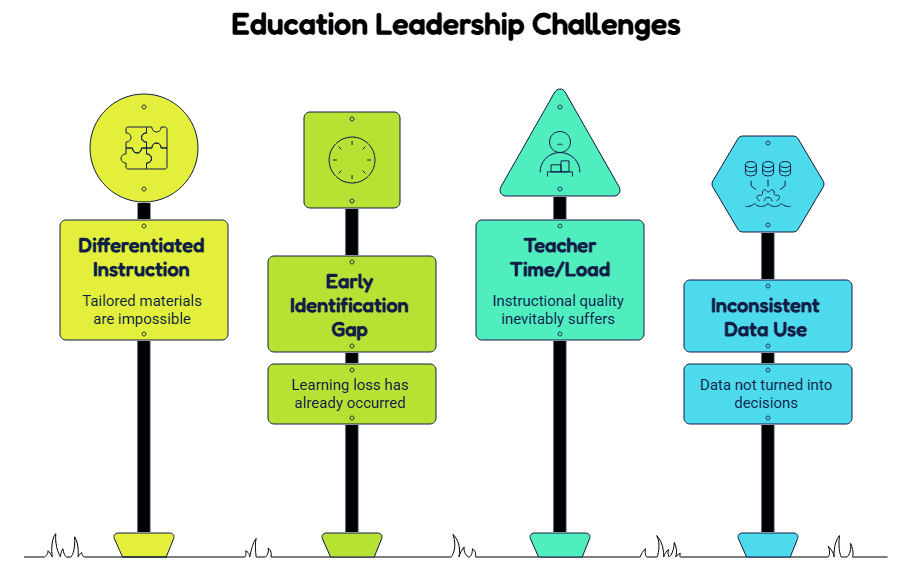
Differentiated instruction at scale remains one of the hardest problems in education. A teacher with 30 students might have 10 different instructional levels in reading alone. Creating tailored materials for each group is theoretically ideal and practically impossible without support.
Early identification of struggling students is another chronic gap. By the time a student is flagged for intervention, weeks or months of learning loss have already occurred. Traditional assessment cycles are too slow.
Teacher time and cognitive load are at a breaking point. Burnout is at record highs. When planning, grading, and reporting consume the majority of a teacher’s non-classroom hours, instructional quality inevitably suffers.
Inconsistent use of data is also widespread. Schools collect enormous amounts of student data, but most teachers lack the tools or the time to turn that data into instructional decisions daily.
Emerging AI Trends Transforming K-12 Education
The landscape of K-12 educational technology solutions has shifted dramatically over the past two years. Several converging trends are making AI-powered personalization both accessible and actionable:
Adaptive learning platforms now use machine learning to adjust reading levels, math problem sets, and pacing in real time not just week to week, but within a single session. Tools like Khan Academy’s Khanmigo, IXL’s real-time diagnostics, and Carnegie Learning’s MATHia are leading examples of how AI tools for student engagement are being embedded directly into curriculum.
Natural language processing has matured enough to give teachers an AI co-planner. Instead of building a differentiated lesson from scratch, a teacher can now describe their learning objective, class composition, and time constraints and receive a structured, editable lesson plan in minutes.
Predictive analytics are enabling proactive intervention. AI models trained on attendance, assessment, and engagement data can flag students showing early signs of disengagement or learning gaps, often before a teacher would notice manually.
Voice and multimodal AI interfaces are making accessibility more equitable. Students who struggle with traditional text-based assessments can now demonstrate knowledge through voice response, visual interaction, or adaptive testing formats an important development for special education and ELL populations.
These aren’t pilots anymore. They represent the leading edge of digital transformation in K-12 schools happening in districts across the country.
Step-by-Step: How Teachers Can Use AI Practically
Adopting AI doesn’t require a complete curriculum overhaul or a major technology budget. Here’s a practical progression that works at the classroom level:
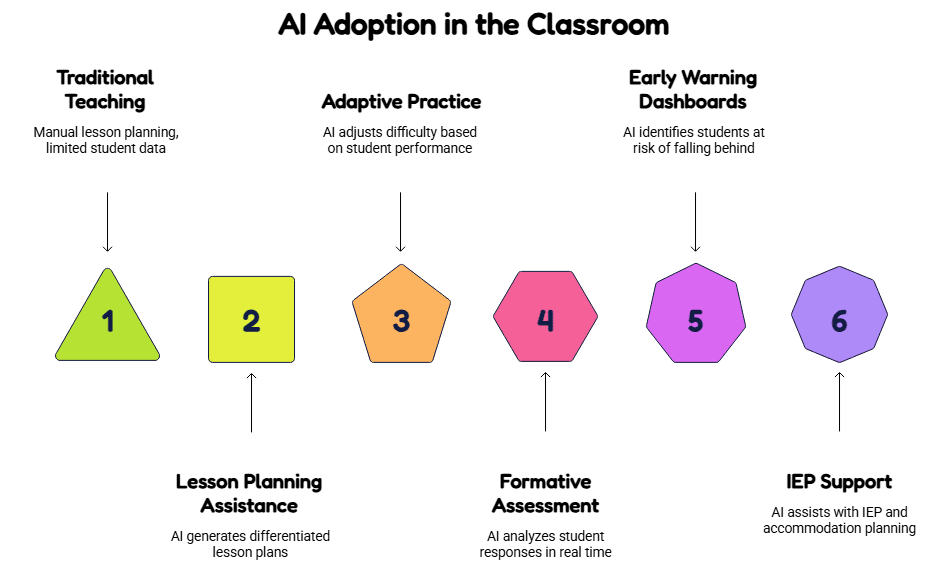
Step 1 Start with lesson planning assistance: Use AI writing tools (ChatGPT, Claude, or education-specific tools like MagicSchool AI or Diffit) to generate differentiated versions of a lesson. Input your standard, your student reading levels, and your time frame. Review, edit, and personalize the output. This alone can save 3–5 hours per week.
Step 2 Integrate an adaptive practice platform: Assign a tool like Khan Academy, Zearn, or Newsela that adjusts difficulty automatically based on student performance. This doesn’t replace direct instruction it handles the independent practice piece, so teachers can use small group time more strategically.
Step 3 Use AI-assisted formative assessment: Tools like Formative, Nearpod, and Edulastic use AI to analyze student responses in real time. A teacher can see, at a glance, which students mastered a concept and which need re-teaching without manually grading 30 exit tickets.
Step 4 Set up early warning dashboards: Work with your instructional technology coordinator to activate predictive analytics features within your existing student information system (many districts using Illuminate, PowerSchool, or Clever already have these capabilities). Review flags weekly.
Step 5 Use AI for IEP and accommodation planning support: AI tools can help draft present levels of performance language, suggest measurable goals, and identify research-based intervention strategies, reducing the administrative burden of special education documentation significantly.
Best Practices and Expert Recommendations
For education technology leaders and administrators guiding AI adoption, a few principles consistently separate successful implementations from failed ones:
Lead with teacher input, not vendor pitches. The tools that stick are the ones teachers helped select. Build pilots with early adopters, collect structured feedback, and scale based on evidence.
Prioritize tools that integrate with existing systems. Adoption drops sharply when teachers are asked to log into yet another platform. The most effective K-12 AI education solutions integrate with Google Classroom, Canvas, or your district’s LMS.
Invest in professional development as much as the technology. AI tools without training produce inconsistent results. Even two to three hours of structured PD can dramatically improve implementation quality.
Establish clear data privacy policies before deployment. Parents, teachers, and administrators need clarity on what student data AI tools collect, how it’s stored, and who can access it. Compliance with FERPA and COPPA is non-negotiable.
Frame AI as a teaching assistant, not a replacement. This framing matters for teacher buy-in. The goal is to reduce administrative burden so teachers can do more of what only humans can do build relationships, provide emotional support, and make nuanced instructional judgments.
Common Mistakes to Avoid
Several patterns consistently undermine AI adoption in K-12 settings:
Deploying AI tools without clear instructional goals. Technology for its own sake rarely moves the needle. Before adopting any tool, define what student outcome you’re trying to improve and how you’ll measure it.
Ignoring equity implications. AI tools trained on biased data can reinforce existing achievement gaps rather than close them. Vet vendors carefully and review outcome data disaggregated by student subgroup.
Overloading teachers with too many tools at once. Introducing five new AI platforms in a single year is a recipe for shallow adoption of all five. Prioritize depth over breadth.
Treating AI output as final. AI-generated lesson plans, assessment items, and student feedback are starting points, not finished products. Teachers must review, contextualize, and personalize everything AI produces.
Neglecting the human side of the change process. Even the best tools fail without trust, communication, and ongoing support. The transition to AI-enhanced instruction is as much a cultural shift as a technological one.
Conclusion: What's Next for AI in K-12 Education
The classroom of 2026 looks different from what it did even three years ago. And by 2028 and beyond, the trajectory is clear: AI will become as embedded in teaching as the internet itself, not as a replacement for great instruction, but as the infrastructure that makes it possible at scale.
For teachers, the opportunity is enormous. AI can handle the tasks that drain time and energy drafting, grading, differentiating, and documenting, so educators can focus on what no algorithm can replicate: knowing their students, building trust, and making the kind of human connection that drives real learning.
For district leaders and administrators, the imperative is to move beyond pilots and proofs-of-concept toward systemic, equitable, well-supported implementation. The public sector digital transformation happening across government and social services is arriving in schools, and those that move thoughtfully and strategically will see the greatest gains.
The students who need differentiated support the most, those with learning disabilities, those reading below grade level, and those who’ve fallen through the cracks, deserve the full benefit of what these tools can offer. That’s not a technology story. It’s an equity story.
Government App Maisters is a purpose-built technology solutions company dedicated to driving digital transformation across public sector and K-12 education environments. With specialized expertise in K-12 educational technology solutions, AI integration, and public sector digital transformation, Government App Maisters works alongside school districts and government agencies to design and deploy technology that delivers real, measurable outcomes.
Frequently Asked Questions
Can AI personalize learning for every student in a large classroom?
Yes. Adaptive platforms like Khan Academy, IXL, and Carnegie Learning adjust content difficulty and pacing in real time based on each student’s performance no manual differentiation required. Teachers focus on instruction while AI handles the personalization layer.
What are the best free AI tools for K-12 teachers?
Top free or low-cost options include MagicSchool AI for lesson planning, Diffit for leveled reading materials, Khan Academy’s Khanmigo for tutoring support, and Google’s Gemini integration within Google Classroom. Most require no special IT setup.
Is student data safe when using AI tools in the classroom?
Only if you choose the right tools. Stick to platforms that are FERPA and COPPA compliant, review the vendor’s data privacy agreement before adopting, and never enter identifiable student information into general-purpose consumer AI tools.
How does AI support students with learning disabilities or IEPs?
AI reduces documentation time by helping draft IEP goals and present levels of performance. Instructionally, adaptive assessments, text-to-speech, and speech-to-text tools give students with disabilities more equitable ways to access content and show what they know.
Will AI replace K-12 teachers?
No. AI handles repetitive tasks like grading and planning. It cannot replicate the trust, mentorship, and human connection that drive real learning. AI gives teachers time back — so they can do more of what only people can do.
How should districts start with AI without overwhelming teachers?
Pick one pain point, pilot one tool, and involve teachers from the start. Provide hands-on training, gather feedback after 6–8 weeks, and scale only what’s working. Treat it as a change management process, not just a tech rollout.