
Imagine a classroom buzzing with activity: students working in groups, some at tablets, a teacher guiding them. In many schools, AI-powered tools are helping make this a reality. AI in education is becoming common 85% of teachers used some AI in 2024-25 and it’s changing how kids learn. When each lesson adapts to the learner, students stay interested longer. Research shows students on AI-powered platforms score 15-35% higher on tests than peers and are up to 10 times more engaged than in a standard lesson. By turning every lesson into a tailored experience, data-driven teaching tools lift engagement and help every child learn at their own pace.
Why Engagement Matters
Student engagement means more than quiet focus it’s about curiosity and participation. Engaged students ask questions, try new ideas, and remember what they learn. When kids lose interest, learning stalls. Traditional “one-size-fits-all” teaching often leaves some learners bored or overwhelmed. Today’s classrooms are diverse: one class can have 20 reading levels and many different interests. Teachers can’t possibly tailor each task manually every day. AI tools offer a solution by using data to adapt lessons on the fly. This data-driven approach is part of the broader digital transformation in k-12 schools, where technology and analytics help personalize learning for each student.
How AI Helps Teachers Engage
AI doesn’t replace the teacher it powers the teacher’s superpowers. AI tools analyse student work (answers, responses, quiz results) and find patterns in the data. For example, an AI quiz app might spot that half the class is stuck on fractions. The app can then give extra practice on that topic to those students, while others move ahead. These data-driven teaching tools adapt difficulty level and pace automatically. This means every learner works at the right challenge neither bored nor lost. This kind of personalisation keeps students motivated and engaged.
AI also brings immediate feedback. In a traditional class, giving each student detailed feedback can take days. AI can correct answers in seconds. Many AI assessment tools give answers “10 times faster” than manual grading. When students see correct solutions right away, they stay focused on improving. This instant loop try, get feedback, improve helps kids keep going rather than giving up.
Another big boost is interactivity. AI powers chatbots, games, and simulations. Instead of watching a lecture, students can debate with an AI character or solve puzzles created in real-time. For example, teachers have students role-play a debate with Thomas Jefferson using an AI chatbot for Alexander Hamilton. Students practise speaking up without the jitters of facing a classmate. In writing classes, AI can jump-start creativity: it might generate an opening line and let each student continue the story. These activities turn learning into a game, so students participate eagerly.
AI tutoring systems are another form of engagement. They work like a personal tutor for each child. The student can ask questions anytime, and the AI answers in simple language. In a study, students using intelligent tutoring systems made a 17% improvement on tests. That extra practice and on-demand help keep students interested in subjects that once frustrated them. In short, AI tools for student engagement range from custom quizzes and chatbots to interactive projects that meet each learner’s needs.
Data-Driven Teaching Tools in Action
What exactly are data-driven teaching tools? In practice, they are apps and platforms that gather data on how students learn. They look at things like quiz scores, time spent on a question, and even answers to open-ended questions. Then the AI adapts. For example, adaptive math apps increase difficulty when a child succeeds, or give hints when they struggle. Learning dashboards let teachers see in real time which topics need more class time. Some reading apps track how fast kids read, and suggest exercises for fluency. All of these are “data-driven” because the tool collects and reacts to each student’s information.
A key example is personalised math software. When a pupil answers a problem, the AI instantly adjusts the next problem’s difficulty. If the student answers correctly, the next question is slightly harder; if not, it might offer a hint or a simpler problem. This keeps the child in the “Goldilocks zone” of learning. Research cited by experts shows that students learn best and stay engaged when lessons adapt to their level. In this way, teaching becomes a conversation between the student and the app, with the teacher guiding the group. This approach is part of ai in education growth, where learning paths are guided by data analysis.
Examples of AI Tools for Engagement
Teachers have a growing toolbox of AI-driven apps:
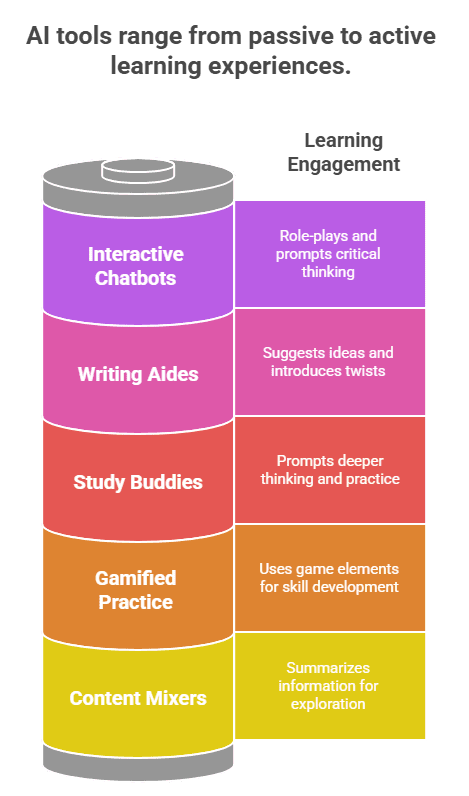
- Interactive chatbots: Tools like SchoolAI or chatbots built on ChatGPT let students ask questions or role-play. In one activity, a student argued against an AI playing Hamilton in a history debate. The AI responded in Hamilton’s voice, prompting the student to think on their feet. This turns a quiet worksheet into an immersive discussion.
- Writing aides: Apps can suggest first sentences or story ideas. A teacher might have a student start a story and ask the AI to introduce a twist mid-way. Students stay engaged because they co-create with the AI. It breaks writer’s block without doing all the work.
- Study buddies: AI tutors act as on-demand helpers. If a student is alone at home, they can type questions into a chatbot. The AI doesn’t give away answers; instead it prompts deeper thinking. It can quiz a student on a topic or explain a hard concept in simpler terms (e.g. “Explain photosynthesis to a 5th grader who loves baseball”). This keeps students practising and learning outside class.
- Gamified practice: Some platforms use game elements. Progress tracking, badges, and levels make practice feel like a game. When challenges match a student’s skill (dynamic difficulty), they feel rewarded for success and not bored or frustrated.
- Content mixers: AI tools like Google’s NotebookLM can take class notes, articles or videos and craft a summary or even a podcast-like “AI radio show” for the class. Students listen or read the summary and ask questions. This way, they explore topics in a new format, which can spark curiosity.
These are just samples. New apps constantly appear. The key is that they make learning interactive and tailored. They are part of a wave of Ai solutions for education sector that aim to put learning in each student’s hands.
Addressing Challenges
Implementing AI isn’t automatic magic. It requires care. Firstly, teachers need training. Surprisingly, less than half of teachers report having any formal training in AI tools. But good professional development can change that. Schools that include AI in teacher training find it easier to adopt these tools. With clear school policies and support, teachers feel confident exploring new apps.
Another point is to keep the human touch. Some studies warn that if students rely too much on AI, they may feel distant from teachers. The goal is not to replace discussions or group projects, but to make them richer. For example, if an AI handles grading practice problems, the teacher has more time to work one-on-one or encourage class chats. AI should free teachers to connect, not replace those connections.
Finally, schools must handle data and equity. Trusted AI tools need to follow privacy rules. Ideally, the tech department vets any new app. And all students should have access (laptops, wifi, etc.) so engagement gains are shared equally. With these steps in place, AI tools can be safely woven into lessons.
Frequently Asked Questions
How can AI improve student engagement?
AI makes learning personal and interactive. It adjusts lessons to each pupil’s level and gives instant feedback, so students stay interested. For instance, an AI quiz can increase difficulty as a student improves, keeping it challenging. It can also turn content into games or chatbots, making lessons feel fresh. Research shows this personalised approach boosts motivation and scores.
What are data-driven teaching tools?
These are classroom apps or systems that use student data (like quiz answers or time on tasks) to guide teaching. For example, an adaptive learning program tracks how well each child does in maths and then presents new problems to match their skill. Teachers use the data to see who needs help with which topics. In short, they use students’ own learning data to tailor lessons and improve engagement.
Can AI personalise learning for every student?
Yes. AI platforms continuously analyze student performance and tweak content in real time. If a child is struggling, the system offers extra practice or a different explanation. If a child excels, it moves them ahead. This means each student effectively has a custom lesson pace and level. Studies consistently show students are more engaged when learning is personalised to their needs.
Will AI replace teachers?
No. AI is a tool to help teachers, not replace them. Education experts emphasize that AI use should always be human-centered. AI handles routine tasks (like grading quizzes or generating practice problems) and provides insights, freeing teachers to focus on mentoring, discussion, and relationship-building. The best results happen when AI augments human teaching, not substitutes it.
Are AI education tools safe and easy to use?
Most AI tools designed for schools are user-friendly and require minimal setup. Teachers usually need some initial training, but many apps have clear guides and support. Safety comes from following school guidelines: use approved platforms, protect student privacy, and explain to students how data is used. When used responsibly, AI apps are straightforward and help students learn more effectively without adding extra burden.