
On a quiet Tuesday morning in 2023, a mid-sized school district in Clark County, Nevada, woke up to find its entire digital infrastructure locked. Grades, attendance records, and payroll systems are encrypted. Held hostage. The ransom demand: $5 million. The actual cost of recovery, even without paying: over $8.7 million in downtime, remediation, and reputational damage.
This was not an isolated incident. It was a preview of what was coming.
By 2025, the threat had escalated dramatically. According to Zscaler ThreatLabz’s 2025 Ransomware Report, ransomware attacks against government entities surged 235.4% year-over-year from 95 incidents in the prior period to 322 between April 2024 and April 2025. Government became the ninth-most targeted sector globally, and education wasn’t far behind, with attacks climbing 25.8% year-over-year, placing it firmly in the top 10 ransomware targets worldwide.
What makes this even more alarming is that ransomware has evolved its playbook. Attackers are increasingly skipping file encryption altogether and going straight for the data, applying extortion pressure by threatening to expose sensitive student records, citizen data, and critical operational files. For a school district administrator or a state agency CIO, this means the old model of “detect the encryption, restore from backup” no longer works. By the time you know you’ve been hit, the damage is already done.
There is a solution. And it starts long before the attack ever lands.
Key Challenges Facing Public Sector IT Leaders
Before exploring solutions, it’s worth naming the specific pain points that make government and education IT especially vulnerable:
1. Attack Volume With No Sign of Slowing: Comparitech’s 2026 global ransomware analysis confirmed that total ransomware attacks across all sectors rose 32% in 2025, with 7,419 attacks recorded globally. For government specifically, Trustwave identified 196 confirmed public sector ransomware victims in 2025 alone, and that number only counts organizations that publicly acknowledged the breach.
2. Astronomical Ransom Demands: In Q1 2025, government organizations faced the highest average ransom demands of any sector: $6.7 million per incident. Even with demand levels softening later in the year to an average of $1.55 million, the financial exposure remains existential for budget-constrained agencies and school systems.
3. Understaffed, Burned-Out Security Teams: The Sophos State of Ransomware in Education 2025 report, drawing on 441 IT and cybersecurity leaders across 17 countries, found that education sector security teams face widespread psychological strain 41% reported increased anxiety or stress, 34% experienced guilt that attacks weren’t stopped in time, and 31% dealt with staff absences due to mental health issues tied to ransomware incidents. This is what chronic understaffing and reactive security postures do to real people.
4. The Third-Party Problem: The three largest education data breaches of 2025 all stemmed from Clop’s exploitation of a zero-day vulnerability in Oracle’s E-Business Suite, a third-party platform used by schools. The PowerSchool breach of late 2024, in which a 19-year-old hacker extorted $2.85 million and exposed data of over 60 million students and 10 million teachers, remains a defining case study in supply chain risk that the public sector has still not fully reckoned with.
5. Compliance Without Security Depth: Meeting FERPA, CJIS, or FedRAMP requirements often creates a false sense of security. Compliance is a floor, not a ceiling, and ransomware actors exploit the gap between what’s required and what’s actually defended. Between July 2023 and December 2024, 82% of K-12 schools in the US experienced a cyber incident, according to the Center for Internet Security. Most were compliant. Most were still breached.
Emerging Tech Trends Solving the Problem
This is where the narrative begins to shift.
Predictive analytics in government cybersecurity is no longer a futuristic concept; it is a deployed, operational reality. The convergence of machine learning, behavioral analytics, and threat intelligence has produced a new category of defense: AI ransomware detection that identifies attacks not after they detonate, but days or weeks before.
Here’s what the modern tech stack looks like for public sector resilience:
1. Risk Intelligence Platforms
A Risk Intelligence Platform aggregates signals from endpoints, network traffic, cloud environments, user behavior, and dark web data feeds to produce continuous risk scores. Rather than waiting for a known signature to trigger an alert, these platforms model “normal” and flag deviations like a contractor account accessing payroll servers at 2 AM.
Vendors like Recorded Future, Darktrace, and CrowdStrike Falcon now offer government-specific configurations with FedRAMP-authorized deployments.
2. AI-Driven Behavioral Analytics (UEBA)
User and Entity Behavior Analytics (UEBA) uses machine learning to establish behavioral baselines for every user and device. When a teacher’s account suddenly begins moving laterally across file servers behavior consistent with ransomware staging UEBA triggers containment before encryption begins.
3. Threat Intelligence Sharing via ISACs
The K-12 Security Information Exchange (K12 SIX) and MS-ISAC (Multi-State Information Sharing and Analysis Center) now provide real-time threat intelligence feeds specifically for education and government. Integrating these feeds into a Risk Intelligence Platform allows districts and municipalities to benefit from collective defense.
4. Zero Trust Network Architecture (ZTNA)
Zero Trust eliminates the implicit trust that lateral ransomware movement exploits. By requiring continuous verification for every user and device regardless of location ZTNA limits blast radius even when a breach occurs.
Step-by-Step: Building a Predictive Defense Framework
Here is an actionable roadmap that education technology leaders and government CISOs can follow today:
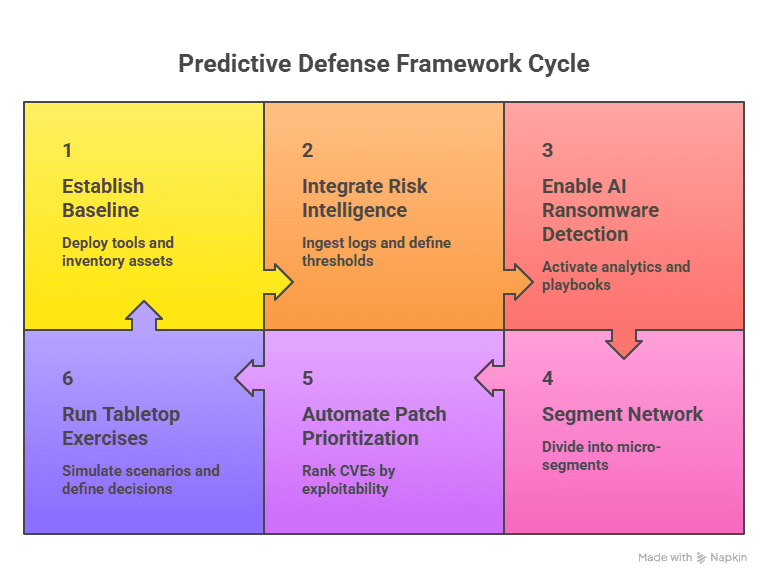
Step 1: Establish Your Baseline (Weeks 1–4)
Deploy endpoint detection tools across all devices. Run a full asset inventory. Identify unmanaged devices (shadow IT) and legacy systems. Use this data to build an accurate risk surface map. You cannot protect what you cannot see.
Step 2: Integrate a Risk Intelligence Platform (Weeks 4–8)
Select a FedRAMP-authorized or FERPA-compliant Risk Intelligence Platform suited to your agency’s size. Configure it to ingest logs from firewalls, Active Directory, email gateways, and cloud services. Define risk thresholds based on your operational context.
Step 3: Enable AI Ransomware Detection (Month 2–3)
Activate behavioral analytics and configure automated playbooks. For example, if a user account accesses more than 500 files in under 10 minutes outside business hours, auto isolates the endpoint and notifies the SOC. This is how AI ransomware detection turns predictive signals into preemptive containment.
Step 4: Segment Your Network (Month 3–4)
Divide your network into micro-segments by function: HR, student records, financial systems, and infrastructure. A ransomware actor who breaches one segment should find a wall, not a highway.
Step 5: Automate Patch Prioritization (Ongoing)
Use vulnerability intelligence feeds to rank CVEs by exploitability in your environment, not just by CVSS score. Predictive analytics can identify which unpatched systems are most likely to be targeted based on the current threat of actor TTPs (Tactics, Techniques, and Procedures).
Step 6: Run Tabletop Exercises Quarterly
Simulate ransomware scenarios with your IT and leadership teams. Pre-define decision trees: Who approves isolation of a critical system? Who communicates with the public? What’s the backup restoration SLA? Decisions made in advance are executed in minutes. Decisions made during an incident take hours.
Real-World Use Cases
Case 1: Active Defense at Los Angeles Unified School District (LAUSD)
When the Vice Society cyber-syndicate hit the Los Angeles Unified School District over a holiday weekend, it threatened the digital infrastructure of America’s second-largest school system. Instead of giving in to extortion, the district deployed emergency endpoint security tools and enforced an immediate password reset for more than half a million student and staff accounts. By isolating network segments, IT teams successfully contained the infection vector. LAUSD publicly refused to pay the ransom demand. While tech cleanup costs reached millions, the district avoided the standard $1.5 million payout average typically forced onto school systems, setting a national benchmark for K-12 defensive resilience.
Case 2: Zero Trust Identity Protection in Public Utilities
Following federal directives like OMB Memorandum M-22-09, which orders public agencies to adopt strict Zero Trust models, municipal and civilian public sector teams have drastically updated their identity management systems. Organizations like the City of Southgate transitioned from traditional passwords to phishing-resistant hardware keys and certificate-based access via Microsoft Entra ID. Because nearly half of all state and local government ransomware vectors start with a stolen credential, this structural change eliminates the risk. Even if a low-level worker clicks on a malicious link, the attacker cannot pivot or move laterally because the system blocks unauthorized lateral domain escalation.
Case 3: The True Cost of Containment Failures (HSE Case Study)
The financial justification for proactive threat hunting became undeniably clear after the Conti ransomware group attacked Ireland’s Health Service Executive (HSE). Because the network lacked centralized endpoint telemetry, the lateral infection spread unabated across multiple state-run healthcare systems. Official government records later revealed that the total technical remediation, system rebuilds, and recovery costs ballooned to over €102 million. This massive financial disaster caused public sector security teams worldwide to pivot toward continuous endpoint monitoring and dark web intelligence. Today, agencies look for early warning signs like unauthorized Cobalt Strike beacons to neutralize attackers before data encryption begins.
Best Practices & Expert Insights
Ransomware is a symptom. The disease has poor visibility. Panel consensus, RSA Conference 2024 Public Sector Track
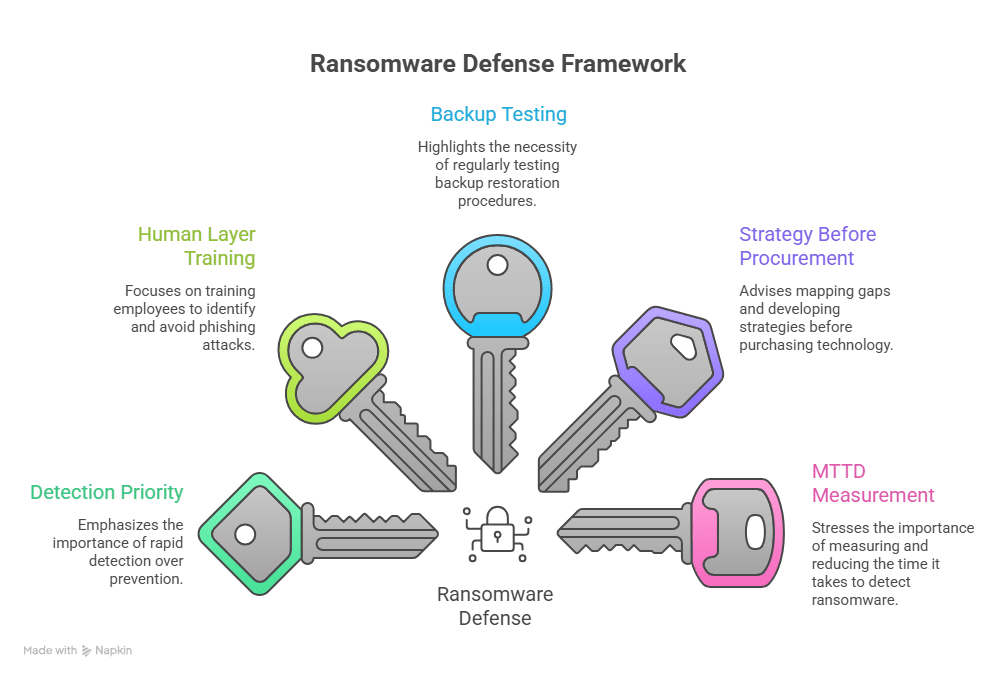
- Prioritize detection over prevention: Prevention will fail. Detection speed determines survival. Every hour of dwell time costs an average of $78,000 in public sector environments.
- Train for the human layer: Phishing is still the #1 initial access vector for ransomware. Quarterly phishing simulations with personalized coaching reduce click rates by up to 70% within 12 months.
- Backup is not optional; test it monthly: Immutable, air-gapped backups with tested restoration procedures are the single most effective ransomware mitigation. Many agencies have backups that have never been successfully restored.
- Adopt ransomware protection strategies before procurement: Map your current gap against the NIST Cybersecurity Framework before writing an RFP. Technology without strategy is expensive noise.
- Measure meantime-to-detect (MTTD) religiously: The average MTTD in government is 197 days. With predictive analytics, leading agencies are hitting under 72 hours. That delta is the difference between a contained incident and a national headline.
Common Mistakes to Avoid
Mistake 1: Treating cybersecurity as an IT issue, not a leadership issue: When a school board or city council doesn’t prioritize cybersecurity solutions for government, budgets stay frozen, and teams stay understaffed. Ransomware is a governance risk. Leadership must own it.
Mistake 2: Buying tools without a use-case map: A sophisticated SIEM or XDR platform deployed without tuned detection rules and staffed analysts generates alert fatigue, not security. 52% of security alerts in government go uninvestigated due to volume.
Mistake 3: Ignoring supply chain and third-party risk: The most dangerous entry point is often a trusted vendor. Managed service providers, curriculum platforms, and payroll systems all represent attack surfaces. Map your third-party access and apply the same risk intelligence rigor to vendors.
Mistake 4: Conflating compliance with security: Meeting CJIS or FERPA requirements does not make you secure. Defending your community against cyber threats requires going beyond checkbox compliance to continuous, adaptive risk management.
Conclusion:
Ransomware is not going away. If anything, the proliferation of Ransomware-as-a-Service (RaaS) platforms and AI-powered intrusion tools means public sector cyberattacks will continue to grow in frequency and sophistication throughout 2025 and beyond. The question is not whether your district or agency will be targeted. The question is whether you’ll see it coming.
Predictive analytics in government cybersecurity fundamentally changes that equation. By shifting from reactive detection to proactive risk intelligence modeling attacker behavior, correlating threat signals, and automating early containment, public sector IT leaders can stop ransomware before it detonates.
The next frontier is even more powerful: federated AI models that allow school districts and municipalities to share anonymized threat of telemetry across jurisdictions without exposing sensitive data. Combine this with federal government IT solutions anchored in Zero Trust and continuous monitoring, and the public sector begins to look like a genuinely resilient and formidable defender.
The attacks will keep coming. The question is whether your community is defended by yesterday’s tools or tomorrow’s intelligence.
Ready to stop ransomware before it starts? Connect with Government App Maisters today and discover how predictive analytics can become your strongest line of defense.
Frequently Asked Questions
Can predictive analytics actually prevent ransomware, or just detect it faster?
Predictive analytics doesn’t just speed up detection, it identifies attack precursors (like unusual account behavior, dark web signals, or lateral movement patterns) days or even weeks before ransomware deploys. Tools like UEBA and Risk Intelligence Platforms flag the staging phase of an attack, giving your team time to shut it down before any encryption or data theft occurs. Prevention is still the goal; prediction is what makes it achievable.
What's the difference between compliance (FERPA, CJIS, FedRAMP) and actual ransomware protection?
Compliance sets a minimum legal floor; it doesn’t reflect your real threat exposure. Between July 2023 and December 2024, 82% of K-12 schools that experienced a cyber incident were already compliant. Ransomware groups specifically exploit the gap between what regulations require and what’s actually defended. True protection requires continuous, adaptive risk management, not annual audits.
How do small school districts or under-resourced agencies afford these solutions?
Many FedRAMP-authorized platforms (like CrowdStrike Falcon or Darktrace) offer tiered pricing, and free resources like MS-ISAC and K12 SIX provide real-time threat intelligence at no cost to public sector members. The ROI calculation also works in your favor: the State of Connecticut avoided an estimated $14 million in incident costs in a single quarter after deploying predictive analytics. The cost of the tool is rarely the problem; the cost of not having it is.
What ransomware groups are actively targeting government and schools right now?
The most active groups hitting the public sector in 2025 were Babuk2 (43 confirmed government victims), Qilin (37 education-specific attacks), INC Ransom, Medusa, and FunkSec. Each uses distinct TTPs. Qilin heavily leverages phishing, while groups like Clop exploit third-party vendor zero-days. Knowing who is targeting your sector matters because your detection rules and vendor vetting should be tuned to those specific behaviors.
Our biggest risk is a third-party vendor, what can we do?
This is the most underaddressed vulnerability in public sector IT right now. The PowerSchool breach (60 million students exposed) and the Clop/Oracle zero-day (three of the largest 2025 education breaches) both came through vendor platforms. Apply the same Risk Intelligence Platform monitoring to vendor access that you apply to internal users, enforce Zero Trust for all third-party connections, require vendors to meet your security standards contractually, and continuously monitor their access patterns.
If we get hit, should we pay the ransom?
The FBI and CISA both advise against paying it funds for future attacks and don’t guarantee data recovery or deletion. More practically: paying doesn’t undo the breach. Groups like Qilin and Medusa increasingly exfiltrate data before demanding ransom, meaning even paying won’t prevent exposure. The better investment is immutable, air-gapped backups with monthly tested restoration. Sophos 2025 data shows organizations with strong backup practices cut recovery costs by 77% year-over-year.