
Every day, millions of citizens visit government websites to renew a license, apply for a permit, check benefit status, or file a complaint. And every day, millions of them leave frustrated, having clicked through broken links, waited in a queue for a live agent, or submitted a form only to receive a generic auto-reply that answers nothing.
This is not a technology gap. It’s an execution gap. And in 2026, it’s one where generative AI government portals are finally beginning to close.
Government agencies are sitting on decades of structured and unstructured data forms, FAQs, policy documents, and case histories, yet most of that knowledge is inaccessible to the average citizen in real time. Meanwhile, overworked staff spend upward of 60% of their time on repeatable, low-complexity requests: password resets, status lookups, document submissions, and appointment scheduling.
The solution isn’t hiring more people. It’s deploying smarter systems.
This post explores how generative AI is transforming government web development and public-sector service delivery and what agencies need to do right now to stay ahead.
Key Challenges Facing Government Portals Today
Before understanding the fix, let’s be honest about the depth of the problem:
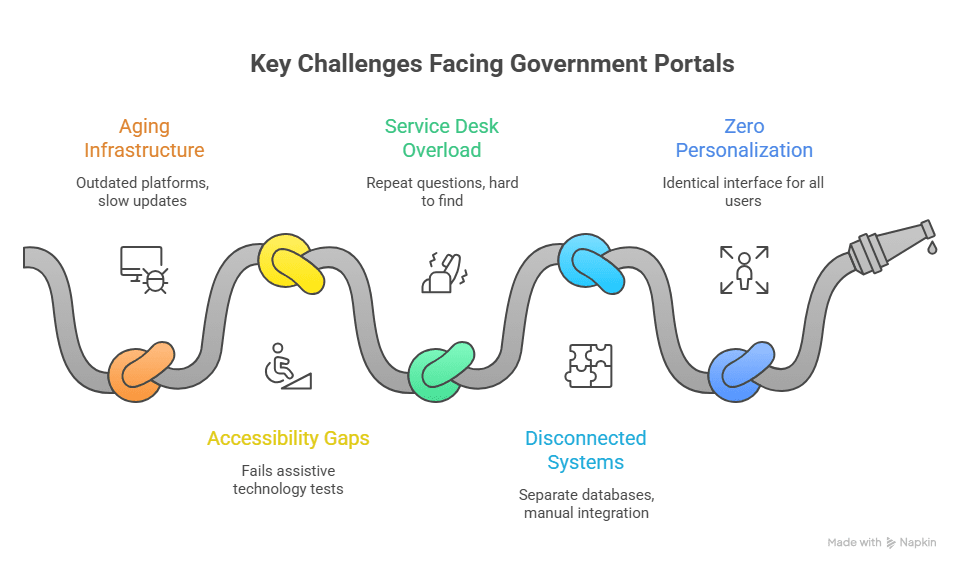
- Aging Infrastructure: A significant portion of federal and municipal websites still run on legacy CMS platforms built before mobile-first design was even a consideration. Updating a single content block can require a formal change request and a two-week approval cycle.
- Accessibility Compliance Gaps: Section 508 and WCAG 2.1 compliance remain inconsistently enforced. Many accessible government websites exist on paper but fail real-world assistive technology tests, such as screen readers, voice navigation, and keyboard-only browsing, regularly.
- Service Desk Overload: A 2025 Deloitte report found that 47% of citizen service inquiries directed to government call centers were repeat questions already answered on the agency’s website, but were impossible to find.
- Disconnected Back-End Systems: Departments that manage permits, taxes, benefits, and licensing often operate on entirely separate databases. Citizens end up as the integration layer, copying data from one form to another across three different portals.
- Zero Personalization: Most government portals treat every user identically. A senior citizen navigating Medicare benefits and a developer pulling zoning APIs receive the same interface, an interface optimized for neither.
Emerging Tech Trends Solving the Problem
The public sector is no longer watching from the sidelines. Here are the technology shifts reshaping AI solutions for government agencies in 2026:
Retrieval-Augmented Generation (RAG) allows AI systems to pull accurate, real-time answers directly from an agency’s internal knowledge base, policy documents, FAQs, and legislation without hallucinating outdated information.
Multimodal AI enables citizens to upload documents (photo of a utility bill, scanned ID) and have the system extract, validate, and pre-fill form fields automatically.
Conversational AI with context memory powers public sector chatbot software that doesn’t reset with every message. It remembers the full interaction thread, reducing citizen frustration and repeated explanations.
AI-driven Content Management Solutions can audit an entire government website for outdated pages, broken links, accessibility violations, and content gaps, then recommend or auto-generate corrected content.
Low-code/No-code AI workflow builders allow non-technical staff to configure automation pipelines for form routing, status notifications, and escalation logic without engineering resources.
Step-by-Step: How Agencies Can Deploy Generative AI on Their Portals
Step 1: Audit Your Current Content and Workflows
Before deploying any AI, map what exists. Use a Content Management Solution to inventory every page, form, and document on your portal. Tag content by department, update frequency, citizen query volume, and compliance status. This audit becomes your AI’s training ground.
Step 2: Identify the Top 10 Repetitive Citizen Requests
Pull 90 days of support ticket data and call center logs. In most agencies, 10 request types account for over 70% of volume (license renewals, FOIA requests, permit status, benefit eligibility checks, appointment scheduling). These are your primary automation targets. Data published by McKinsey & Company confirms that citizens overwhelmingly prefer digital self-service options, meaning automating these top requests directly aligns with user demand.
Step 3: Deploy a RAG-Powered Chatbot for Tier-1 Support
Implement a public sector chatbot trained on your policy documents and FAQ database. Use RAG architecture so the AI cites source documents, never fabricates policy details, and escalates to a human agent when confidence scores drop below the threshold. This is not optional; accuracy is a legal and reputational obligation.
Step 4: Automate Document Processing with Multimodal AI
For any form that requires document submission, integrate an AI layer that extracts fields from uploaded files, validates data against agency records, and pre-fills downstream forms. This alone can reduce manual processing time by 60–80% for high-volume applications.
Step 5: Rebuild Content Workflows Around AI Assistance
Train content teams to use generative AI to draft, translate, and update policy pages with human review as the final gate. This compresses a 3-week content update cycle to 3 days. Build this into your municipal website development roadmap as a core capability, not an afterthought.
Step 6: Bake Accessibility In From the Start
Require that all AI-generated content pass automated WCAG 2.2 checks before publishing. Use AI tools that flag non-compliant language, insufficient contrast ratios, and missing alt text in real time during the authoring process.
Step 7: Measure, Iterate, and Scale
Define KPIs before launch: resolution rate without human escalation, average handling time, citizen satisfaction score, and accessibility audit pass rate. Set a 90-day review cadence. AI systems improve significantly with feedback loops; don’t deploy and walk away.
Real-World Use Cases Driving Results
Los Angeles County, Permit Portal Automation: LA County deployed a generative AI assistant on its Development Services Portal to handle permit eligibility questions. The system, trained on zoning codes and building regulations, resolved 68% of inquiries without human intervention in its first quarter, cutting average response time from 3 days to under 4 minutes.
Estonia’s X-Road + AI Layer: Estonia, long the global benchmark for government web development, has layered generative AI onto its X-Road data exchange platform. Citizens interacting with any of the 800+ connected services now receive AI-assisted guidance that spans departments, pulling real-time status from tax, health, and licensing systems in a single conversational interface.
USDA Virtual Assistant (Ask the Expert): The U.S. Department of Agriculture’s AI assistant handles crop insurance queries, farm loan eligibility, and disaster assistance applications, previously a category requiring specialist phone support. The system uses RAG against the USDA’s 50,000-page regulatory database. First-contact resolution rates improved by over 40% within six months of deployment.
UK Government’s GOV.UK Chat Pilot (2025): The UK’s Government Digital Service ran a pilot deploying a GPT-4-class model trained on GOV.UK content to answer benefit and tax questions. Early results showed a 52% reduction in citizens bouncing to phone support after visiting the site, a meaningful shift in citizen engagement with AI that the agency is now scaling nationally.
Best Practices and Expert Recommendations
Transparency is non-negotiable: Every AI interaction on a government portal must clearly identify itself as automated. Citizens have a right to know. Agencies that obscure this face are facing growing legal exposure under emerging AI disclosure regulations.
Keep humans in the loop for complex or sensitive cases: Generative AI excels at Tier-1 resolution. Benefits denials, legal status questions, and disability assessments require human judgment and formal due process. Design escalation paths that are frictionless, not buried.
Use federated fine-tuning, not generic models: A general-purpose LLM trained on internet data will not reliably understand your specific municipal codes, benefit rules, or procurement processes. Invest in domain-specific fine-tuning or robust RAG pipelines grounded in your actual documentation.
Build for multilingual access from day one: AI can generate content in 50+ languages with minimal additional cost. For agencies serving diverse communities, multilingual accessible government websites aren’t a nice-to-have; they’re a legal and ethical mandate.
Involve frontline staff in design: The employees who answer citizen questions daily know where the confusion happens. They should be co-designers of AI workflows, not passengers watching IT deploy something that misses the real pain points.
Common Mistakes to Avoid
Deploying AI without a fallback plan: When AI systems fail or lack confidence, citizens will need a clear, immediate path to a human agent or an alternative resolution method. Dead ends destroy trust.
Over-automating without legal review: Some government decisions carry due process requirements. Automating them without legal sign-off creates liability. Always run AI-assisted workflows through agency counsel before going live.
Ignoring data privacy architecture: Government portals handle personally identifiable information (PII). Any AI layer must comply with FISMA, HIPAA (where applicable), and state-level data protection laws. Confirm data residency, encryption standards, and model training data policies with every vendor.
Treating AI as a one-time project: AI deployments are living systems. Models drift. Policies change. Regulations evolve. Agencies that budget for initial deployment but not ongoing maintenance and retraining will see performance decay within 12–18 months.
Measuring only efficiency, not equity: A chatbot that resolves 70% of queries sounds like a success until you discover it resolves 85% of queries from users with fast broadband and college education, and 40% for elderly citizens on mobile data. Measure outcomes by demographic segment, not just aggregate.
Conclusion:
Generative AI is not a futuristic concept for the public sector; it is an actively deployable, compliance-ready technology that is reducing costs, improving resolution rates, and meaningfully improving the experience of citizens interacting with government services.
The agencies leading this transition share a common thread: they treat AI not as a cost-cutting shortcut, but as an infrastructure investment in how government communicates and delivers value to the people it serves.
What’s next in this space?
By 2028, expect proactive AI government portal systems that don’t wait for citizens to ask a question, but anticipate needs based on life events: a new child triggers automatic benefit eligibility notifications; a small business license expiry triggers a renewal reminder with a pre-filled application. Predictive, personalized, and privacy-preserving,g this is the direction.
Agencies that start building toward this architecture now with solid data foundations, compliant AI pipelines, and trained staff will be the ones delivering on the promise of government that actually works for people.
Government App Maisters is a specialized technology partner for public sector agencies navigating the complexity of digital transformation. From municipal website development and accessible government website design to enterprise-grade Content Management Solutions and public sector chatbot software, the team brings deep compliance expertise and hands-on delivery experience to every engagement.
Frequently Asked Questions
How is generative AI used in government portals?
Generative AI is used in government portals to automate citizen-facing tasks such as answering service inquiries, processing document submissions, pre-filling forms, and routing requests without human intervention. It works by training AI models on agency-specific policy documents, FAQs, and regulations using Retrieval-Augmented Generation (RAG), so responses are accurate and legally grounded. Agencies like USDA and the UK’s GOV.UK have already deployed these systems, achieving 40–68% reductions in manual handling time.
What routine tasks can AI automate on government websites?
AI can automate permit status lookups, license renewals, appointment scheduling, FOIA request intake, benefits eligibility checks, document verification, and multilingual content updates on government websites. These 10 task types typically account for over 70% of total citizen service volume, making them the highest-ROI targets for automation. Once automated, average response time drops from days to minutes.
Is AI safe to use on government portals for citizen data?
Yes, when deployed correctly, AI on government portals is safe for handling citizen data, provided it complies with FISMA, HIPAA (where applicable), and relevant state data protection laws. Safe deployment requires end-to-end encryption, strict data residency controls, no use of citizen PII in model training, and regular third-party security audits. Agencies should confirm these standards with every AI vendor before going live.
What is a public sector chatbot and how does it work?
A public sector chatbot is an AI-powered conversational tool deployed on government websites to answer citizen questions, guide service requests, and resolve common issues without a human agent. It works by connecting to the agency’s knowledge base through an RAG pipeline pulling real-time answers from official policy documents and escalating to a live agent when the query is too complex or sensitive. Unlike generic chatbots, public sector versions are built for compliance, accuracy, and audit trails.
How does generative AI improve citizen engagement on government websites?
Generative AI improves citizen engagement by delivering instant, personalized, and accurate responses instead of static web pages that citizens struggle to navigate. It reduces the need for phone calls and in-person visits by resolving Tier-1 queries in under 4 minutes on average. Features like multilingual support, accessibility-compliant interfaces, and proactive service nudges (e.g., renewal reminders) significantly increase the percentage of citizens who complete transactions fully online.
What are the biggest challenges of implementing AI on government portals?
The biggest challenges of implementing AI on government portals are legacy infrastructure incompatibility, data privacy compliance, over-automation of legally sensitive decisions, and lack of ongoing maintenance budgets. Agencies often deploy AI as a one-time project and see performance decay within 12–18 months as policies change and models drift. The fix is treating AI as a managed service with continuous retraining, regular compliance reviews, and clearly defined human escalation paths built into every workflow.