Here’s a startling reality: nearly 60% of citizens who attempt to access government services digitally abandon the process before completion. Not because they lack motivation but because the apps and portals they encounter are clunky, confusing, and designed around bureaucratic process rather than human need.
In an era where citizens book flights, manage investments, and access healthcare from a single tap on a smartphone, interacting with government agencies still often means navigating dense PDF forms, outdated portals, and service desks only open from 9 to 5. The expectation gap between consumer technology and civic technology has never been wider.
But that gap is closing faster than most people realize.
Across the globe, a new generation of government mobile apps is emerging, built on AI, machine learning, real-time data, and human-centered design principles. From Singapore’s Singpass to Estonia’s e-government ecosystem to the U.S. federal push toward mobile-first citizen services, public sector technology is undergoing a fundamental reinvention. The leaders driving this change aren’t just solving convenience problems; they’re addressing deep systemic issues in how governments communicate, respond to emergencies, and serve vulnerable populations.
Key Challenges Facing Digital Government Today
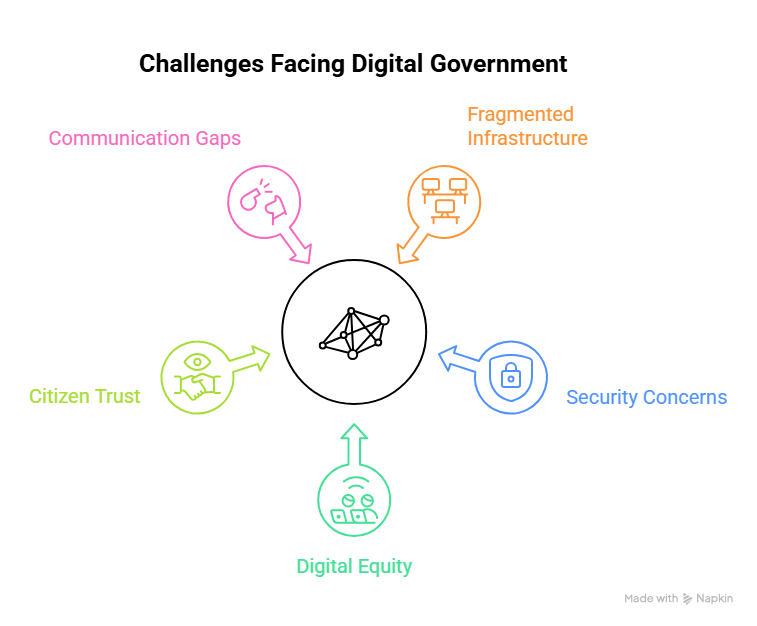
Before celebrating the wins, it’s important to understand the terrain. Public sector technology leaders from state and local government IT directors to federal CIOs consistently cite a common set of obstacles:
Fragmented legacy infrastructure: Most government apps are layered on top of decades-old backend systems. Integration is painful, data silos are pervasive, and modernization budgets are politically difficult to secure.
Security and identity verification: Unlike private apps, government platforms handle enormously sensitive data, such as tax records, health histories, and legal identities. This creates stringent security requirements that can slow UX improvements if not architected thoughtfully.
Digital equity and accessibility: Government services must work for everyone, including elderly citizens, non-English speakers, and those with disabilities. Many existing mobile apps for digital government fail these populations entirely.
Citizen trust deficits: After years of data breach headlines and opaque bureaucratic systems, many residents approach government apps with skepticism. Building trust requires more than good UI; it demands transparency, reliability, and genuine responsiveness.
Emergency communication gaps: The COVID-19 pandemic exposed catastrophic weaknesses in how governments push critical public alerts. Agencies relying solely on broadcast TV or physical signage to reach populations during fast-moving crises are dangerously behind the curve.
Emerging Tech Trends Solving the Problem
The public sector technology landscape in 2026 looks dramatically different from just three years ago. Here are the trends driving the most meaningful change:
1. Conversational AI and Public Sector Chatbots
The deployment of public sector chatbot software has moved well beyond FAQ bots. Modern AI assistants built for government use can handle benefits eligibility screening, permit application guidance, grievance intake, and even mental health triage referrals, all in natural language, across multiple languages, available 24/7.
New York City’s MyCity platform, for example, uses conversational AI to guide small business owners through licensing requirements, a process that previously required multiple agency visits. The system handles over 400,000 queries monthly and has reduced call center volume by 34%.
2. AI-Powered Public Warning Systems
Perhaps the highest-stakes application of AI innovation in mobile apps for government is emergency alerting. A modern Public Warning Platform Solution integrates geolocation targeting, behavioral data, multi-channel delivery (push notifications, SMS, in-app banners), and machine learning to ensure the right alerts reach the right people at the right time with message content adapted for clarity and urgency.
FEMA’s Integrated Public Alert and Warning System (IPAWS) has been upgraded with AI-driven targeting capabilities, and several EU member states have deployed similar systems that can push hyper-local alerts based on real-time disaster modeling.
3. Unified Digital Identity and Access Management
State and local government mobile access management has become a strategic priority. Citizens increasingly expect a single, secure identity layer that lets them access any government service, DMV, tax, health benefits, and court records without creating separate accounts for each agency.
Estonia’s X-Road infrastructure is the global gold standard here, enabling over 1,000 public and private sector organizations to exchange data securely under a single authenticated citizen identity. Several U.S. states are implementing Login.gov as their federated identity layer, with significant UX improvements reducing drop-off during authentication.
4. Predictive and Proactive Services
The most sophisticated government mobile apps are shifting from reactive (citizens request, government responds) to proactive (government anticipates needs and reaches out). Using AI to analyze life events, such as a new child, a change in employment, or an approaching license renewal, agencies can push relevant service offers to citizens before they even search.
The UK’s HMRC tax app proactively notifies citizens of relevant tax credit eligibility changes, increasing uptake of benefits by 21% in pilot regions.
Step-by-Step: How Governments Are Building Better Apps in 2026
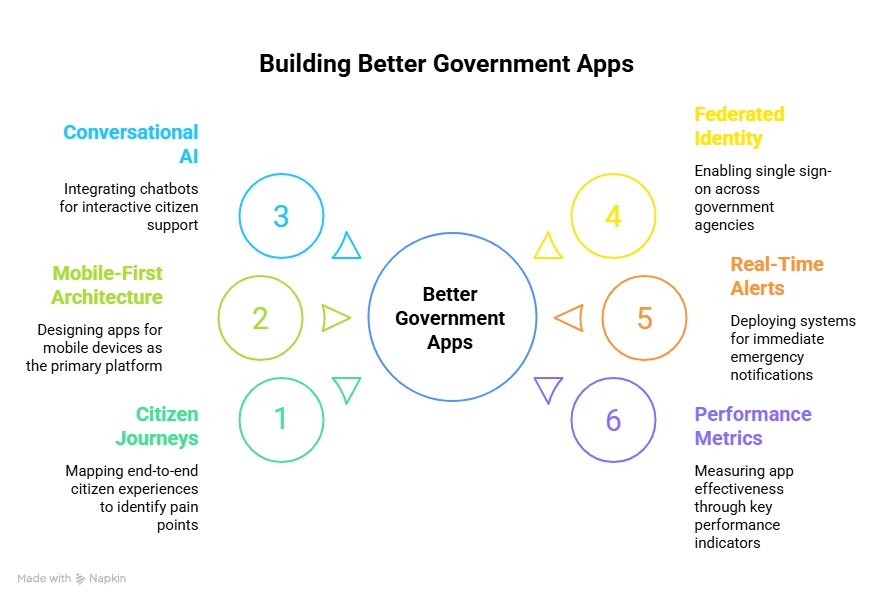
For technology and operations leaders at any level of government, here is a practical framework for modernizing digital services:
Step 1 Audit Citizen Journeys, Not Just Features: Map the full end-to-end experience for 3–5 high-volume services. Identify where citizens abandon processes and why. This data should drive your roadmap before a single line of code is written.
Step 2 Adopt a Mobile-First Architecture: Responsive web is no longer sufficient. Citizens are on phones. Design for small screens, intermittent connectivity, and one-handed use as the baseline experience, not an afterthought.
Step 3 Integrate a Conversational AI Layer: Partner with a specialized public sector app development company that understands government compliance requirements (ATO, FedRAMP, WCAG 2.1). Deploy chatbot capabilities tied to live service data, not static content.
Step 4 Implement Federated Identity: Eliminate siloed logins. Adopt standards-based identity frameworks (SAML, OAuth 2.0, OpenID Connect) to enable cross-agency state and local government mobile access management under a single citizen credential.
Step 5 Deploy a Real-Time Alert Infrastructure: Evaluate your current emergency communication stack against a modern Public Warning Platform Solution. Capability requirements should include geofencing, multi-language delivery, ADA-compliant formats, and integration with national alert systems.
Step 6 Measure What Matters: Task completion rate, time-to-service, and citizen satisfaction scores should be reported monthly. Vanity metrics like app downloads tell you nothing about whether the app actually works.
Real-World Use Cases: Government Apps Leading the Way
Singapore Singpass Super App: Singapore’s Singpass now serves 4.5 million users and integrates over 2,000 services from healthcare appointments to property transactions under a single biometric-authenticated identity. Its face verification technology meets both security and accessibility needs simultaneously, an achievement most Western governments are still working toward.
Estonia X-Road and e-Residency: Estonia handles 99% of government services digitally. Citizens can vote, file taxes, register businesses, and access medical records entirely via mobile. The architecture is open-source and has been exported to Finland, Japan, and several African nations.
Australia myGov App Redesign (2024–2025): After a scathing government audit of the original myGov portal, Services Australia led a ground-up redesign using behavioral research and agile development. The new app reduced average service completion time from 22 minutes to under 6 and achieved a citizen satisfaction rating of 78%, a 31-point jump from the prior platform.
U.S. VA Mobile App Suite: The Department of Veterans Affairs now offers a suite of mobile apps for digital government services that let veterans schedule appointments, manage prescriptions, access mental health resources, and communicate with care teams all from a single authenticated app. Over 2 million veterans actively use the platform monthly.
Best Practices & Expert Recommendations
Drawing from the leading implementations globally, here are the strategies that consistently separate excellent government apps from mediocre ones:
Work with a specialized public sector app development company, not a generic consumer agency. Government compliance, accessibility law, and security architecture require specific expertise that consumer-focused firms often underestimate.
Make accessibility a design requirement, not a compliance checkbox. WCAG 2.1 AA compliance should be validated with real users who have disabilities. Automated testing catches only ~30% of real accessibility issues.
Build in public by default. Open APIs, published performance dashboards, and transparent roadmaps build citizen trust and encourage civic tech innovation from the outside.
Prioritize offline functionality. Rural citizens and those with limited data plans need apps that work on intermittent connections. Core services should function with cached data.
Run continuous discovery. The best government UX teams conduct weekly user research sessions with real citizens, not just periodic usability studies.
Common Mistakes to Avoid
Even well-resourced agencies stumble in predictable ways. Watch out for these pitfalls:
Digitizing broken processes: Moving a confusing paper form into an app doesn’t improve the experience; it just changes the medium. Redesign the underlying process before digitizing it.
Treating accessibility as an afterthought: Retrofitting WCAG compliance into a finished app is expensive and often incomplete. Bake it into design and development from day one.
Neglecting change management: Apps fail not just from bad technology, but from internal resistance. Staff training, stakeholder communication, and clear ownership models are essential.
Underinvesting in integration: An app is only as useful as its backend data. Failing to connect front-end experiences to live, authoritative data sources produces a frustrating experience where citizens still have to call a phone number to complete their task.
Launching without a feedback loop: Many government apps ship without in-app feedback mechanisms or user research processes. Without continuous input, the app calcifies around its launch-day assumptions.
Conclusion: What Comes Next and Why It Matters
The trajectory is clear. By 2030, leading governments will deliver the majority of public services through AI-assisted, mobile-first platforms that know who you are, anticipate what you need, and get you there in minutes. Biometric authentication will replace passwords. Predictive AI will offer services before citizens know they need them. Emergency alerts will be hyper-personalized and delivered across every channel simultaneously.
But technology alone doesn’t create transformation. It requires leadership, investment, and a genuine commitment to building around citizen needs rather than government convenience.
The agencies winning today share a common characteristic: they chose the right partners. Working with a proven public sector app development company that brings together AI expertise, compliance knowledge, accessibility design, and civic sector experience is the single highest-leverage decision a government technology leader can make.
App Maisters Government is a leading public sector app development company specializing in building secure, accessible, and AI-powered government mobile apps for federal, state, and local agencies. From Public Warning Platform Solutions and public sector chatbot software to unified state and local government mobile access management systems.
Frequently Asked Questions
What are the best examples of AI-powered government mobile apps in 2025–2026?
Leading examples include Singapore’s Singpass for AI-driven identity verification, the U.S. VA app for personalized healthcare services, Australia’s myGov app for faster service delivery, and NYC’s MyCity platform, which uses conversational AI to assist with business licensing and citizen services.
How does a Public Warning Platform Solution work on mobile devices?
A Public Warning Platform Solution uses AI, geofencing, and multi-channel alerts to deliver emergency notifications via mobile apps, SMS, and other channels. It can target specific audiences, personalize messages, and send alerts within minutes of an incident.
What should I look for when choosing a public sector app development company?
Choose a company with government compliance expertise, accessibility experience, a strong public-sector portfolio, and proven integration capabilities with legacy systems. Ongoing user testing and citizen-focused design are also essential.
How does state and local government mobile access management differ from enterprise IAM?
Government access management must securely serve millions of citizens while supporting diverse user needs and strict identity standards. Unlike enterprise IAM, it focuses on public access, fraud prevention, and compliance with government security frameworks.
Can public sector chatbot software actually handle complex citizen service queries?
Yes. Modern AI-powered chatbots can assist with benefits eligibility, permit applications, appointment scheduling, multilingual support, and other complex services when connected to real-time government data sources.
What are the biggest UX mistakes in mobile apps for digital government?
Common mistakes include digitizing inefficient processes, neglecting accessibility testing, ignoring offline access, creating multiple agency logins, and lacking feedback channels. Successful apps prioritize continuous user research and improvement.