
Artificial intelligence can help government agencies and school districts process documents faster, improve constituent services, identify operational risks, and reduce repetitive administrative work. However, launching an AI pilot before the organization is ready can create inaccurate outputs, privacy incidents, procurement complications, staff resistance, and solutions that never progress beyond demonstration.
That is why agencies need a structured government AI readiness assessment before selecting a platform or issuing a solicitation.
AI readiness is not simply a question of whether an organization has enough data or an approved technology budget. It measures whether the agency has a suitable problem, reliable data, accountable leadership, appropriate infrastructure, defined safeguards, and a practical path from pilot to production.
For education technology leaders and school district administrators, the stakes are especially high. AI applications may interact with student records, instructional materials, accessibility needs, staff evaluations, or decisions affecting educational opportunities. A promising tool can quickly become a governance problem when ownership, acceptable use, and human oversight have not been established.
Why Government AI Readiness Matters in 2026
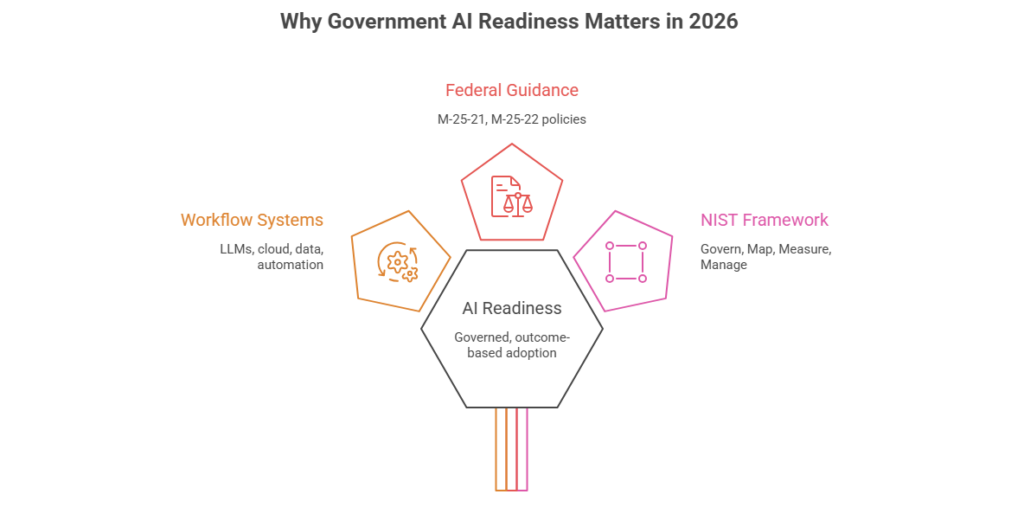
Public-sector organizations are moving from informal experimentation toward governed, outcome-based AI adoption. The most important shift is not simply the growth of generative AI. It is the emergence of smaller, workflow-specific systems that combine large language models, secure cloud environments, agency data, automation, and human review.
Current government AI trends include:
- Retrieval-augmented generation grounded in approved agency documents
- AI copilots for employees rather than fully autonomous decision-making
- Multimodal AI capable of interpreting text, images, forms, and audio
- Small and domain-specific language models for controlled environments
- Agentic AI for coordinating multistep administrative workflows
- Privacy-enhancing technologies and automated data classification
- Continuous AI evaluation, logging, and model-performance monitoring
- Modular procurement designed to reduce vendor lock-in
Federal guidance also emphasizes rapid adoption paired with risk management. OMB Memoranda M-25-21 and M-25-22 address federal AI use, governance, acquisition, competition, data portability, and vendor accountability. State agencies, local governments, and school districts are not automatically subject to every federal requirement, but these policies provide valuable procurement and governance benchmarks.
The NIST AI Risk Management Framework organizes AI risk activities into four practical functions: Govern, Map, Measure, and Manage. Its Generative AI Profile adds guidance for risks such as fabricated information, privacy exposure, cybersecurity threats, harmful bias, and overreliance on AI-generated content.
The 10-Step Government AI Readiness Checklist
1. Define the Public-Service Problem
Do not begin with “Where can we use AI?” Begin with a measurable operational problem.
A school district might face a five-day backlog in processing enrollment documents. A city may receive thousands of service requests that employees must manually classify. A health department may spend hundreds of staff hours searching policies and preparing routine responses.
Create a concise problem statement containing:
- The affected service or workflow
- Current processing time and cost
- Number of users or transactions
- Error, backlog, or abandonment rate
- Consequences for employees and residents
- Desired improvement
A strong first pilot addresses a narrow, repetitive, measurable process. Avoid beginning with high-impact decisions such as student discipline, benefits eligibility, law enforcement prioritization, or employee termination.
2. Establish Executive Ownership and Governance
Every pilot needs a named business owner, technical owner, data steward, security representative, legal or privacy reviewer, and frontline-user representative.
The steering group should approve:
- Permitted and prohibited AI uses
- Data-access boundaries
- Human-review requirements
- Risk classification
- Escalation procedures
- Pilot continuation or termination decisions
One practical approach is creating a small government AI innovation lab that provides a controlled environment for testing use cases. This does not need to be a new department. It can be a cross-functional working group operating with documented intake, evaluation, and approval procedures.
3. Inventory Existing and Shadow AI Use
Employees may already be using publicly available AI tools to summarize meetings, write reports, analyze spreadsheets, or generate instructional materials. An official pilot should not proceed without understanding this existing activity.
Conduct a short organization-wide inventory covering:
- Approved AI applications
- Unapproved or personally created accounts
- Departments and workflows using AI
- Information entered into external systems
- Existing vendor products containing embedded AI
- AI-related incidents or complaints
This inventory frequently reveals that the agency is not starting its AI journey. It is bringing existing experimentation under appropriate control.
4. Assess Data Readiness
AI performance depends on the quality, accessibility, relevance, and legal usability of the underlying data.
For the proposed use case, examine:
| Readiness area | Questions to answer |
|---|---|
| Availability | Does the required data exist in a usable digital format? |
| Quality | Is it complete, current, consistent, and accurately labeled? |
| Authority | Does the agency have permission to use it for this purpose? |
| Representation | Does it adequately represent affected populations and cases? |
| Sensitivity | Does it contain student, health, financial, biometric, or other protected data? |
| Integration | Can systems provide secure, reliable access through APIs or controlled pipelines? |
| Retention | How long may prompts, outputs, logs, and source records be stored? |
For school districts, reviews should account for FERPA, the Protection of Pupil Rights Amendment, state student-privacy requirements, records-retention rules, and applicable contractual restrictions.
The GAO AI Accountability Framework similarly highlights governance, data, performance, and monitoring as complementary foundations for accountable AI.
5. Classify Risk and Potential Impact
Not every AI system requires the same degree of review.
A low-risk pilot might help employees search approved policy documents. A moderate-risk application might draft correspondence that employees must verify. A high-impact system could influence access to services, educational placement, public safety, employment, or legal rights.
Assess:
- Who could be affected by an incorrect output?
- Can a person challenge or appeal the result?
- Will a qualified employee review the recommendation?
- Could the system create unequal outcomes?
- Can its sources and reasoning be examined?
- What happens when the model is unavailable or uncertain?
Higher-risk use cases require stronger testing, documentation, human control, and independent review. Some should not be selected as an organization’s first pilot.
6. Evaluate Infrastructure, Security, and Integration
The agency must determine where the AI system will run and how it will connect to existing technology.
Review:
- Cloud and on-premises hosting requirements
- Identity management and role-based access
- Encryption in transit and at rest
- Audit logs and security-event integration
- Data-loss-prevention controls
- API readiness
- Backup and disaster recovery
- Model and prompt configuration management
- Accessibility and multilingual requirements
- Exit and data-portability provisions
For generative AI, confirm whether agency data will be used to train vendor models, where prompts are processed, what subcontractors are involved, and whether administrators can control retention.
7. Prepare the Workforce
AI adoption fails when employees believe the system is being imposed on them or when they are expected to use it without understanding its limitations.
Training should cover:
- Appropriate and prohibited use
- Prompting and source verification
- Privacy and confidential-information handling
- Recognition of fabricated or misleading outputs
- Bias and accessibility considerations
- Incident reporting
- When human judgment must override AI
Education leaders should include teachers, instructional specialists, special education representatives, IT teams, families, and students where appropriate. The Department of Education’s toolkit addresses privacy, civil rights, data security, accessibility, and digital equity across ten implementation modules.
8. Select a Bounded, Valuable Pilot
A good pilot should be important enough to generate measurable value but limited enough to control risk.
Suitable first-pilot examples include:
- Searching and summarizing approved policies with citations
- Classifying non-emergency service requests for staff review
- Extracting information from standardized forms
- Producing first drafts of routine public communications
- Translating low-risk informational content with human verification
- Answering employee questions from approved internal knowledge bases
For example, a school district could deploy an internal AI assistant that searches board policies, HR procedures, and technology guidance. The assistant would answer only from approved documents, display its sources, restrict access by employee role, and direct uncertain questions to the appropriate department.
That is more manageable than deploying a public chatbot with unrestricted access to district systems.
9. Define Success, Safety, and Exit Criteria
A pilot is an experiment, not a small production launch. It needs documented evaluation criteria before testing begins.
Measure three categories:
| Category | Example measures |
|---|---|
| Operational value | Processing time, backlog reduction, employee hours saved, cost per transaction |
| Output quality | Accuracy, groundedness, citation correctness, completeness, false-positive rate |
| Public responsibility | Privacy incidents, demographic performance differences, accessibility, complaints, human overrides |
An AI knowledge assistant, for example, might require at least 90% citation accuracy, no disclosure of restricted data, a defined response-time target, and measurable improvement over the existing search process.
Also define stop conditions. The pilot should pause if it produces harmful advice, exposes protected information, fails agreed security testing, or performs materially worse for a particular population.
10. Build the Scale, Procurement, and Monitoring Plan
A successful demonstration does not automatically justify organization-wide deployment.
Before scaling, determine:
- Which integrations must become production-grade
- Who will monitor quality and security
- How model or vendor changes will be tested
- Whether users can report problematic outputs
- How costs will change with higher usage
- Who owns prompts, configurations, outputs, and custom components
- How data and configurations can be exported
- What happens if the vendor discontinues a model
- How frequently the system will be reevaluated
These controls turn a pilot into a sustainable capability. They are also central to the practical steps to implement AI in government, because deployment without continuous monitoring can allow accuracy, relevance, or fairness to deteriorate over time.
Quick AI Readiness Scorecard
Score each area from 0 to 2:
- 0: Not established
- 1: Partially established
- 2: Established and documented
| Readiness dimension | Score |
|---|---|
| Defined problem and baseline | /2 |
| Executive owner and governance | /2 |
| AI-use inventory | /2 |
| Data readiness | /2 |
| Risk and impact assessment | /2 |
| Security and infrastructure | /2 |
| Workforce preparation | /2 |
| Bounded pilot scope | /2 |
| Success and stop criteria | /2 |
| Scale and monitoring plan | /2 |
| Total | /20 |
A score of 16–20 generally indicates readiness for a controlled pilot. A score of 11–15 suggests that specific gaps should be resolved first. A score of 10 or below indicates that the organization should focus on foundational governance, data, and security work before deployment.
This score is a prioritization aid, not a compliance determination. Legal, privacy, civil-rights, procurement, and cybersecurity reviews must reflect the agency’s jurisdiction and use case.
Common Mistakes to Avoid
The most frequent AI pilot failures are managerial rather than technical:
- Buying a platform before defining the problem
- Using unreliable data without establishing quality standards
- Treating vendor claims as independent evidence
- Measuring usage instead of service outcomes
- Allowing AI to make consequential decisions without meaningful human review
- Ignoring accessibility, language access, and digital equity
- Running a pilot without a production budget or system owner
- Failing to document prompts, model versions, tests, and incidents
- Accepting contracts that permit unclear reuse of agency data
- Scaling before comparing results against a non-AI baseline
A credible public sector AI readiness assessment exposes these issues early, when they are less expensive and less disruptive to correct.
What Comes Next for Government AI
The next phase of AI transformation in the public sector will move beyond standalone chatbots. Agencies will increasingly use secure, workflow-integrated AI systems that retrieve trusted information, coordinate routine tasks, explain their outputs, and keep employees accountable for final decisions.
The strongest public organizations will not necessarily be those that adopt AI first. They will be those that select the right problems, establish evidence before scaling, protect public interests, and build reusable governance and technology foundations.
A readiness assessment provides that foundation. It helps an agency determine not only whether it can launch an AI pilot, but whether the pilot can deliver measurable public value without creating risks the organization is unprepared to manage.
How App Maisters Government Can Help
App Maisters Government helps public-sector organizations evaluate, design, and implement secure digital and AI-enabled solutions. Its approach can support agencies from initial readiness assessment and use-case prioritization through UX design, cloud architecture, application development, systems integration, testing, deployment, and post-launch support. For governments and school districts preparing their first AI initiative, App Maisters Government can help translate operational needs into a controlled pilot with clear performance measures, human oversight, security safeguards, and a practical path to responsible scale.
Frequently Asked Questions
What is a government AI readiness assessment?
A government AI readiness assessment evaluates whether a public agency has the strategy, governance, data, infrastructure, workforce capabilities, security controls, and performance measures required to implement AI responsibly. It identifies gaps that should be resolved before investing in an AI pilot or selecting a technology vendor.
How can a government agency determine whether it is ready for an AI pilot?
An agency is generally ready when it has a clearly defined problem, an accountable executive owner, reliable and legally usable data, documented security controls, trained users, human oversight, measurable success criteria, and a plan for ongoing monitoring. If these elements are incomplete, the agency should address them before deployment.
What is the best first AI pilot for a government agency?
The best first pilot addresses a narrow, repetitive, and measurable workflow with limited public risk. Suitable examples include searching approved policy documents, classifying service requests, extracting information from standardized forms, drafting routine communications, and helping employees locate internal information with source citations.
What data and privacy risks should agencies evaluate before using AI?
Agencies should evaluate whether the AI system will access personally identifiable information, student records, health information, financial data, biometric information, or confidential government records. They should also verify data ownership, retention periods, processing locations, access controls, encryption, vendor data-use policies, and whether agency data may be used to train external models.
How should governments measure the success of an AI pilot?
Governments should measure operational value, output quality, and public responsibility. Relevant metrics may include processing-time reduction, employee hours saved, accuracy, citation correctness, error rates, user satisfaction, accessibility, privacy incidents, human overrides, and performance differences across affected populations. These metrics should be defined before the pilot begins.
How long does a government AI readiness assessment take?
The timeline depends on the agency’s size, number of departments, data complexity, and proposed use case. A focused assessment for one pilot may take several weeks, while an organization-wide assessment can take several months. Agencies can accelerate the process by beginning with a single workflow, assigning responsible stakeholders, and gathering existing policies, system inventories, data documentation, and vendor contracts in advance.