Residents call about a pothole. They emailed about a late utility bill. They show up to a council meeting to ask why a permit is taking six weeks. Every one of these moments is a signal, but most local governments have no reliable way to collect that signal, let alone use it to make better decisions.
A civic engagement platform solves this by giving residents one place to interact with their government and giving staff one system to manage, track, and learn from those interactions. This guide explains what these platforms do, how 311 service request management fits in, and how a modern local government resident portal turns everyday resident contact into better policy and budget decisions.
What Is a Civic Engagement Platform?
A civic engagement platform is a digital system that lets residents interact with their local government online instead of through phone calls, walk-ins, or paper forms. Residents can report an issue, request a permit, pay a utility bill, or ask a question, and every one of those actions is logged, tracked, and routed automatically.
For government staff, the same platform becomes a shared workspace. Public works, code enforcement, utilities, and the clerk’s office all see the same resident record instead of working from separate systems that never talk to each other.
The Problem: Fragmented Systems Make Government Decisions Harder
In brief: Most local governments run separate systems for permits, billing, service requests, and records. This fragmentation hides patterns in resident needs, slows response times, and forces leaders to make budget and policy decisions with incomplete information.
Why Fragmentation Happens
Local governments rarely set out to build patchwork of software. It happens gradually. One department adopts a permitting tool. Another buys separate billing software. A third still tracks requests in a shared spreadsheet. Over time, no single person can see the full picture of how residents interact with the city or county.
This isn’t a staffing problem or a training problem. It’s a structural one: when every department owns its own system, there is no shared source of truth for leadership to draw from.
Who Feels the Impact
Residents feel it first, waiting on hold or resubmitting the same request twice. Frontline staff feel it next, manually re-entering data between systems. Ultimately, CIOs and administrators feel it most acutely, because they are asked to justify budget requests and service changes without the data to back them up.
The Solution: Connecting Residents and Departments Through One Platform
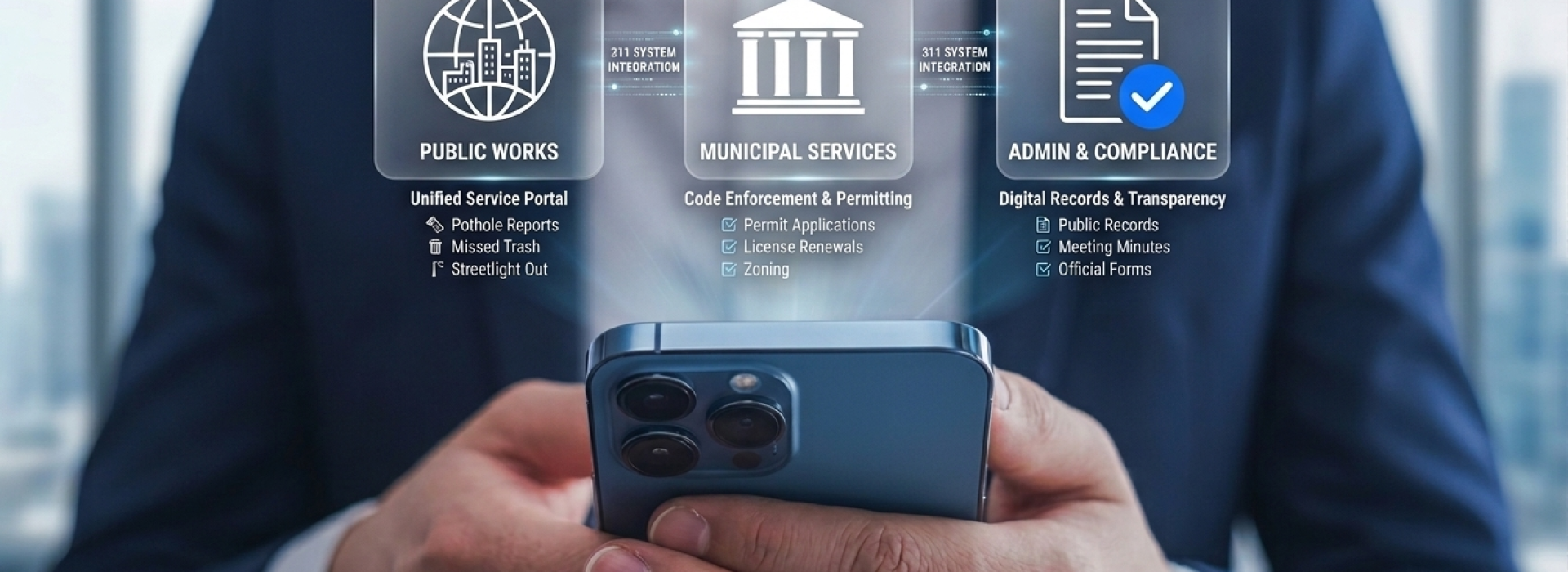
A local government resident portal addresses fragmentation by giving residents a single point of access and giving every department a shared view of that activity. Instead of a resident calling public works, then billing, then the clerk’s office separately, they log in once and see everything tied to their account in one place.
This matters for decision-making because a unified portal creates a single, structured dataset. When permit applications, utility payments, service requests, and public records requests all live in the same system, leadership can finally see trends across the entire organization instead of guessing based on anecdotal complaints.
Resident portal support also reduces the operational load on call centers and counter staff, since residents can check status, upload documents, and get answers without waiting for a callback. That frees staff time for the requests that genuinely need a human
How 311 Service Request Management Improves Response and Data Quality
In brief: 311 service request management routes resident-reported issues to the right department automatically, tracks them against service-level timers, and keeps a full record of what happened. This turns individual complaints into a structured, searchable dataset local governments can act on.
311 service request management is often the first thing residents notice about a civic engagement platform, because it replaces the old model of calling a general number and hoping the message reaches the right person.
How a Request Moves Through the System
- A resident submits a request through the portal or mobile app, selecting a category and location.
- The system automatically routes the request to the correct department based on category and geography.
- Staff receive the request with an attached service-level agreement (SLA) timer.
- The resident receives automatic status updates as the request moves through review, assignment, and resolution.
- Once resolved, the request and its full history are stored for reporting and audit purposes.
This structure does two things at once. It gets residents a faster, more transparent response, and it builds a clean dataset of what issues are being reported, where, and how quickly they’re resolved.
From Resident Input to Better Decisions: The Data Connection
Benefits of a resident portal for local government go beyond convenience. Every logged request, permit application, and payment becomes a data point that leadership can use.
A cluster of pothole reports in one neighborhood, for example, becomes visible as a pattern rather than a series of unrelated calls. A spike in permit delays in one department shows up in dashboards instead of surfacing months later as a council complaint. Budget requests can point to actual request volume and resolution times instead of estimates.
This is the practical difference between civic engagement as a communication tool and civic engagement as a decision-making tool. Technology matters less than what an organization does with the data it produces.
Checklist: Signs Your Government Is Ready for a Civic Engagement Platform
- Residents submit requests through more than one channel with no shared record
- Departments cannot see requests or permits handled by other departments
- Staff manually re-enter the same resident information across systems
- Leadership lacks reliable data to support budget or staffing decisions
- Response times to resident requests are inconsistent or untracked
- Public records requests take longer than your jurisdiction’s compliance window allows
What to Look for in a Civic Engagement Platform
Not every platform is built the same way, and civic engagement software for cities varies widely in scope and depth. The comparison below outlines the core distinction most agencies run into during evaluation.
| Feature | Point Solution (single-purpose tool) | Connected Civic Engagement Platform |
|---|---|---|
| Resident data | Siloed by department | Shared across departments |
| 311 request routing | Manual or partial automation | Automatic, SLA-tracked |
| Reporting | Department-level only | Organization-wide dashboards |
| Vendor contracts | One per function | Consolidated |
| Resident experience | Multiple logins and forms | Single portal login |
| Compliance (ADA/WCAG) | Varies by vendor | Built in by default |
Quick answer for featured snippets: A civic engagement platform is software that connects residents to local government services like permits, billing, and 311 requests through one portal, while giving staff a shared system to track and respond to that activity.
When evaluating a best civic engagement platform for counties or cities, ask vendors about their approach to security (role-based access, audit logging), accessibility (ADA/WCAG alignment), and how easily the platform expands as new departments come online.
Conclusion: Turning Resident Voices into Better Government
A civic engagement platform is not just a convenience upgrade for residents. It’s the infrastructure that lets local governments see patterns, respond faster, and make decisions based on what residents are experiencing rather than isolated complaints.
Maisters ServiceConnect™, App Maisters Government’s resident portal, brings 311 service request management, permitting, billing, and communication into one connected system built specifically for state and local government agencies, with resident portal support and onboarding included from day one.
If your agency is managing fragmented systems and limited visibility into resident needs, a scoped conversation is a reasonable next step. Schedule a demo of Maisters ServiceConnect™ to see how a connected resident portal could work for your organization.
Frequently Asked Questions
What is a civic engagement platform?
A civic engagement platform is software that connects residents to local government services, such as service requests, permits, billing, and public records, through a single online portal. It also gives staff a shared system to manage and respond to that activity, replacing disconnected tools across departments.
How is a civic engagement platform different from a government website?
A website mostly shares information in one direction. A civic engagement platform is interactive: residents can submit requests, track status, make payments, and receive updates, while staff manage that activity from a connected backend system.
What is 311 service request management?
311 service request management is the process of collecting, routing, and tracking resident-reported issues, like potholes or missed trash pickup, through a structured system. Requests are automatically sent to the right department and tracked against response-time goals.
Do civic engagement platforms help with government transparency?
Yes. By centralizing resident requests and department responses into shared dashboards, these platforms make response times, request volumes, and service trends visible to both staff and leadership, supporting more transparent reporting.
How long does it take to implement a resident portal?
The timeline depends on the number of modules and departments involved. Agencies starting with core services like 311 requests and permitting typically launch faster than those deploying every module at once. A vendor proposal should include a specific timeline based on scope.
Can smaller municipalities afford a civic engagement platform?
Most platforms are modular, letting smaller agencies start with core resident services and add features like utility billing or code enforcement later. This allows smaller municipalities to adopt technology without a large upfront investment.