
Introduction: The Line That Never Ends
It’s 8:47 a.m. on a Tuesday. A working mother of two walks into her local government service center to renew a business license. She takes a number 247. The display reads: Now serving 189. She’ll wait nearly two hours for a task that should take ten minutes.
This isn’t an isolated story. It’s the daily reality for millions of citizens worldwide. According to a 2025 Deloitte Public Sector Report, the average in-person wait time at government service centers globally sits at 47 minutes, with peak-day surges exceeding two hours. Phone queues are no better; citizens report average hold times of 22 minutes before reaching a live agent, only to be transferred again.
The cost isn’t just frustration. Governments lose an estimated $140 billion annually in productivity drag caused by citizen-facing service inefficiencies, according to McKinsey’s 2025 Government Efficiency Index. And for small business owners, caregivers, and hourly workers, every minute in that queue is money lost.
The good news? AI chatbots for government services are rewriting this story and fast.
Key Challenges Facing Government Service Centers
Before exploring solutions, it’s critical to understand why the problem persists despite decades of digital transformation attempts:
- Volume-Staffing Mismatch: Most government agencies were designed for predictable workloads. Today, citizen service demand spikes unpredictably tax season, benefits enrollment periods, pandemic-era relief programs, and hiring can’t keep pace.
- Legacy System Silos: Government databases often don’t talk to each other. A DMV agent might need to access four different platforms to answer one question about license renewal, creating internal bottlenecks that directly translate into longer citizen wait times.
- Repetitive, Low-Complexity Query Overload: Studies show that up to 70% of government service center queries are repetitive and low-complexity: “What documents do I need?” “What’s my application status?” “When is the office open?” Human agents handle these queries at significant cost when automation could resolve them instantly.
- Staff Burnout and Attrition: The monotony of answering the same questions hundreds of times per day contributes to high turnover in public sector service roles, which compounds the staffing problem into a self-reinforcing cycle.
Emerging Tech Trends Solving the Problem
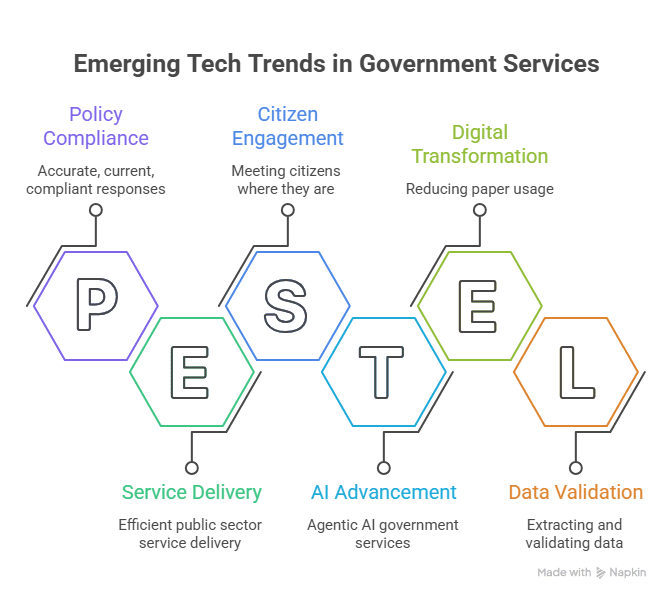
The convergence of several technologies in 2025–2026 has created an inflection point for public sector service delivery:
Agentic AI Government Services: The shift from reactive chatbots to agentic AI systems that can independently take multi-step actions is transforming what automation can accomplish. An agentic AI government services platform doesn’t just answer “What’s my application status?” It can check the database, identify a missing document, send the citizen a notification, and schedule a follow-up call, all without human intervention.
Multimodal AI Interfaces: Modern AI chatbots now handle text, voice, images, and documents in a single conversation. A citizen can upload a photo of their utility bill as proof of address directly in the chat interface the AI extracts and validates the data instantly.
Large Language Models (LLMs) with RAG Architecture: Retrieval-Augmented Generation (RAG) allows AI systems to pull from live government databases and policy documents, ensuring responses are accurate, current, and compliant, addressing the #1 historical failure point of government chatbots: outdated or incorrect information.
Omnichannel Deployment Leading: AI solutions for government agencies now deploy across web portals, WhatsApp, SMS, kiosk terminals, and voice IVR systems, simultaneously meeting citizens where they already are.
Step-by-Step Solutions: Deploying AI Chatbots in Government
Here’s a practical implementation roadmap for government agencies looking to deploy AI chatbot solutions effectively:
Step 1: Audit Your Query Taxonomy: Before deploying any AI, catalog the top 50 citizen queries by volume. Segment them by complexity. This audit will reveal that the majority of volume comes from a small set of repeatable questions and identify where automation delivers the fastest ROI.
Step 2: Choose the Right Architecture: Not all AI chatbots are equal. Agencies should evaluate:
- Rule-based bots (for highly structured, compliance-sensitive interactions)
- LLM-powered bots with RAG (for nuanced, dynamic citizen queries)
- Hybrid systems that escalate to human agents based on sentiment, complexity, or citizen preference
Step 3: Integrate with Backend Systems: A chatbot is only as good as the data it can access. Prioritize API integrations with your case management system, document portal, payment gateway, and scheduling platform. This is where most deployments stall. Invest in this layer upfront.
Step 4: Design for Accessibility and Equity: Government services serve everyone. AI chatbot deployments must support multiple languages, plain-language responses (targeting a Grade 8 reading level), voice interfaces for citizens with disabilities, and low-bandwidth fallbacks for underserved communities.
Step 5: Implement Human-in-the-Loop Escalation: The goal isn’t to eliminate human agents; it’s to elevate them. Build clear escalation logic that routes complex, sensitive, or frustrated citizens to a live agent with full conversation context pre-loaded. This dramatically reduces agent handle time even on escalated calls.
Step 6: Measure, Iterate, and Optimize: Deploy with a 90-day sprint mentality. Track: deflection rate, first-contact resolution rate, citizen satisfaction score (CSAT), and average handle time. Use these metrics to continuously fine-tune the AI’s responses and routing logic.
Real-World Use Cases
Estonia’s X-Road AI Layer: Estonia long the gold standard in digital government, integrating conversational AI into its X-Road data exchange platform in 2024. Citizens can now query benefits eligibility, tax status, and digital ID renewals through a single chat interface. Result: a 63% reduction in call center volume within six months of launch.
Singapore’s Singpass AI Concierge: Singapore’s national digital identity platform deployed an AI concierge capable of handling over 200 distinct query types across 15 government agencies. The system resolves 78% of citizen queries without human intervention, cutting average resolution time from 22 minutes to under 90 seconds.
Los Angeles County’s Benefits Navigation Bot: Faced with surging demand for social services post-pandemic, LA County deployed an AI chatbot for public sector benefits navigation in 2023, later upgrading to an agentic version in 2025. The bot guides citizens through eligibility checks, document submission, and appointment scheduling. It reduced in-person visit volume by 41% in the first year.
Dubai’s DubaiNow Super-App Integration: Dubai’s government super-app integrated generative AI to handle municipal service requests across 55 government entities. The AI processes requests in Arabic and English, with real-time translation for 12 additional languages. Average service resolution time dropped from 3.2 days to 4.7 hours.
Best Practices and Expert Insights
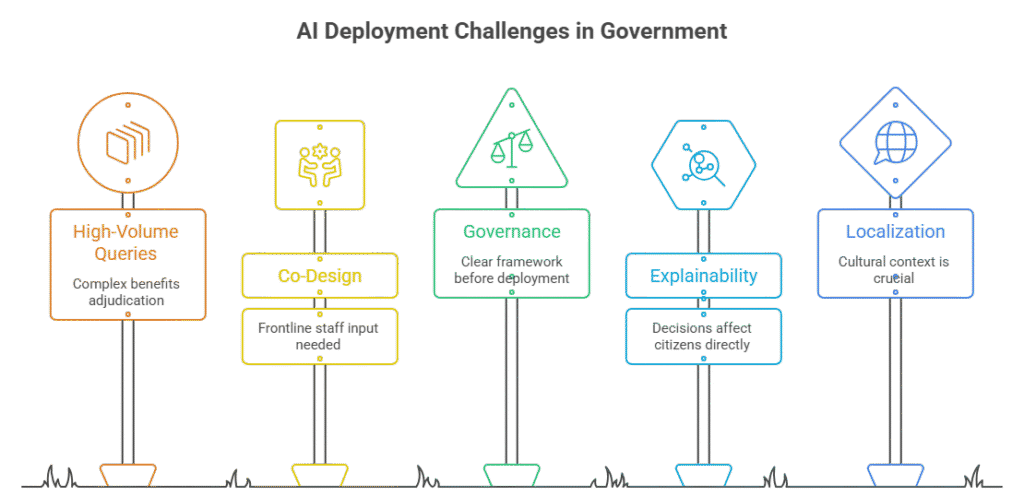
Start with High-Volume, Low-Risk Queries: Don’t begin your AI deployment with complex benefits adjudication or legal compliance queries. Start with FAQs, office hours, document checklists, and status lookups. Build citizen trust before expanding the scope.
Co-Design with Frontline Staff: Government service agents know what citizens actually ask and how they ask it. Their input in designing conversation flows dramatically reduces the gap between what the AI is trained on and real-world query patterns.
Governance Before Go-Live: Establish a clear AI governance framework before deployment: who owns model updates, how errors are reported, what triggers a rollback, and how citizen data is protected. In the public sector, trust is the product. Protect it.
Invest in Explainability: Citizens and oversight bodies will ask Why did the AI say that? Ensure your AI automating government portals platform provides explainability logs, especially for decisions that affect benefits, fines, or applications.
Localize, Don’t Just Translate: Language support isn’t just about translation. It’s about cultural context, local terminology, and regional policy variations. A chatbot serving a multilingual city must understand that “SNAP benefits” and “food stamps” mean the same thing to different citizens.
Common Mistakes to Avoid
Mistake #1 Deploying Without Change Management: Agencies that roll out AI without preparing frontline staff for the transition face internal resistance that undermines adoption. Agents fear job loss; managers resist new workflows. Invest in change management as seriously as you invest in the technology.
Mistake #2 Treating the Chatbot as a Finished Product: AI chatbots degrade over time without continuous retraining. Policy changes, new programs, and evolving citizen language patterns mean your bot from 18 months ago may be confidently giving wrong answers today.
Mistake #3 Over-Automating Sensitive Interactions: AI is not appropriate for every government interaction. Grief-adjacent services (death certificates, domestic violence resources), mental health referrals, and complex legal disputes require human empathy that no current AI can replicate. Define these boundaries clearly before launch.
Mistake #4 Ignoring the Analog Citizen: Not everyone has a smartphone or reliable internet. An AI strategy that ignores walk-in citizens, phone-only households, and digitally excluded populations will widen inequality rather than close it. Design hybrid service models that let AI and in-person service coexist.
Conclusion:
The trajectory is clear. By 2028, the government service center experience will look fundamentally different. Most citizens will resolve their queries in under three minutes through an AI interface that knows their history, anticipates their needs, and proactively notifies them before problems arise. Human agents will handle only the most complex, sensitive, and high-value interactions, a role that is more meaningful, not less.
The agencies winning this transition aren’t just deploying technology. They’re redesigning service philosophy: from reactive queue management to proactive, citizen-centered digital service delivery.
AI chatbots for government aren’t a future aspiration; they’re a present-day operational imperative. The question for public sector leaders is no longer whether to deploy, but how fast and how thoughtfully.
At App Maisters Government, we apply a philosophy to public sector digital transformation. That means holding government service delivery to the same standards of speed, personalization, and efficiency that citizens experience in their best private sector interactions.
Our team has designed and deployed AI solutions for government agencies across municipal, state, and federal contexts, from intelligent intake systems to fully agentic case management bots. We specialize in building AI that is not just powerful, but equitable, explainable, and built for public trust.
Frequently Asked Questions
How do AI chatbots reduce wait times in government service centers?
AI chatbots reduce wait times by instantly handling common questions like document requirements, application status, and office timings. These repetitive queries usually overload call centers and front desks. By deflecting 60–70% of routine requests to self-service AI, staff can focus on complex cases, which leads to faster responses and shorter queues for citizens.
Are AI chatbots for government services secure and compliant?
Yes, when properly built and managed. Government AI chatbots follow strict standards like GDPR, HIPAA, and FedRAMP depending on data type. They use encryption, secure APIs, access controls, and audit logs to protect sensitive information, while new frameworks like FedRAMP 20x are improving safe and faster AI adoption.
What types of government services can AI chatbots handle?
AI chatbots can support a wide range of public services, including permits, benefits checks, license renewals, appointments, and application tracking. Some advanced systems also handle transactions and cross-department queries, similar to tools being tested in the UK and Ukraine’s Diia platform.
How much can AI automation save government agencies?
AI automation can deliver major time and cost savings. Studies suggest up to 96.7 million to 1.2 billion work hours can be saved annually in federal operations, translating into $3.3 to $41.1 billion in potential savings, while also improving efficiency and reducing manual workload.
How widely are governments adopting AI chatbots right now?
Adoption is growing quickly across global governments. Around 43% of public-sector employees were already using AI by 2025, up from 17% in 2023, and experts expect 60% of government organizations to prioritize automation by 2026 as countries like the U.S., UK, and India scale national AI systems.
What are the risks of using AI chatbots in government services?
AI chatbots improve efficiency but also bring risks such as errors in decision-making and unclear accountability in government contexts. There is also automation bias, where humans over-trust AI outputs, so governments reduce risks through human review systems, explainability logs, and strong governance frameworks.