
Government applications are essential to delivering public services, from benefits enrollment and healthcare access to permit applications and citizen service requests. However, digital transformation creates a critical responsibility: ensuring every individual, including people with disabilities, can use these services effectively.
For federal agencies, Section 508 compliance is a legal requirement that directly affects application development, procurement, and technology modernization.
The challenge remains significant. The General Services Administration’s FY 2025 Governmentwide Section 508 Assessment, published in March 2026, found that agencies reported an average accessibility conformance score of just 1.96 out of 5. Approximately half of agencies did not routinely test their information and communication technology for accessibility.
These findings highlight an important problem: government technology may be digitally advanced without being accessible.
For agencies investing in government web application development, integrating Section 508 requirements from the beginning can reduce costly remediation, improve usability, and ensure broader access to essential public services.
What Is Section 508 Compliance?
Section 508 is part of the Rehabilitation Act of 1973. It requires federal agencies to ensure that covered information and communication technology (ICT) is accessible to individuals with disabilities, unless an applicable exception applies.
The requirement covers technology federal agencies develop, procure, maintain, or use, including:
- Government websites and citizen portals
- Mobile applications and self-service platforms
- Internal employee software and administrative dashboards
- Electronic documents and digital forms
- Information kiosks and other covered ICT
- AI-powered interfaces and digital communication systems
For example, a citizen using a screen reader should be able to access an online benefits portal, complete the application, upload required documents, and receive submission confirmation without encountering inaccessible controls.
Section 508 compliance therefore goes beyond visual design. It ensures government technology supports meaningful interaction regardless of a user’s visual, auditory, physical, or cognitive abilities.
Section 508 vs. WCAG: What Government Agencies Must Understand
Section 508 and the Web Content Accessibility Guidelines (WCAG) are closely related, but they serve different purposes.
Section 508 establishes federal accessibility obligations, while WCAG provides technical success criteria for accessible digital content.
The Revised Section 508 Standards incorporate WCAG 2.0 Level A and AA requirements for covered web content and software, alongside additional applicable provisions.
| Standard | Purpose | Agency consideration |
|---|---|---|
| Section 508 | Federal accessibility requirements | Mandatory for covered federal ICT |
| WCAG 2.0 AA | Technical accessibility criteria | Incorporated into the Revised Section 508 Standards |
| WCAG 2.1 AA | Expanded accessibility guidance | Useful for modern mobile and responsive interfaces |
| WCAG 2.2 AA | Additional modern accessibility criteria | Recommended design target where appropriate |
| ADA Title II | Accessibility requirements for public entities | Particularly relevant to state and local government applications |
Important distinction: WCAG 2.2 AA is not automatically the legal baseline for federal Section 508 compliance in 2026. Agencies should evaluate applicable requirements while adopting newer accessibility practices where feasible.
Why Section 508 Compliance Is Challenging for Federal Agencies
Despite established accessibility standards, government agencies continue to face implementation challenges.
The FY 2025 federal assessment identified testing and remediation as particularly weak areas, with agencies placing greater emphasis on website accessibility than on software, hardware, and other ICT.
Legacy government applications
Many federal systems were developed before current accessibility practices became standard.
Common problems include inaccessible navigation, outdated interface components, poorly structured documents, and software that does not communicate correctly with assistive technologies.
Practical solution: Conduct an accessibility inventory, identify mission-critical applications, and prioritize remediation based on public impact and workflow severity.
Agencies pursuing federal IT modernization should integrate accessibility requirements into modernization planning rather than treating them as a separate upgrade.
Accessibility testing occurs too late
Accessibility issues discovered immediately before launch can require major interface changes, additional testing, and revised delivery schedules.
Practical solution: Establish measurable accessibility acceptance criteria during requirements gathering, validate interface designs before development, and conduct accessibility regression testing throughout implementation.
Limited accessibility expertise
Development teams may understand conventional software testing but lack experience with assistive technologies, accessible interaction patterns, or Section 508 documentation.
Practical solution: Provide accessibility training, use established testing methodologies, and involve accessibility specialists when evaluating complex workflows.
Key Section 508 Requirements for Government Applications
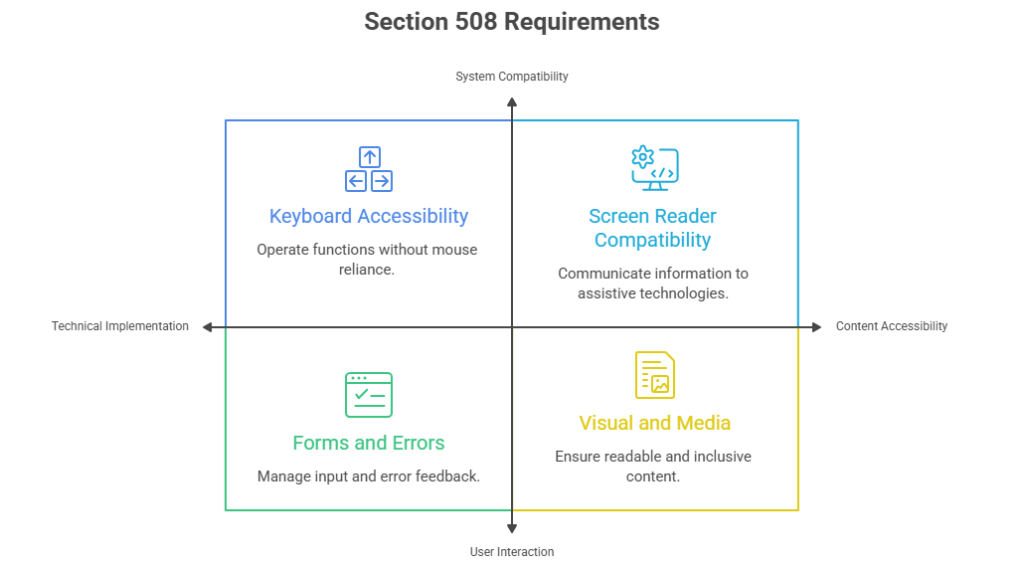
Building accessible government applications requires attention to several critical technical areas.
1. Keyboard accessibility
Citizens and government employees must be able to perform applicable functions without relying on a mouse.
Navigation menus, forms, buttons, and interactive components should support keyboard operation with a logical focus sequence.
For example, a government licensing portal should allow users to complete an application using keyboard controls without becoming trapped in dropdown menus or modal windows.
2. Screen reader compatibility
Applications must communicate meaningful information to assistive technologies.
Developers should implement semantic HTML, accessible labels, proper heading structures, and appropriate interface roles and states.
Native mobile applications should use relevant operating-system accessibility APIs.
Government teams should test with screen readers such as JAWS, NVDA, VoiceOver, and TalkBack.
3. Accessible forms and error handling
Online forms are among the most critical components of government service delivery.
Accessible forms should provide descriptive field labels, clear instructions, understandable errors, and appropriate focus management.
For example, when a citizen submits an incomplete tax or benefits form, the system should identify missing information and explain how to correct it.
4. Color contrast and readable content
Government applications should provide readable text, sufficient contrast, meaningful headings, and layouts that remain usable when users enlarge content.
WCAG AA generally requires a minimum 4.5:1 contrast ratio for normal text, with specified exceptions.
Information should never depend entirely on color. An application status labeled only by a green or red indicator may be difficult to interpret for users with certain visual disabilities.
5. Accessible documents and multimedia
Government applications frequently contain downloadable PDFs, public notices, videos, and electronic forms.
These materials may also require accessible document structure, appropriate reading order, meaningful alternative text, captions, and other relevant accommodations.
An accessible website does not automatically make every document hosted on it accessible.
How to Integrate Section 508 Into Government Application Development
Accessibility should be part of the software development lifecycle rather than a final-stage compliance exercise.
| Development phase | Recommended action | Deliverable |
|---|---|---|
| Requirements gathering | Identify relevant Section 508 requirements and critical user tasks | Accessibility requirements matrix |
| UX/UI design | Evaluate navigation, contrast, forms, and interaction patterns | Accessible design prototypes |
| Development | Implement semantic controls and assistive technology support | Accessible software components |
| Quality assurance | Perform automated, manual, and screen reader testing | Accessibility defect reports |
| Deployment | Verify critical workflows and resolve release-blocking issues | Acceptance evidence |
| Maintenance | Retest updates and monitor accessibility regressions | Ongoing conformance records |
This approach is particularly important for government mobile application development, where accessibility must account for touch interactions, screen readers, device orientation, scalable text, and platform-specific behavior.
For example, an emergency notification application should provide alerts that can be understood without relying exclusively on sound, vibration, or color.
Real-World Use Cases of Accessible Government Applications
Federal benefits and assistance portals
A benefits application may require citizens to complete lengthy forms, authenticate their identity, and submit supporting documents.
Without accessible controls, individuals using assistive technologies may struggle to complete the process.
Recommended approach: Introduce accessible form validation, logical navigation, meaningful status announcements, and compatible document upload controls.
Expected benefit: More citizens can complete applications independently, potentially reducing avoidable support requests.
Government employee management systems
Accessibility also applies to covered internal government technology.
Human resources platforms, training systems, case management tools, and employee dashboards should support accessible navigation and data interaction.
Recommended approach: Test core employee workflows using keyboard navigation and relevant screen readers before system acceptance.
Expected benefit: Employees with disabilities gain more equitable access to essential workplace functions.
Citizen-facing government mobile applications
Mobile government applications may support public transportation, inspections, emergency communications, or municipal service requests.
Recommended approach: Implement accessible touch targets, dynamic text scaling, meaningful screen reader announcements, and consistent navigation.
Expected benefit: Citizens can access essential public services across devices and interaction methods.
Section 508 Testing: How Agencies Can Validate Accessibility
Testing should establish whether users can successfully complete essential tasks, not simply whether software passes an automated scan.
A comprehensive approach includes three testing methods.
Automated accessibility testing: Tools such as axe-core, Accessibility Insights, and Pa11y can identify detectable issues involving labels, contrast, markup, and interface structure.
Manual accessibility testing: Reviewers evaluate keyboard navigation, focus management, error recovery, meaningful reading order, and workflow usability.
Assistive technology testing: Teams validate application behavior using relevant screen readers, browsers, operating systems, and devices.
The U.S. Access Board also provides an ICT Testing Baseline for Web to support more consistent evaluation against the Revised Section 508 Standards.
Agencies should maintain test evidence identifying the accessibility criterion, affected workflow, severity, remediation owner, and retest result.
Useful program metrics include critical-workflow accessibility pass rates, unresolved high-severity defects, test coverage, and remediation completion time.
Section 508 Compliance in Government Software Procurement
Accessibility requirements should be evaluated before a government agency purchases or accepts new software.
Federal procurement teams should require vendors to explain how accessibility is incorporated into the design, development, testing, and maintenance process.
Key procurement considerations include:
- Accessibility requirements incorporated into solicitation documents.
- An Accessibility Conformance Report (ACR) using an appropriate VPAT template.
- Evidence supporting the vendor’s reported conformance.
- Documented accessibility limitations and corrective actions.
- Contractual acceptance criteria and remediation responsibilities.
- Accessibility regression testing for future software updates.
A completed VPAT-based ACR is a vendor conformance statement, not an official government accessibility certification.
Agencies should also distinguish accessibility from cybersecurity compliance. Meeting Section 508 requirements does not establish conformance with FedRAMP, FISMA, NIST security controls, or other applicable security obligations.
Emerging Accessibility Trends in Government Technology
AI-assisted accessibility evaluation
AI-powered development tools can help identify potentially inaccessible components, analyze interface patterns, and assist remediation teams.
However, automated analysis cannot replace human judgment or functional assistive technology testing.
Accessible AI-powered citizen services
As agencies explore AI chatbots and automated public-service assistance, accessibility requirements extend to conversational interfaces.
Government chatbots should support keyboard navigation, readable responses, meaningful status announcements, accessible error recovery, and a clear path to human assistance.
Continuous accessibility validation
More mature software delivery practices incorporate accessibility checks into continuous integration and deployment pipelines.
Automated testing can identify regressions after software changes, while scheduled manual evaluations verify critical workflows.
This helps agencies maintain accessibility as applications evolve.
Section 508 Compliance Checklist for Federal Agencies
Before deploying or modernizing an application, agencies should verify the following:
- Applicable Section 508 requirements have been identified and documented.
- Essential workflows are accessible using keyboards and assistive technologies.
- Forms and interactive controls provide meaningful labels and errors.
- Text, contrast, zoom, and layout accessibility have been evaluated.
- Relevant electronic documents and multimedia are accessible.
- Automated and manual accessibility testing has been completed.
- High-impact accessibility defects have documented corrective actions.
- Procurement and acceptance documentation contains accessibility evidence.
- Accessibility testing is included in maintenance and release management.
These checks should support a documented evaluation against applicable standards rather than substitute for one.
Build Accessible Government Applications With App Maisters Government
Section 508 compliance should be part of how government applications are planned, developed, evaluated, and maintained.
For agencies, the objective extends beyond meeting technical standards. Accessible digital services help citizens interact independently with government programs and enable employees to perform essential work.
App Maisters Government supports federal, state, and local government organizations through secure, scalable, and accessibility-focused web and mobile application development.
Our government technology services include application modernization, custom software development, systems integration, and digital solutions designed around public-sector operational requirements.
Whether your agency is developing a new citizen portal, modernizing an internal platform, or improving existing digital services, incorporating accessibility from the beginning can help reduce implementation risks and support long-term usability.
Frequently Asked Questions
Is Section 508 compliance mandatory for federal government software?
Yes. Section 508 generally applies to covered ICT that federal agencies develop, procure, maintain, or use, subject to applicable exceptions. This includes many websites, mobile applications, enterprise systems, and electronic documents.
Does Section 508 apply to state and local government applications?
Section 508 primarily governs federal agencies. State and local governments have separate obligations, including applicable ADA Title II rules and state accessibility requirements. Federal funding conditions and contracts may also introduce additional requirements.
Is WCAG 2.2 AA required for government applications in 2026?
The Revised Section 508 Standards incorporate WCAG 2.0 Level A and AA. WCAG 2.2 AA provides additional accessibility guidance and may be adopted as a project requirement, but it is not automatically the federal Section 508 baseline.
Can an automated accessibility scanner prove Section 508 compliance?
No. Automated tools can identify many technical accessibility defects, but manual testing and assistive technology evaluation are necessary to assess complete interactions and application workflows.
What documents should agencies request from software vendors?
Agencies should request a relevant Accessibility Conformance Report, documented testing evidence, known accessibility limitations, and a remediation plan where gaps remain. These documents support procurement evaluation and acceptance decisions.