Mobile devices are changing how residents access government services, report local issues, and communicate with public agencies. According to Pew Research Center’s 2026 findings, 91% of U.S. adults own a smartphone, making mobile access an important consideration for modern public service delivery.
For government agencies, however, mobile accessibility involves more than launching an application. Residents expect convenient ways to submit service requests, receive emergency notifications, access public records, and complete routine transactions without unnecessary delays. Meeting these expectations requires secure, accessible, and well-integrated digital services.
As government mobile app trends evolve in 2026, agencies are placing greater emphasis on mobile-first service design, connected government systems, AI-assisted support, and measurable citizen experiences. This article examines the latest adoption trends, real-world government mobile app examples, service delivery benefits, and implementation considerations shaping the future of digital government.
The Rise of Mobile Apps in Government
Citizen Expectations Are Increasingly Mobile-First
Smartphones have become a primary way for residents to access information, manage appointments, and complete everyday transactions. This behavior is also influencing expectations for government services. Whether someone needs to report a pothole, renew a permit, or check a utility bill, convenient mobile access can reduce unnecessary steps.
However, mobile-first service delivery does not always require a standalone application. Government agencies must consider how frequently residents use a service, what mobile capabilities are needed, and whether an accessible mobile website can meet the same needs.
Government Agencies Are Expanding Mobile Service Delivery
Federal, state, and local governments are using mobile applications and responsive digital platforms to make public services more accessible. Common applications include 311 service requests, utility payments, public transportation information, emergency communications, permit tracking, and benefit services.
Rather than developing separate digital experiences for every department, agencies are increasingly considering integrated service platforms that provide residents with a consistent way to access government information and transactions.
Mobile Traffic Is Reshaping Government Digital Services
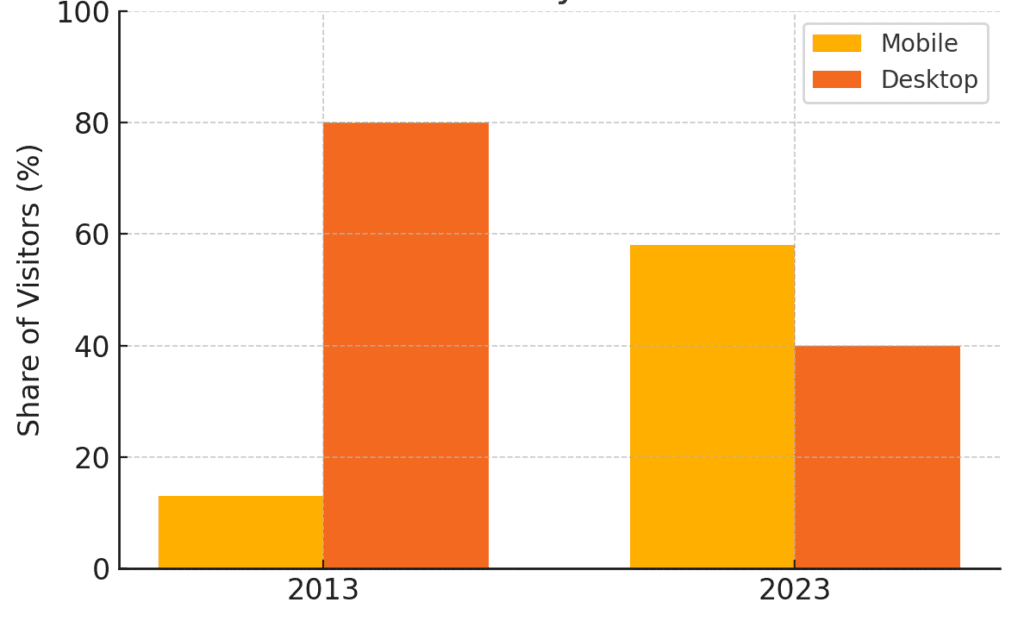
Mobile access has become a major consideration in public-sector website and application design. Digital.gov’s analysis of federal website traffic documented how visits from mobile devices increased substantially over the preceding decade.
This growth reinforces the need for responsive interfaces, accessible forms, simplified navigation, and reliable mobile performance. It does not necessarily mean every government agency needs a native app. The most appropriate solution depends on user needs, service complexity, and the capabilities of the existing digital infrastructure.
Mobile Government Is Part of a Global Digital Transformation
Mobile service delivery is also developing alongside broader efforts to make government services more connected and user-centered. The OECD Digital Government Outlook 2026 emphasizes integrated service channels, trusted data sharing, digital identity, and continuous performance improvement.
For government agencies, the priority is moving beyond isolated applications toward connected digital experiences. Mobile platforms can support this transformation by giving residents convenient access to services while allowing agencies to coordinate workflows across departments.
Key Government Mobile App Trends in 2026
Government mobile applications are evolving from basic informational tools into connected service platforms. The most important trends focus on simplifying resident interactions, improving accessibility, and integrating mobile channels with existing government operations.
1. Integrated Citizen Service Platforms
Government agencies are exploring ways to bring multiple services into a unified digital experience. Instead of requiring residents to navigate separate systems for permits, utilities, public records, and service requests, integrated platforms can provide a more consistent entry point.
These solutions may connect mobile applications with customer relationship management systems, geographic information systems, payment platforms, and departmental databases. The goal is to simplify service access without duplicating backend operations.
2. AI-Assisted Citizen Support
Artificial intelligence is becoming an additional tool for improving digital government interactions. Mobile applications can incorporate AI-powered assistants to answer common questions, explain application requirements, or guide residents toward appropriate services.
For example, an AI assistant could help a resident identify the correct permit application or locate instructions for reporting a municipal issue. Agencies must establish safeguards for accuracy, privacy, accessibility, escalation, and human oversight before deploying these capabilities.
3. Real-Time Government Communication
Mobile applications can help agencies communicate service interruptions, emergency information, road closures, appointment reminders, and application updates.
Push notifications are particularly useful for time-sensitive information, provided residents can manage their preferences. Public agencies should also maintain alternative communication channels because mobile notifications depend on device settings, connectivity, and user enrollment.
4. Accessibility and Inclusive Mobile Design
Accessibility is increasingly important in government mobile app development. Agencies must consider screen reader compatibility, clear navigation, readable content, accessible forms, and support for residents with different language and technology needs.
Mobile services should be designed to reduce barriers rather than create additional ones. Accessibility testing should therefore be included throughout design, development, and maintenance.
5. Data-Driven Service Improvement
Government mobile applications can provide agencies with information about how residents use digital services. Metrics such as transaction completion, service request volume, abandonment rates, and support inquiries can help identify areas needing improvement.
When used responsibly, these insights can support better service design and more informed operational decisions. The emphasis is shifting from counting downloads toward understanding whether residents can successfully complete essential government tasks.
Service Impact: Benefits and Outcomes
Government mobile applications can improve public service delivery by simplifying transactions, connecting residents with departments, and reducing unnecessary administrative steps. Their effectiveness, however, depends on how well digital services integrate with existing agency workflows and respond to residents’ needs.
Improved Citizen Satisfaction and Convenience
Mobile apps give residents more flexibility to access public services without visiting an office or waiting for assistance during business hours. Common tasks such as submitting requests, checking application status, and receiving appointment reminders can be completed from a mobile device.
A well-designed application can also reduce confusion by providing clear instructions, accessible navigation, and timely updates. Rather than relying on downloads alone, agencies should evaluate satisfaction through resident feedback, successful transactions, and repeat usage.
Faster Service Requests and Issue Resolution
Government mobile apps can simplify reporting and tracking of non-emergency issues such as potholes, damaged streetlights, missed waste collection, and maintenance problems.
Residents can submit information directly, including photographs and location details. When integrated with a service management platform, these requests can be assigned to appropriate departments, tracked, and updated as work progresses.
The potential benefit is a more organized service process with fewer manual handoffs. Actual improvements in resolution times should be measured against an agency’s performance before implementation.
Greater Operational Efficiency
Mobile applications can support government efficiency by reducing paper-based processes, duplicate data entry, and routine administrative inquiries.
For example, digital permitting, online payments, inspection reporting, and appointment scheduling can allow employees to focus on requests requiring specialized attention. Mobile access can also support field staff who need to review assignments, update work orders, or collect information while away from their desks.
These improvements are most effective when applications are connected with existing government systems rather than operating as separate tools.
More Inclusive Access to Government Services
Mobile services can expand access for residents who prefer smartphones or have limited opportunities to visit government offices.
However, accessibility requires more than providing a downloadable application. Government mobile platforms should support assistive technologies, clear language, accessible forms, and alternative service channels.
Agencies must also consider residents with limited connectivity, older devices, language barriers, or lower digital literacy. Providing multiple accessible ways to complete a service helps prevent digital transformation from excluding the people it is intended to serve.
Stronger Communication and Transparency
Mobile applications give agencies additional ways to communicate with residents through service updates, appointment reminders, emergency notifications, and community announcements.
For example, a resident who submits a maintenance request can receive confirmation when the request is accepted, assigned, and completed. This visibility can reduce uncertainty and make public-service processes easier to understand.
Government agencies should establish clear notification policies, respect user preferences, and avoid relying exclusively on push alerts for critical communications.
Together, these benefits demonstrate how government mobile apps can support responsive, accessible, and coordinated public services when designed around real operational needs.
Real-World Examples of Government Mobile Applications
Government mobile apps are already being used to support municipal operations, federal benefits, and direct communication with residents. The following examples demonstrate how public agencies use mobile technology to simplify common services.
Boston's BOS:311 App: Simplifying Municipal Service Requests
The City of Boston’s BOS:311 application allows residents to report non-emergency issues and follow the status of their requests.
In November 2026, Boston announced an update designed to make reporting easier through a streamlined interface, location information, photo submission, and improved accessibility.
The application demonstrates how government mobile apps can connect resident reporting with established municipal service workflows.
Key takeaway: Government apps can improve the service experience by simplifying how residents submit and monitor requests.
NYC 311: Connecting Residents with City Services
New York City’s NYC 311 mobile application allows residents to submit service complaints and requests, track their status, and access citywide alerts.
Instead of requiring residents to identify the responsible department for every issue, the service provides a central channel for accessing municipal assistance.
Key takeaway: A unified mobile service experience can make government services easier to navigate and reduce confusion about where requests should be submitted.
VA Health and Benefits: Integrating Federal Services
The U.S. Department of Veterans Affairs provides a mobile application that allows eligible users to access health and benefits information, review claim status, manage appointments, communicate with care teams, and use additional self-service features.
In July 2026, the VA announced that more than 4.6 million Veterans were using the VA Health and Benefits application. The agency also introduced additional features for accessing lab results and managing certain benefit-related debts.
Key takeaway: Integrated mobile platforms can bring several frequently used government services into a consistent digital experience.
These examples illustrate an important principle: successful government mobile applications focus on clearly defined public needs and connect those needs with reliable agency operations.
Native Mobile Apps vs. Mobile-Friendly Government Websites
Government agencies do not necessarily need a dedicated mobile application for every public service. The decision should depend on how residents use a service, the functionality required, and the resources available for ongoing support.
A mobile-responsive government website is often suitable for informational services, public notices, document access, and occasional transactions. Residents can access these services through their browser without installing another application.
A dedicated government mobile app may be more appropriate when services require frequent interaction, personalized notifications, device capabilities, or limited offline functionality.
For example, a municipal website may be sufficient for viewing council agendas or reading public announcements. A dedicated application may provide greater value for residents who regularly report issues, monitor requests, receive location-specific alerts, or manage recurring service transactions.
Before selecting an approach, agencies should evaluate:
- Service frequency: How often will residents need the service?
- Mobile functionality: Are camera access, location services, notifications, or offline features required?
- System integration: Will the application communicate with existing government databases and workflows?
- Accessibility: Can residents with different abilities and devices complete essential tasks?
- Maintenance: Can the agency support updates, security, and ongoing improvements?
The best digital government strategy is not necessarily the one with the most applications. It is the one that provides residents with reliable access to services through the most appropriate channels.
Key Challenges and Considerations
While the case for government mobile apps is compelling, agencies must navigate several challenges to fully realize these benefits. Developing and deploying an app in the public sector comes with unique considerations:
Integration with Legacy Systems:
Successful integration requires a clear understanding of existing data structures, API availability, authentication requirements, and departmental workflows. Agencies should assess these dependencies early to avoid creating disconnected applications or duplicating information across systems. Where older platforms lack modern integration capabilities, secure middleware and phased modernization can help establish reliable connections.
Security and Privacy:
Ensuring robust application security for government apps is paramount. Public-sector apps often handle sensitive information from personal citizen data to payment transactions making them attractive targets for cyber threats. Agencies need to implement strong encryption, user authentication, and vulnerability testing for their apps, just as they do for websites. Alarmingly, a 2024 study found that 93% of organizations felt confident in their mobile app security, yet 62% had experienced a mobile breach in the past year. This gap highlights the importance of rigorous security measures and ongoing audits. Government apps must also adhere to privacy regulations and be transparent about data use. Users will only adopt apps if they trust them. Engaging a reputable government IT solutions provider or in-house cybersecurity team to conduct thorough security assessments is a smart step before launch. In addition, compliance with standards like ADA accessibility is now legally required for government websites and mobile apps. Agencies must build apps that are secure and accessible to all users, including those with disabilities.
Accessibility and ADA Compliance
Accessibility is an essential requirement for government mobile services. Applications must account for residents who use screen readers, voice controls, alternative input methods, and other assistive technologies.
Under the U.S. Department of Justice’s ADA Title II web and mobile accessibility rule, state and local government entities generally must meet WCAG 2.1 Level AA requirements for covered web content and mobile applications, subject to the rule’s provisions and exceptions.
Following the 2026 compliance-date extension, the applicable deadlines are April 26, 2027, for public entities with populations of 50,000 or more, and April 26, 2028, for smaller entities and special district governments.
Government agencies should include accessibility reviews from the beginning of development. Testing should cover navigation, form labels, contrast, text resizing, error messages, and compatibility with assistive technologies.
Accessibility is not only a compliance consideration. It directly affects whether residents can independently access the public services they need.
User Experience and Adoption:
Simply launching an app doesn’t guarantee that citizens will use it. Governments need to invest in user experience (UX) design and outreach. Early municipal apps sometimes saw low adoption because they were unintuitive or failed to address real user needs. Modern best practices call for citizen-centric design involving residents in testing and focusing on top tasks people want to accomplish. Features like intuitive navigation, multilingual support, and fast loading times are crucial for engagement. Marketing the app to the community is also important (e.g. social media, city newsletters, QR codes at public offices). When Toronto first released its 311 app, officials found they had to actively promote it to drive downloads, even though the service itself was high-value. Offering exclusive features (like mobile-only alerts or easy bill pay) can incentivize residents to try the app. Governments should treat their apps as continually evolving products, using analytics and feedback to improve over time. Public sector app modernization isn’t just a one-time project it’s an ongoing process of updating features, content, and compatibility as technology and user expectations change.
Governance and Maintenance:
Another consideration is long-term maintenance. Mobile operating systems update frequently, and security threats evolve, so government apps require regular patches and updates. Agencies must budget and plan for the app’s lifecycle, not just the initial development. This is where working with an experienced government IT solutions provider or having a dedicated internal team pays off. Ongoing support agreements can ensure the app stays up-to-date with OS changes (iOS, Android updates), remains secure, and continues to integrate with any new internal systems. Additionally, clear governance on content management is needed who will update the app with the latest news or handle incoming service requests on the back-end? Successful deployments often designate an app manager or cross-department team to coordinate the app’s operation. By planning for maintenance, training staff, and allocating resources post-launch, agencies can avoid the launch and forget pitfall and keep their app useful for years to come.
In summary, adopting mobile apps in government requires more than just coding skills. It demands a strategic approach to mobile app development government bodies undertake, addressing security, integration, UX, and sustainability. When these challenges are met, the payoff in citizen satisfaction and efficiency is well worth it. Many public agencies mitigate risks by partnering with a government app developer or a trusted government IT solutions provider that understands compliance and can deliver a polished, secure product. With careful planning, even risk-averse public institutions are overcoming hurdles and successfully launching apps that residents embrace.
How Government Agencies Can Measure Mobile App Success
Launching a government mobile application is only the beginning. Agencies need to determine whether the technology improves service delivery, reduces administrative effort, and makes public services easier to access.
The OECD’s Digital Government Outlook 2026 emphasizes the importance of continuous service measurement and using performance information to guide improvements. According to the report, only 28% of OECD countries have standardized approaches to measuring the burdens public services place on users.
Government agencies can evaluate mobile application performance using several key indicators:
- Service Completion Rate: Measures the percentage of users who successfully complete a transaction after starting it.
- Monthly Active Users: Helps agencies understand ongoing application use rather than relying only on download counts.
- Request Resolution Time: Tracks how long departments take to resolve service requests submitted through mobile channels.
- Digital Service Adoption: Measures the proportion of eligible transactions completed through digital channels.
- Application Abandonment Rate: Identifies processes that users begin but do not complete.
- Resident Satisfaction: Collects feedback on ease of use, clarity, and service outcomes.
- Accessibility Performance: Monitors identified usability barriers and progress toward remediation.
For example, a city introducing mobile permit applications might compare the number of successfully completed applications, average processing time, and support inquiries before and after launch.
These metrics help agencies distinguish between an app that attracts initial interest and one that delivers sustained improvements in government operations. Continuous measurement also supports better decisions about future features, accessibility improvements, and technology investments.
Future Outlook: Smart, Mobile-First Government
The future of government mobile applications is increasingly connected to broader digital transformation initiatives. Rather than functioning as isolated service channels, mobile platforms are expected to support more integrated, accessible, and responsive public services.
Deeper Smart City Integration
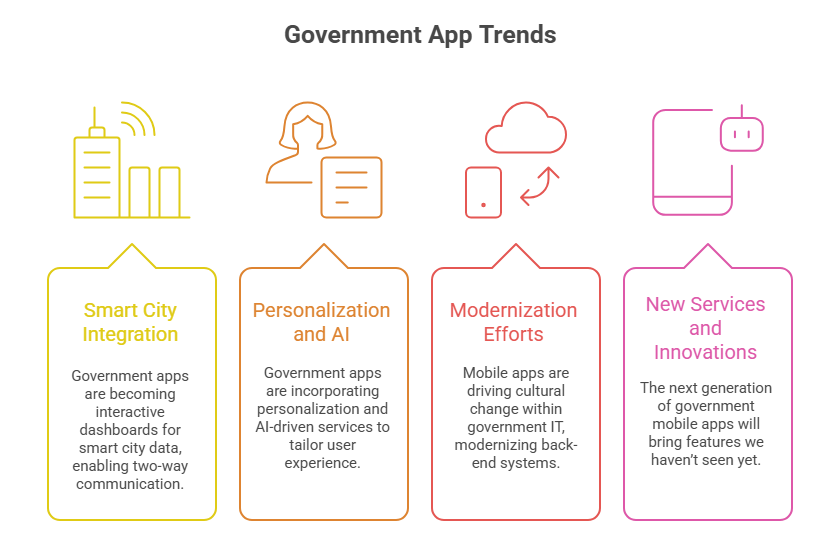
Government mobile apps can serve as an interface for connected city infrastructure, including transportation services, utilities, public safety information, and environmental monitoring.
For example, residents may use mobile platforms to receive transportation updates, report infrastructure problems, or view location-specific information. Connecting these services with existing government systems can provide a more coordinated experience for both residents and agency staff.
Responsible AI and Personalized Services
AI-assisted government mobile experiences may help residents find information, understand service requirements, and navigate common administrative tasks.
Personalized features can also support appointment reminders, application updates, and relevant service notifications. However, agencies must establish clear policies governing data use, transparency, accuracy, and human oversight.
AI should help simplify government interactions without introducing unnecessary complexity or reducing accountability.
Connected Government Systems
Future improvements in mobile service delivery will depend heavily on the modernization of underlying technology.
Secure APIs, cloud infrastructure, identity management, and shared service platforms can help agencies connect information across departments while maintaining appropriate privacy and access controls.
This integration can reduce the need for residents to repeatedly submit the same information or navigate disconnected service systems.
More Proactive Public Services
Mobile technology may also support a shift toward proactive government service delivery.
Rather than relying exclusively on residents to initiate requests, agencies can use appropriate information and consent-based communication to provide timely reminders, status updates, and relevant service guidance.
The objective is not to make every government interaction digital. It is to reduce avoidable effort while preserving accessible alternatives for residents who need assistance through other channels.
Ultimately, the future of mobile government will be shaped by how effectively agencies connect technology with meaningful public-service outcomes.
Conclusion
Mobile apps are becoming an important part of how government agencies improve access to public services, strengthen resident communication, and support more efficient operations.
The government mobile app trends emerging in 2026 highlight a growing emphasis on integrated services, accessible experiences, responsible AI adoption, and measurable outcomes. However, successful implementation requires more than developing a mobile interface. Agencies must consider security, accessibility, legacy system integration, and long-term maintenance from the beginning.
For public-sector leaders, the priority should be identifying the services that residents need most and selecting mobile solutions that genuinely simplify those interactions.
**App Maisters Government** supports public-sector organizations with secure, scalable mobile application development and digital modernization solutions designed around operational requirements and citizen needs. By connecting technology strategy with practical service delivery, agencies can build digital experiences that remain effective as public expectations evolve.
Frequently Asked Questions
What are the current government mobile app trends?
Government mobile app trends show a strong shift toward mobile-first citizen services, real-time notifications, and self-service portals. Agencies are prioritizing accessibility, security, and integration with legacy systems to improve service delivery.
Why are mobile apps important for digital government?
Mobile apps for digital government allow agencies to meet citizens where they are—on smartphones. They improve service access, reduce administrative workload, and support faster communication between governments and communities.
What are the benefits of government mobile apps for citizens?
The benefits of government mobile app adoption include faster service requests, real-time alerts, improved transparency, and higher citizen satisfaction. Apps also increase accessibility for residents who rely on mobile devices as their primary internet access.
How do mobile apps support public sector digital transformation?
Mobile apps are a core part of public sector app modernization by replacing paper-based workflows and outdated portals. They integrate with existing systems while enabling smarter, data-driven government operations.
Can mobile apps integrate with existing government systems?
Modern government mobile apps are designed to integrate with local government software, CRMs, GIS platforms, and legacy databases using secure APIs. This ensures continuity while enabling innovation.
Who develops mobile apps for government agencies?
A specialized government app developer with public-sector experience is critical. App Maisters delivers mobile app development for government agencies with a focus on compliance, accessibility, and long-term scalability.
Do mobile apps improve community engagement in the public sector?
Yes. The benefits of mobile apps for digital communities include higher engagement, faster issue resolution, and two-way communication through notifications, reporting tools, and service tracking.
What certifications should a government mobile app development company have?
A qualified government IT solutions provider should follow standards such as ISO 9001 for quality management, ISO 27001 for information security, WCAG accessibility guidelines, and relevant public-sector compliance requirements areas where App Maisters aligns strongly.