
If you work in local government, you’ve probably heard some version of this question from your council or your city manager: “What are we doing about AI?” And if you’re honest, the answer is often “we’re still figuring it out.” You’re not alone. A 2024 survey of city and county IT leaders by the Public Technology Institute found that only 46% felt even “somewhat prepared” to use AI safely and productively. Thirty-eight percent said they weren’t prepared at all.
That gap matters because AI adoption in local government isn’t really optional anymore. It’s already happening, whether or not there’s a policy in place. The real question isn’t whether to adopt AI. It’s how to do it in a way that actually helps residents, doesn’t blow up your budget, and doesn’t put sensitive data at risk.
This article walks through what’s working, what to watch out for, and how to get started without overcommitting.
The Risk Isn't Adopting AI: It's Ignoring How It's Already Being Used
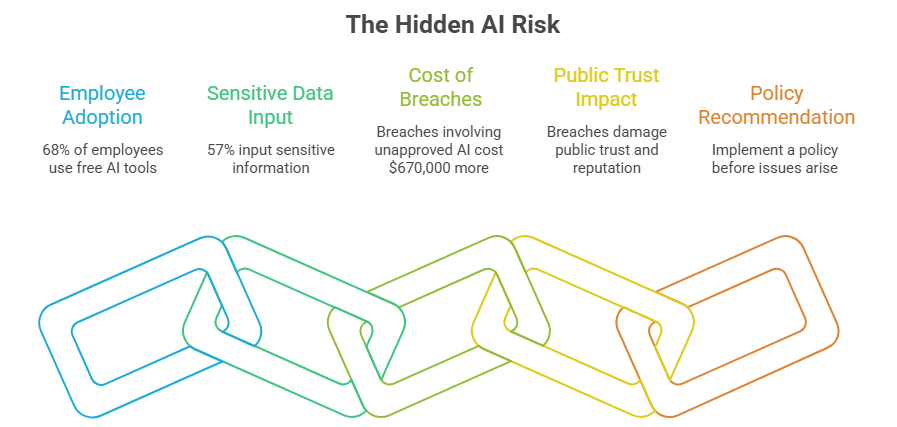
Here’s something that surprises a lot of department heads: your staff are probably already using AI tools, whether you’ve approved them or not. Research from Menlo Security in 2025 found that 68% of employees use free tools like ChatGPT through personal accounts at work, and 57% of them admitted to putting sensitive information into those tools. That’s not a hypothetical risk. It’s happening in offices right now, often because staff are trying to get through their workload faster and no one has given them a sanctioned alternative.
That matters because unsanctioned AI use gets expensive when things go wrong. IBM’s 2025 Cost of a Data Breach Report found that breaches involving unapproved AI tools cost, on average, about $670,000 more than a typical breach. For a public agency, that’s not just a budget problem. It’s a records request, a council hearing, and a hit to public trust that takes years to rebuild.
The takeaway here isn’t “ban AI.” It’s that doing nothing isn’t actually the safe option. The safer path is putting a policy in place before something forces your hand.
Where AI Actually Makes a Difference
It’s easy to get distracted by flashy AI demos that don’t solve any real problem your office has. The agencies getting genuine value tend to start somewhere much more boring: they look at what’s slow, what’s expensive, or what residents complain about most, and they apply AI there. A few areas keep showing up as the best starting points.
Permitting and inspections. Slow permit reviews are one of the most visible complaints residents and local businesses have about government. Los Angeles, Austin, and Honolulu have all started using AI to speed up plan review and permitting, automating parts of the check process and routing applications to the right person instead of letting them sit in a shared inbox. This is usually one of the fastest ways to show a visible win, because delays here are easy to measure and easy for the public to notice.
311 and resident requests. Several cities have improved their 311 systems using AI, either through resident-facing chat tools or internal systems that sort and route incoming requests automatically. A pothole reported by text at midnight doesn’t need to wait for a staffer to log in the next morning to get assigned to the right crew.
Bringing scattered services into one place. A lot of the frustration residents feel with local government isn’t about any one office being bad at its job. It’s that they have to call five different departments to pay a bill, check a permit, or find out about a case. Consolidating these into a single portal, like Resident Portal, with some AI-assisted routing behind the scenes, removes a lot of that friction without requiring residents to learn anything new.
Public safety and infrastructure are two other areas where this is picking up. Instead of reacting to a failure after it happens, some counties are using AI to flag maintenance needs or risk patterns early, based on the data they’re already collecting.
How to Actually Roll This Out
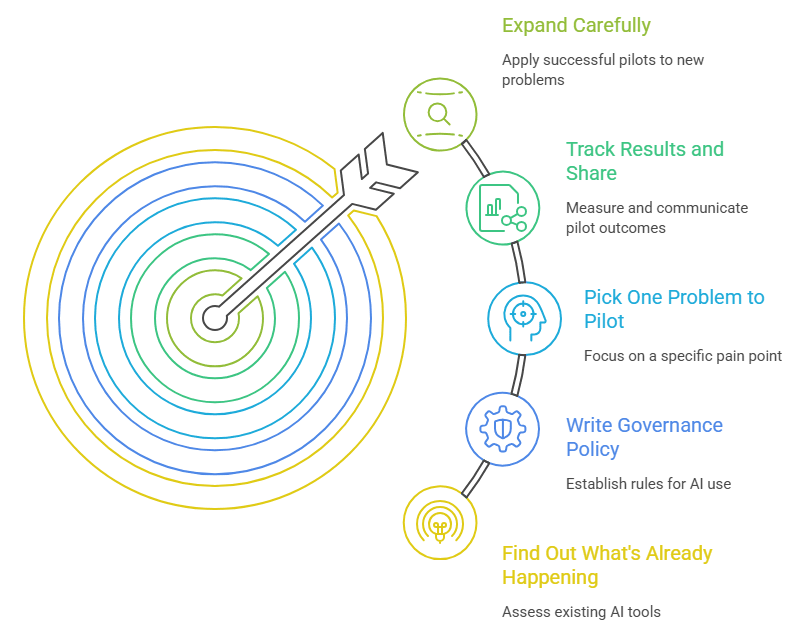
Most successful AI adoption in local government doesn’t happen through one big rollout. It happens in stages, and skipping a stage is usually where things go wrong.
Start by finding out what’s already happening. Before you write any policy, ask department heads what tools their staff is already using informally. You can’t govern something you don’t know exists, and this step alone usually closes off your biggest near-term risk.
Write your governance policy before you buy anything. In that same PTI survey, only 53% of IT leaders said they were actively building AI governance frameworks, and 40% hadn’t taken any steps at all to think about how AI would affect their workforce. A governance policy doesn’t need to be complicated. It needs to answer a few basic questions: What data is allowed to touch an AI tool? Who has to review the output before it affects a resident, like a permit denial or a benefits decision? How long are records kept, and how do they hold up under a public records request?
Pick one problem to pilot, not five. Choose something with clear pain (a permitting backlog, a records request queue, a 311 bottleneck) where a person still reviews the final decision. This limits your risk while giving you something concrete to measure.
Track the results and share them. Councils and taxpayers support what they can see working. Track how much time or backlog you’ve cut, and be upfront about it. This is usually what turns a pilot into something that gets funded again next year.
Expand carefully. Once a pilot proves itself, look for other problems the same approach could solve, rather than starting from scratch with a new vendor and a new system every time.
A Few Trends Worth Knowing About
AI in government is shifting away from simple chatbots and toward tools that sit inside the workflows staff already use permitting software, case management, records systems rather than being a separate thing employees have to remember to open.
Predictive tools are also becoming more common in public safety and infrastructure, giving agencies a heads-up on maintenance or risk before something fails, instead of finding out after the fact.
Cybersecurity and AI policy are increasingly treated as the same conversation rather than two separate ones, since AI use expands the ways sensitive data can leak or be misused if it isn’t governed properly.
The Real Difference Between Success and a Failed Pilot
Budget isn’t usually what separates the agencies that succeed with AI from the ones that stall out. It’s whether governance and security were built in from the start, instead of being an afterthought once something’s already gone wrong. Before adopting any AI tool, it’s worth asking a few blunt questions: Where does resident data actually go? Is there a clear record of what the AI recommended versus what a person decided? Can a staff member always override it? If a vendor can’t answer these clearly, that’s worth taking seriously before signing anything.
You don’t need a five-year transformation plan to get started. One well-chosen pilot, a short governance policy, and a clear way to measure results will get you further than a broad initiative with no focus.
App Maisters Government works with cities, counties, and public agencies on exactly this kind of work: resident service platforms, permitting and inspection automation, and AI governance planning built around how the public sector actually operates. If you’re weighing where to start or want a second opinion on a vendor proposal, you can find more about their approach to AI for government agencies on their site.
Frequently Asked Questions
Where should a city or county start with AI adoption?
Start with one specific, high-friction problem rather than a broad AI strategy, something like permit backlogs, 311 request routing, or records request processing. Pick a process where a person still reviews the final outcome, so you limit risk while you learn what works. Departments that start broad usually end up with a lot of activity and nothing to show for it.
Is it safe to use AI with resident data and government records?
It can be, but only with the right safeguards in place. That means knowing exactly what data the AI tool can access, keeping a record of what it recommended versus what a person decided, and making sure sensitive information isn’t being sent to public, free-tier AI tools. A lot of the risk in local government AI use isn’t the technology itself; it’s staff using unapproved tools because no sanctioned option exists.
How much does it cost for a local government to adopt AI?
Costs vary widely depending on scope, but a single-process pilot (like automating one part of permitting or 311 intake) is far more affordable than a large-scale rollout, and it’s the more common starting point. Many jurisdictions also underestimate the cost of not acting: staff time lost to manual, repetitive work, and the cost of a breach involving unapproved AI tools, which tends to run well above the cost of an average data breach.
What AI use cases work best for small cities and counties with limited budgets?
Resident-facing chatbots for common questions, automated 311 request routing, and basic document or permit processing tend to deliver the fastest return with the least complexity. These don’t require a large IT team to maintain, and they address problems residents notice immediately, which makes the value easy to explain to a council or budget committee.
Do government employees need special training before using AI tools?
Yes, at least some baseline training, not because the tools are hard to use, but because staff need to understand what data they can and can’t put into them, and when a human still has to make the final call. Skipping this step is one of the more common reasons AI pilots run into trouble, even when the technology itself works fine.
What are the biggest risks of using AI in local government?
The three that come up most often are: data privacy (sensitive resident information ending up in the wrong tool), bias in decisions that affect residents directly, like permitting or benefits eligibility, and unapproved “shadow” AI use by staff that goes untracked. All three are manageable with a clear policy and some oversight; the risk comes mainly from not having either in place.