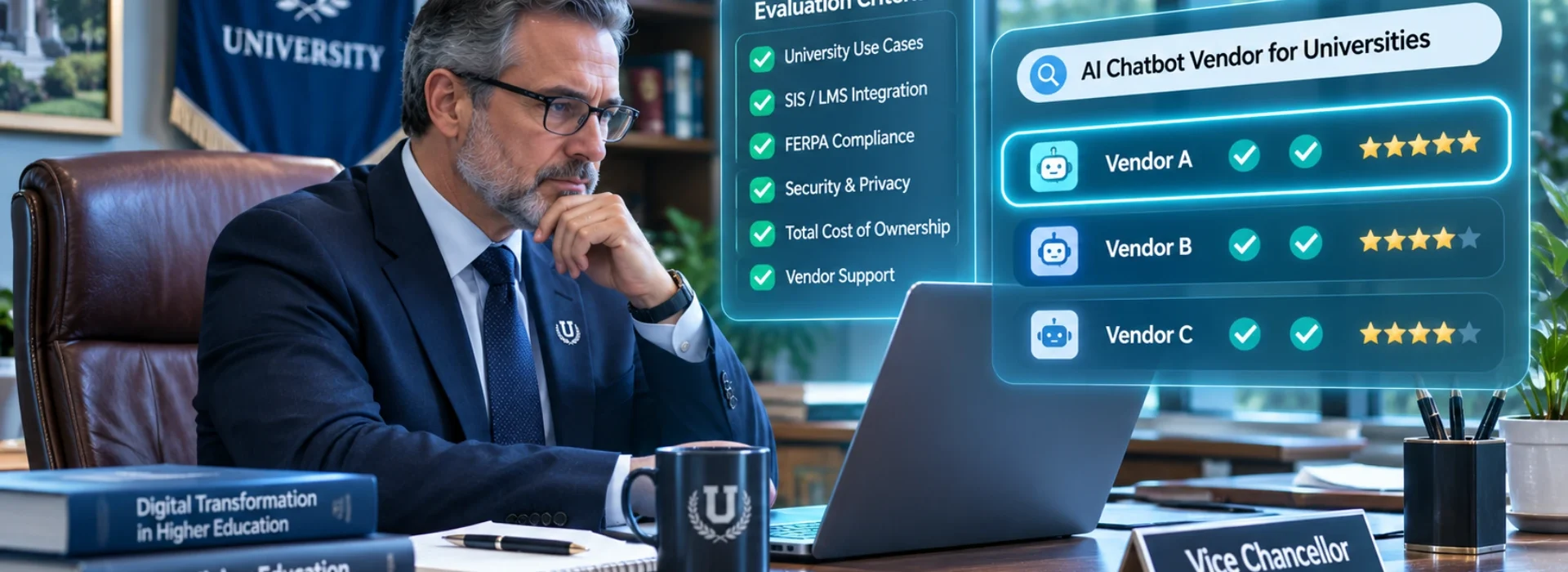
Universities do not struggle with a lack of information. They struggle with making the right information available when students need it.
An international applicant wants to confirm an admission deadline after office hours. A first-year student cannot access the learning management system. A financial aid recipient needs clarification about missing documents. Each inquiry may be routine, but handling thousands of them across disconnected departments creates a substantial operational burden.
An AI chatbot for universities can address these challenges by providing immediate responses, guiding students through institutional procedures, and connecting them with appropriate staff when necessary.
However, selecting the wrong solution can introduce new problems, including inaccurate policy information, fragmented student records, privacy risks, and poor user experiences.
The question is no longer simply whether universities should adopt AI-powered support. It is which AI chatbot can reliably support institutional workflows, integrate with existing systems, protect student information, and deliver measurable value.
This guide explains the essential capabilities, technical requirements, compliance considerations, costs, and vendor evaluation criteria universities should examine before purchasing a Higher Education AI Assistant.
What Is an AI Chatbot for Universities?
An AI chatbot for universities is a conversational software solution that helps students, prospective applicants, faculty, and administrative staff access institutional information and complete supported service requests.
Unlike traditional rule-based chatbots that rely on predefined menus, modern AI assistants can interpret natural-language questions, retrieve relevant information, and maintain conversational context.
Advanced platforms may also connect with student information systems (SIS), customer relationship management (CRM) platforms, learning management systems (LMS), and IT helpdesk applications.
For example, a student asking about a transcript request should receive more than a link to the registrar’s homepage. A properly configured University AI Chatbot could explain the procedure, identify required steps, direct the student to the correct authenticated service, and create a support request when necessary.
The distinction is important: a chatbot answers questions; an integrated AI assistant can help students complete tasks.
Not every product supports secure transactions or personalized records access. Buyers should verify these capabilities through demonstrations and testing rather than assuming they are standard features.
Why Universities Need a More Strategic Approach to AI Chatbots
The value of AI in higher education is increasingly tied to institutional governance, workforce readiness, and measurable operational outcomes.
The 2025 EDUCAUSE AI Landscape Study identifies AI strategy, institutional policies, workforce implications, and disparities in adoption readiness as significant issues across higher education. A subsequent 2026 EDUCAUSE analysis also emphasizes developing employees’ AI-related capabilities.
For university leaders, these findings reinforce an important principle: chatbot procurement should be treated as an institutional service improvement initiative, not merely a software purchase.
- Student experience: Faster access to relevant, consistent, and accessible institutional support.
- Administrative efficiency: Fewer repetitive inquiries and better allocation of staff time.
- Institutional accountability: Secure access, reliable information, defined ownership, and transparent performance reporting.
Before approaching vendors, universities should identify which existing service problems are sufficiently frequent, measurable, and standardized to justify automation.
1. Identify the Campus Problems Your AI Chatbot Must Solve
\An AI chatbot that performs well for admissions may not automatically meet the requirements of financial aid, IT, or academic advising. Universities should begin with department-specific workflows instead of purchasing the platform with the longest feature list.
| Department | Common student problem | Required chatbot capability |
|---|---|---|
| Admissions | Requirements, deadlines, application progress | Program information, application guidance, authenticated status lookup |
| Financial Aid | FAFSA requirements, documentation, disbursement | Approved guidance, secure case routing |
| Registrar | Transcripts, registration, academic policies | Policy retrieval, authenticated workflows |
| IT Helpdesk | Account lockouts, MFA, LMS access | Troubleshooting, tickets, identity-system workflows |
| Student Services | Housing, dining, transportation | Service information and navigation |
| Academic Advising | Prerequisites, appointments | Approved information, scheduling, referrals |
Consider an admissions office receiving repeated questions about international application requirements. A basic chatbot might provide the international admissions webpage. A more capable Higher Education AI Assistant could identify the intended program, clarify published requirements, provide an approved checklist, and direct the student to the correct application portal.
Buyer recommendation: Select two or three high-volume workflows for the initial implementation. Expand institution-wide once accuracy, integration reliability, and student satisfaction are demonstrated.
2. Evaluate the Seven Essential Features of a University AI Chatbot
Not all AI chatbot platforms provide the same level of automation, institutional integration, or administrative control. The following capabilities deserve attention.
1. Answers grounded in university-approved information
A University AI Chatbot should retrieve answers from institutional websites, policy documents, knowledge bases, and other approved sources. Retrieval-Augmented Generation (RAG) allows an AI system to consult relevant content before responding. RAG can reduce unsupported responses, but it does not guarantee accuracy. Universities still need test datasets, content governance, and regular evaluations.
- Citations supporting each answer
- Approved policy version control
- Handling of conflicting or missing information
- Escalation instead of invented answers
2. Integration with existing campus systems
A disconnected chatbot offers limited value beyond generic FAQs. Evaluate compatibility with systems such as Ellucian Banner, Workday Student, Salesforce Education Cloud, Slate, Canvas, Blackboard, Microsoft Entra ID, and ServiceNow where relevant. A listed logo does not prove a maintained supported connector.
3. Secure personalization and identity management
Students need different information based on enrollment status, programs, and circumstances. The platform should support identity verification, role-based permissions, and session controls. Anonymous users must not receive protected student records.
4. Human support and escalation
Sensitive issues, complex eligibility, or cases requiring judgment should reach qualified personnel. Look for live-agent transfers, conversation summaries, departmental routing, and ticket creation that prevent students from repeating their concerns.
5. Multilingual and accessible experiences
Test supported languages against actual institutional terminology, rather than relying on claims of translation. Include keyboard navigation, screen-reader compatibility, error messages, and mobile responsiveness in accessibility testing.
6. Analytics and continuous improvement
Track successful self-service resolution, unanswered questions, escalations, answer accuracy, and satisfaction. Analytics must respect student privacy and retention policies.
7. Configurable departmental governance
Designated administrators should be able to maintain deadlines and policies using approval workflows, change histories, and granular permissions without requiring IT developers for every content change.
3. Understand FERPA, Security, and Accessibility Before Procurement
A university chatbot may process information concerning enrollment, academic records, financial aid, and student identity. That makes data governance a core procurement requirement.
FERPA and student information
The Family Educational Rights and Privacy Act (FERPA) protects qualifying student education records. When an institution discloses personally identifiable information from education records to a vendor under the school official exception, applicable requirements include legitimate educational interests, institutional direct control, and restrictions on redisclosure.
Ask about data purposes, subprocessors, retention, deletion, permitted AI model use, and security incidents. A vendor describing a product as “FERPA-compliant” is not sufficient proof that a specific deployment satisfies institutional obligations.
Security requirements
- Encryption in transit and at rest
- Single sign-on and role-based access
- Administrative audit trails
- Security testing and incident response
- Data segregation and access restrictions
- Subprocessor controls, retention, deletion, and backup arrangements
The NIST Generative AI Risk Management Profile offers a useful voluntary framework to evaluate reliability, security, and governance risks.
ADA accessibility
For covered public universities, the U.S. Department of Justice’s Title II web accessibility rule adopts WCAG 2.1 Level AA, subject to exceptions. A 2026 interim rule extended relevant compliance dates to April 26, 2027 for larger public entities and April 26, 2028 for smaller public entities and special district governments, as specified. WCAG 2.2 may be a useful additional benchmark but is not automatically the legal standard under this rule.
Ask vendors for accessibility testing evidence and demonstrations using assistive technology.
4. Compare AI Chatbot Vendors Using a Weighted Evaluation Scorecard
Feature lists make nearly every vendor appear capable. A scoring process distinguishes demonstrated capabilities from marketing claims.
| Evaluation category | Weight | What to verify |
|---|---|---|
| Accuracy and knowledge | 20% | Tested answers, citations, updates |
| FERPA, security and privacy | 20% | Contracts, access controls, evidence |
| Campus integrations | 20% | APIs and authentication |
| Experience and accessibility | 15% | Usability, languages, accessibility |
| Escalation and automation | 10% | Routing, tickets, authorized actions |
| Analytics and administration | 5% | Reporting, approvals, audits |
| Cost and support | 10% | Three-year costs, SLAs, support |
| TOTAL | 100% |
Score each vendor from one to five and calculate weighted totals. Essential privacy, security, and accessibility requirements should remain mandatory acceptance criteria: a high overall score cannot compensate for a critical failure.
5. Ask These Questions During Every Vendor Demonstration
- Can the chatbot answer questions using our actual admissions and registrar policies?
- What happens when institutional documents conflict?
- Can the platform securely retrieve personalized data from our SIS or CRM?
- How does it prevent unauthorized access to student records?
- Can administrators update knowledge without vendor assistance?
- How are incorrect answers detected and corrected?
- What happens if an integration or AI service becomes unavailable?
- Can the vendor demonstrate keyboard and screen-reader accessibility?
- Are institutional conversations used to train external AI models?
- What are implementation costs, support commitments, and exit provisions?
Ask vendors for written responses, technical documentation, and evidence from comparable deployments. Reliable suppliers should also explain what the chatbot cannot safely automate.
6. Calculate the True Cost and ROI of a Higher Education AI Assistant.
Total ownership costs can include licensing, implementation, system integrations, knowledge preparation, security assessment, training, usage charges, and ongoing maintenance.
Suppose a university receives 10,000 routine inquiries each month, and a pilot demonstrates 30% verified self-service resolution. At four minutes of staff handling per avoided inquiry, theoretical capacity released is 10,000 × 30% × 4 minutes = 200 staff hours per month.
This is an illustrative calculation, not an observed industry benchmark. Actual savings depend on resolution quality, repeat contacts, and how recovered staff time is used. Measure outcomes and total costs together.
7. Run a Controlled Pilot Before Campus-Wide Deployment
- Establish baseline performance: Record inquiry volume, response time, repeat questions, and staff workload.
- Configure approved knowledge: Assign content owners, review documents, define escalations, and limit sensitive data access.
- Test realistic scenarios: Include ambiguity, outdated policies, accessibility, failures, and unauthorized-access attempts.
- Evaluate acceptance criteria: Measure accuracy, resolution, satisfaction, safeguards, and staff workload before expansion.
The U.S. Department of Education emphasizes the role of human judgment and educational needs in AI adoption, especially when outputs affect academic or administrative decisions.
8. Common Mistakes Universities Should Avoid
- Choosing based on conversational fluency: A convincing answer can still contain a wrong deadline.
- Ignoring content ownership: Old policies remain problematic without responsible maintenance.
- Overlooking integration limitations: Verify read/write functionality, authentication, and support.
- Automating sensitive decisions prematurely: Begin with approved information and workflows.
- Measuring activity rather than outcomes: Chat volume does not equal problem resolution.
Choose a University AI Chatbot Built Around Institutional Needs.
Selecting an AI chatbot for universities requires more than conversational features. Institutions need technology that connects with existing systems, provides trustworthy answers, respects student privacy, and produces measurable service improvements.
App Maisters Government supports colleges and universities through its higher education technology solutions. CampusAssist™ is positioned to support institution-grounded knowledge, departmental configuration, workflow automation, omnichannel communications, and human escalation. Integration, security, and deployment requirements must be verified for each environment.
Ready to evaluate an AI chatbot for your university? Explore App Maisters Government’s CampusAssist™ and request a demonstration tailored to admissions, student services, and IT support workflows.
Frequently Asked Questions
What is the most important feature of an AI chatbot for universities?
Reliable answers grounded in approved information are foundational. Secure integration, FERPA-aware handling, accessibility, and escalation are also essential when handling personalized requests.
Can a Higher Education AI Assistant integrate with Banner, Slate, or Canvas?
Integration may be possible using supported APIs, connectors, or custom development. Verify compatibility, licensing, permissions, and workflow capabilities.
Does an AI chatbot for universities need to be FERPA-compliant?
When protected education records are involved, the institution must satisfy applicable FERPA obligations. The outcome depends on data, vendor arrangements, and deployment controls.
Can a University AI Chatbot help students complete admissions applications?
It can explain requirements, guide applicants, flag missing information, and support authorized workflows. Direct record changes require secure integration and institutional approval.
How should universities measure AI chatbot success?
Assess verified resolution, accuracy, repeat contacts, escalation, satisfaction, staff time, and total ownership costs against baseline values.
Should universities choose a general-purpose or specialized chatbot?
Evaluate actual capabilities, security, extensibility, support, and total costs, not merely how a platform is categorized.