
In 2026, state and local governments are prioritizing five technology trends: moving AI from pilot projects into daily operations, treating cloud as the foundation AI runs on (not just storage), building citizen-facing digital services that meet “Amazon-like” expectations, unifying data across departments for faster decisions, and automating cybersecurity as ransomware attacks on public agencies keep climbing. Below, each trend includes what’s actually changed this year and where to start.
Budgets are tight. Citizen expectations aren’t. That gap is what’s driving nearly every technology decision state and local leaders are making right now. According to the National Association of State Chief Information Officers’ 2026 outlook, IT leaders are converging on the same short list: AI, cybersecurity, modernization, and workforce with fiscal pressure and federal funding uncertainty shaping how fast agencies can move on any of them.
What’s different about 2026 isn’t the list of trends, it’s the maturity level. AI is no longer a pilot sitting in an innovation lab. Cybersecurity is shifting from “buy more tools” to “automate the response.” And the agencies pulling ahead are the ones connecting these pieces into one system, not running five disconnected initiatives. Here’s what that looks like in practice.
1. AI Moves From Pilot to Production
For the last few years, AI in government mostly lived in proof-of-concept projects: a chatbot demo here, a pilot analytics dashboard there. That phase is ending. Agencies are now expected to show measurable outcomes from AI, not just experiments.
Agentic AI is the shift to watch. Rather than tools that just recommend an action, agentic AI systems can carry out multi-step workflows on their own, processing a routine permit renewal end-to-end, for example, and looping in a human only when judgment is genuinely needed. Industry analysts tracking 2026 state IT priorities describe this as AI moving from “advising” to “acting,” with cloud infrastructure serving as the operational backbone that makes it possible.
That doesn’t mean AI is replacing government staff. State IT leaders speaking at a recent Public Technology Institute webinar were consistent on this point: AI is being deployed to augment human services and free up staff for higher-value, resident-facing work, not to cut headcount. The agencies seeing the best results are the ones that paired AI rollout with clear governance from day one: who owns the model, how accuracy gets measured, and what happens when it’s wrong.
Practical starting points for 2026:
- AI-powered chatbots and virtual assistants that handle routine citizen questions in multiple languages, 24/7, freeing call center staff for complex cases.
- Predictive analytics that flag infrastructure issues, staffing needs, or budget risks before they become emergencies.
- Governance guardrails first, accuracy thresholds, human review checkpoints, and documentation, so AI tools scale without creating new liability. (If your agency is deploying generative AI for citizen-facing services, our guide to the NIST AI Risk Management Framework for government walks through exactly this.)
2. Cloud as the Foundation for AI, Not Just Storage
Cloud migration used to be justified almost entirely on cost savings and uptime. In 2026, that reasoning has shifted: cloud is now described by public-sector technology leaders as the infrastructure layer that AI and automation actually run on. Agencies rightsizing their hybrid cloud environments this year are doing it specifically to support AI workloads, not just to retire aging servers.
The practical benefits haven’t gone away; they’ve just become table stakes:
- Scalability and remote collaboration: Cloud platforms let workloads scale on demand and let staff collaborate on shared documents and applications from anywhere, which matters as hybrid work becomes permanent rather than a pandemic-era exception.
- Lower infrastructure overhead: Moving off physical servers cuts both capital costs and the ongoing burden of patching, maintaining, and securing on-premises hardware.
- Stronger baseline security: Major cloud providers invest heavily in encryption, automated backups, and disaster recovery protection that’s difficult for most individual agencies to replicate in-house.
At App Maisters Government, our government services team helps agencies plan cloud migrations that are built with AI and automation workloads in mind from the start, rather than treating cloud as a separate project to revisit later.
3. Citizen-Centric Digital Services
Residents compare their experience with a city website to their experience with Amazon or their bank’s app, not to the government portal they used five years ago. That expectation gap is real, and public-sector leaders openly acknowledge it: most agencies recognize AI’s potential to improve citizen experience, but citizen experience still isn’t the primary focus of most current AI initiatives. That’s the opening for agencies willing to act on it now.
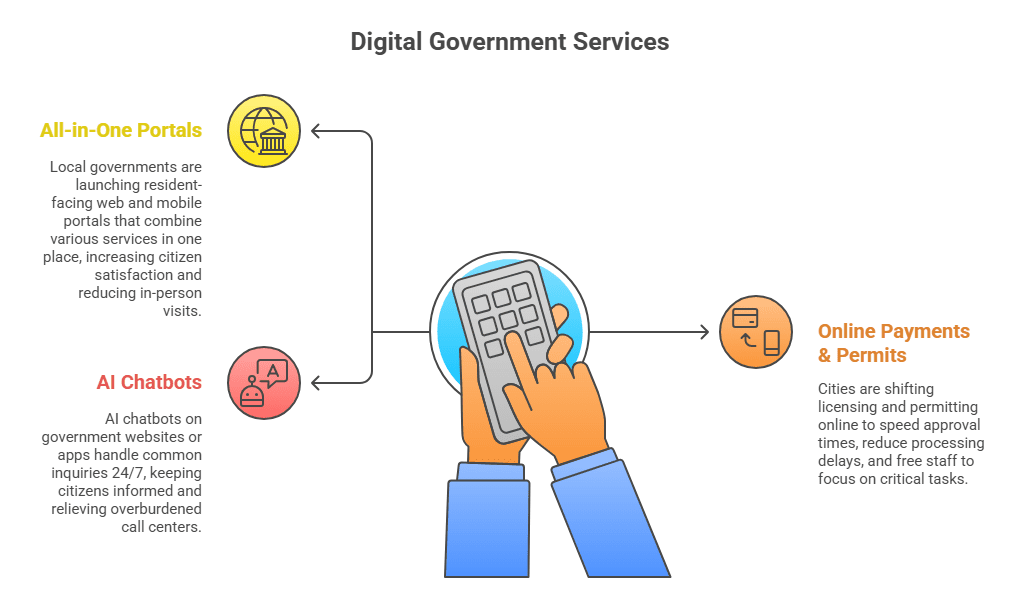
All-in-one resident portals: Combining payments, permits, service requests, and status updates into a single login reduces both call volume and in-person visits. We built a Resident Portal for Johnson County, Kansas, that lets 600,000+ residents report issues, submit permits, and track progress in real time, cutting the number of trips residents need to make to a government office.
Digital permitting and payments: Moving licensing and permitting online shortens approval times and removes the bottleneck of paper-based review. Digital payment integration adds another benefit agencies often underweight: fees post immediately instead of sitting in a mail queue.
AI chatbots that actually resolve issues: Phoenix’s “myPHX311” virtual assistant uses natural language processing to answer resident questions about services and bill payments in both English and Spanish. In Williamsburg, Virginia, an AI chatbot resolved 79% of resident questions on first contact, a meaningful reduction in the load on human staff. App Maisters Government, AI Chatbot for Government is built for exactly this: 24/7 citizen support for permits, benefits, and service requests, without the months-long buildout most agencies expect.
Accessibility and digital equity aren’t optional extras: As more services move online, agencies are under growing pressure from both residents and regulators to make sure digital-first doesn’t mean digital-only for residents without reliable internet access or with disabilities. Building accessibility in from the start is far cheaper than retrofitting it after a complaint.
4. Data-Driven Decision Making
Data only becomes an asset when departments actually share it: The trend accelerating in 2026 is agencies building unified data platforms instead of leaving planning, police, health, and public works each locked in their own database. When those departments can see the same information, leaders catch problems a strained water system, a spike in service calls, an emerging public safety pattern before they escalate.
Predictive analytics: now routinely blends current and historical data to flag infrastructure that needs repair, forecast budget trends from spending patterns, and estimate emergency service demand ahead of time, turning maintenance and staffing from reactive to planned.
Integrated platforms: tie permits, code enforcement, citizen requests, and GIS data into one system, so a single record update is reflected everywhere instead of requiring the same information to be re-entered department by department.
Cross-department sharing turns integration into real decision-making speed: When planning, health, and public safety can see the same real-time data, response times shrink and reporting becomes far less manual. App Maisters helps agencies stand up secure data platforms built for exactly this kind of cross-department visibility.
5. Cybersecurity Automation and Resilience
This is the trend with the sharpest 2026 data behind it, and it’s not a positive story if agencies stand still. Ransomware attacks on government entities rose roughly 13% in the first half of 2026 compared to the second half of 2025, and the U.S. accounted for nearly a third of all government-sector attacks tracked globally in that period. When state and local governments do get hit, they pay the ransom at a higher rate than any other sector 72%, according to the 2026 Sophos State of Ransomware report largely because backup infrastructure and incident-response capacity lag behind other industries.
The response public-sector security leaders are converging on for 2026 isn’t “buy more point tools”; it’s automation. As one field CISO put it, the shift is “away from relying on increased head count and moving toward scaling through AI automation,” with security operations built to defend against AI-amplified threats while embedding governance and continuous training into daily operations, not treating them as a once-a-year training day.
Priorities agencies are actually funding this year:
- Automated threat detection and response, so incidents are contained in minutes rather than discovered days later.
- Multi-factor authentication and continuous monitoring as baseline requirements, not optional upgrades; most ransomware still starts with phishing or compromised credentials, not exotic exploits.
- Cloud-based security, since major providers can invest in protection at a scale most individual agencies can’t match on their own.
- Unified, single-login platforms so citizens (and staff) aren’t juggling five disconnected logins across departments, which also reduces the attack surface security teams have to defend.
Conclusion:
You don’t need to tackle all five trends simultaneously, and trying to do so almost always backfires. Start with an honest inventory: which systems are still on-premises and aging, where is data still siloed between departments, and what’s your actual incident response time if ransomware hits tomorrow? That inventory should point you toward one or two trends worth funding first usually cloud modernization and cybersecurity automation since they make everything built on top of them (AI, integrated data, citizen portals) both safer and easier to deploy.
App Maisters Government works with federal, state, and local agencies on exactly this kind of prioritization: cloud migration, AI solutions for government, citizen portals, and cybersecurity built for public-sector requirements from the ground up. If you’re mapping out where to start, talk to our government services team.
Frequently Asked Questions
What are the top government technology trends in 2026?
The five leading trends are AI moving from pilot projects into daily operations, cloud infrastructure built to support AI workloads, citizen-facing digital services, unified data platforms across departments, and automated cybersecurity. Budget pressure and federal funding uncertainty are shaping how quickly agencies can act on each.
What does government digital transformation mean?
It means replacing manual, paper-based, or siloed processes with connected digital systems, cloud infrastructure, automation, and citizen-facing apps, so agencies can deliver services faster and make decisions based on shared, real-time data.
How is AI actually being used in government right now?
Mostly to augment staff rather than replace them: chatbots that resolve routine citizen questions, predictive analytics that flag infrastructure or budget issues early, and increasingly in 2026, agentic AI systems that can complete multi-step workflows like permit processing with minimal human intervention.
What are the best technology services for government agencies?
The services delivering the most measurable value in 2026 are cloud migration, AI-powered citizen chatbots, integrated data and permitting platforms, and automated cybersecurity monitoring, ideally sourced from a vendor with direct public-sector compliance experience, not a generic enterprise IT provider.
Why is cybersecurity such an urgent priority for government agencies?
Ransomware attacks on government entities rose about 13% in the first half of 2026, and state and local governments pay ransoms at a higher rate than any other sector. Legacy systems, tight budgets, and understaffed IT teams make agencies a disproportionately attractive target.
How does cloud technology benefit the public sector?
Beyond lower infrastructure costs, cloud platforms give agencies the scalability and security foundation that AI and automation tools need to run, plus better support for remote and hybrid staff collaboration.
Why does system integration matter for government IT?
Disconnected systems force staff to re-enter the same information across departments and slow down cross-department response. Integrated platforms let planning, health, and public safety teams work off the same real-time data, cutting manual work and response times.
What's the difference between digital government and traditional government?
Digital government delivers services online permits, payments, service requests instead of requiring in-person visits or paper forms. It’s typically faster, more transparent, and cheaper to operate, though it requires deliberate investment in accessibility so it doesn’t leave residents without reliable internet access behind.
What services does App Maisters Government provide for government agencies?
App Maisters Government provides cloud migration, AI development, citizen-facing mobile and web apps, data platform integration, and cybersecurity solutions built specifically for federal, state, and local government requirements.