
Your agency just deployed a generative AI chatbot to handle citizen inquiries and three weeks later, it confidently tells a resident the wrong deadline for property tax appeals. No one signed off on the model’s accuracy thresholds. No one documented the risk. No one can explain, in an audit, how the decision to deploy was made.
This scenario is playing out across federal, state, and local government right now. Agencies are under pressure to modernize with AI, but most don’t have a repeatable, defensible process for deciding what’s safe to deploy, what needs guardrails, and what should never touch a citizen-facing system. That gap is exactly what the NIST AI RMF for government was built to close and in 2026, it has become the closest thing the public sector has to a common language for AI risk.
The Real Problem: AI Adoption Is Outpacing AI Governance
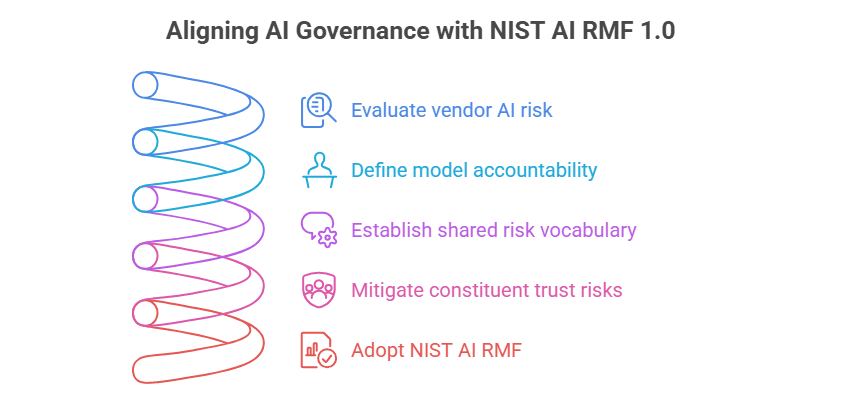
IT directors, CIOs, and program leaders aren’t struggling because they lack AI tools. They’re struggling because:
- Procurement teams don’t have a standard way to evaluate vendor AI risk claims
- Agency leadership can’t answer “who is accountable if this model fails” in a way that survives an inspector general review.
- Legal and compliance teams are fielding new generative AI use cases weekly, with no shared risk vocabulary between technical and non-technical staff.
- Constituent trust is fragile; one biased benefits-eligibility model or one hallucinated policy answer can trigger lasting reputational damage
This isn’t a hypothetical. Since OMB Memorandum M-24-10 directed federal agencies to strengthen AI governance, and as more states adopt their own AI accountability laws, the NIST AI Risk Management Framework (AI RMF 1.0) has become the de facto reference point agencies are expected to align with voluntarily in name, but increasingly mandatory in practice through procurement clauses and audit expectations.
What's Changed: The Framework Has Grown Up
The original AI RMF, released in January 2023, gave agencies four functions Govern, Map, Measure, and Manage to structure AI risk decisions. What’s new, and what most implementation guides miss, is how much the ecosystem around it has expanded heading into 2026:
| Development | Why It Matters for Government |
|---|---|
| Generative AI Profile (NIST AI 600-1), finalized July 2024 | Adds 200+ specific actions covering 12 GenAI-specific risks confabulation, data leakage, harmful content mapped directly onto the four core functions |
| Critical Infrastructure Profile (concept note, April 2026) | Signals sector-specific guidance coming for agencies overseeing energy, transportation, water, and public safety systems |
| Draft Cyber AI Profile (NIST IR 8596), December 2025 | Bridges AI risk management with the Cybersecurity Framework 2.0 relevant as agencies treat AI systems as attack surfaces, not just productivity tools |
| SP 800-53 Control Overlays for AI Systems (in development) | Will let agencies map AI RMF actions directly to the security controls they already use for FedRAMP and FISMA compliance |
| AISIC → CAISI transition | NIST's AI Safety Institute evolved into the Center for AI Standards and Innovation, continuing model evaluation partnerships relevant to agencies procuring frontier models |
The practical takeaway: agencies that treat the AI RMF as a one-time checklist will fall behind. Agencies that build a living program around its four functions will be positioned to absorb each new profile as it lands.
A Step-by-Step Implementation Path for Government Agencies
Here’s how mature government AI programs are actually operationalizing the framework not in theory, but in the order teams are executing it.
Step 1: Govern — Establish Ownership Before You Deploy Anything
Before a single model goes into production, define:
- An AI governance committee spanning IT, legal, procurement, and the program office that owns the use case
- A risk tolerance policy: what level of accuracy, bias, or explainability is acceptable for a given category of decision (e.g., a chatbot answering FAQ questions has a different risk bar than a model scoring eligibility for benefits)
- Documented accountability: who signs off on deployment, and who owns incident response if the model fails
Common mistake: Treating governance as a document that lives in a compliance folder rather than a working process tied to actual deployment decisions. If your governance policy hasn’t blocked or modified a real project, it isn’t functioning yet.
Step 2: Map — Inventory Every AI System Touching Government Operations
Most agencies underestimate how much AI is already in use, embedded in procurement software, HR tools, fraud detection systems, and citizen-facing portals. Mapping means:
- Building a full inventory of AI systems, including third-party and embedded AI (not just agency-built models)
- Classifying each system by risk tier based on the decisions it influences and the population it affects
- Documenting intended use, so a model built for internal drafting doesn’t quietly get repurposed for public-facing decisions without a new risk review
This is where agencies increasingly lean on government AI consulting services; mapping dozens or hundreds of systems across departments requires structured methodology, not spreadsheets built department by department.
Step 3: Measure — Test Before Trust
This is the function most agencies skip or shortcut, and it’s where the Generative AI Profile adds the most concrete value. For any generative AI system, measurement should include:
- Accuracy and hallucination testing against domain-specific benchmarks, not generic ones
- Bias testing across demographic groups the system’s decisions affect
- Red-teaming for prompt injection, data leakage, and misuse, especially for public-facing chatbots
- Ongoing monitoring, not a one-time pre-launch test, since model behavior drifts as usage patterns and underlying models change
Step 4: Manage — Build the Response Muscle
Managing risk means having a plan for when, not if, something goes wrong:
- Incident response procedures specific to AI failures (a hallucinated answer to a resident isn’t the same incident type as a data breach)
- A rollback plan that doesn’t require an emergency all-hands to execute
- Feedback loops from front-line staff and constituents back into the Measure function
Real-World Use Case: A State Benefits Agency
Consider a state health and human services department piloting a generative AI assistant to help caseworkers navigate eligibility rules across multiple benefit programs. A framework-aligned rollout looked like this:
- Govern: Legal and program leadership agreed the tool would only draft suggested answers for caseworker review, never issue determinations directly
- Map: The team classified the tool as moderate-risk because it influences, but doesn’t finalize, benefits decisions
- Measure: Before launch, the agency tested the assistant against 500 historical case scenarios and found a 12% error rate on complex multi-program cases, triggering additional guardrails for those categories
- Manage: A monthly review cycle now tracks caseworker override rates as a leading indicator of model drift
This is the pattern behind most successful examples of how government agencies implement AI today: narrow scope, human-in-the-loop by design, and measurement that continues after launch rather than stopping at go-live.
Generative AI: Opportunity and Risk in the Same System
It’s worth being direct about this tension, because it’s the one driving most current agency anxiety. The same generative AI capabilities creating efficiency gains drafting correspondence, summarizing case files, answering routine constituent questions are also the source of the framework’s newest risk categories: confabulation, sensitive data exposure through prompts, and overreliance by staff who stop verifying model output.
Weighing generative AI opportunities and risks in government isn’t a one-time decision at procurement; it’s a continuous function of the Measure and Manage stages. Agencies that pair GenAI Profile controls with clear human-oversight requirements are seeing productivity gains without the reputational exposure that comes from unchecked deployment.
Best Practices Emerging Across Mature Programs
- Tier your risk, don’t flatten it: A single blanket AI policy for every use case either over-restricts low-risk tools or under-governs high-risk ones. Use risk tiers tied to the framework’s categories.
- Crosswalk, don’t duplicate: The AI RMF maps cleanly to ISO/IEC 42001 and increasingly to NIST SP 800-53 controls agencies already use for FISMA. Build one compliance evidence set that satisfies multiple frameworks instead of maintaining parallel programs.
- Start with inventory, not policy: You can’t govern what you haven’t mapped. Agencies that lead with a use-case inventory move faster than those that start by drafting policy documents in a vacuum.
- Treat vendors as part of your risk surface: Most agency AI risk today comes through third-party and embedded tools, not custom-built models. Vendor risk assessment needs to be part of the Map function, not an afterthought.
What's Next for Government AI Governance
Expect 2026 and 2027 to bring sector-specific profiles (critical infrastructure and likely others), tighter integration between AI RMF and cybersecurity control baselines, and continued state-level legislation that references NIST alignment as a compliance benchmark. Agencies that build their program around the four core functions now rather than reacting to each new profile in isolation will absorb these updates as incremental additions, not overhauls.
For agencies without deep in-house AI governance expertise, working with experienced AI solutions for state and local government partners can compress this timeline significantly, turning a multi-year governance buildout into a structured, phased rollout aligned to the framework from day one.
App Maisters Government works with federal, state, and local agencies to translate the NIST AI RMF into a practical, phased implementation from AI system inventories and risk tiering to model testing, monitoring, and full governance program design. Learn more about how App Maisters Government supports agencies building trustworthy, compliant AI programs.
Frequently Asked Questions
Is the NIST AI RMF mandatory for government agencies?
Not legally mandatory in most cases, but effectively required in practice. Federal agencies follow it under OMB Memorandum M-24-10, and a growing number of state AI laws and procurement RFPs cite NIST AI RMF alignment as a compliance benchmark, so treating it as optional carries real audit and contracting risk.
What's the difference between the NIST AI RMF and the Generative AI Profile (NIST AI 600-1)?
The core AI RMF (2023) provides the four-function structure: Govern, Map, Measure, Manage for any AI system. The Generative AI Profile, finalized in 2024, is a companion document that adds 12 GenAI-specific risk categories (like confabulation and data leakage) and maps them onto those same four functions specifically for LLMs and generative tools.
How long does it take a government agency to implement the NIST AI RMF?
Timelines vary by agency size and existing AI footprint, but most agencies see 3–6 months to complete an initial AI system inventory and risk tiering (Govern + Map), followed by an ongoing cycle for Measure and Manage. Agencies working with experienced government AI consulting services often compress the initial buildout significantly by using pre-built risk-tiering frameworks.
Do we need to assess AI tools we didn't build ourselves, like embedded vendor AI features?
Yes, this is one of the most commonly missed steps. Most agency AI risk today comes through third-party and embedded tools (procurement software, HR platforms, citizen portals), not custom-built models. Vendor AI capabilities need to go through the same Map and Measure process as internally developed systems.
How does the NIST AI RMF relate to other frameworks like ISO 42001 or FISMA?
NIST has published crosswalks mapping the AI RMF to ISO/IEC 42001, and SP 800-53 control overlays for AI are in active development to connect it with FISMA/FedRAMP security controls. Agencies can build one evidence set that satisfies multiple frameworks rather than running parallel compliance programs.
What's the biggest mistake agencies make when adopting the NIST AI RMF?
Treating it as a one-time compliance document instead of a continuous process. The most common failure is skipping or shortcutting the Measure function deploying a model after initial testing but never monitoring for drift, bias, or accuracy decay once it’s in production.