Residents rely on government websites and mobile apps to access public information and services. Digital accessibility helps people with disabilities find the information they need, understand instructions, and complete transactions independently.
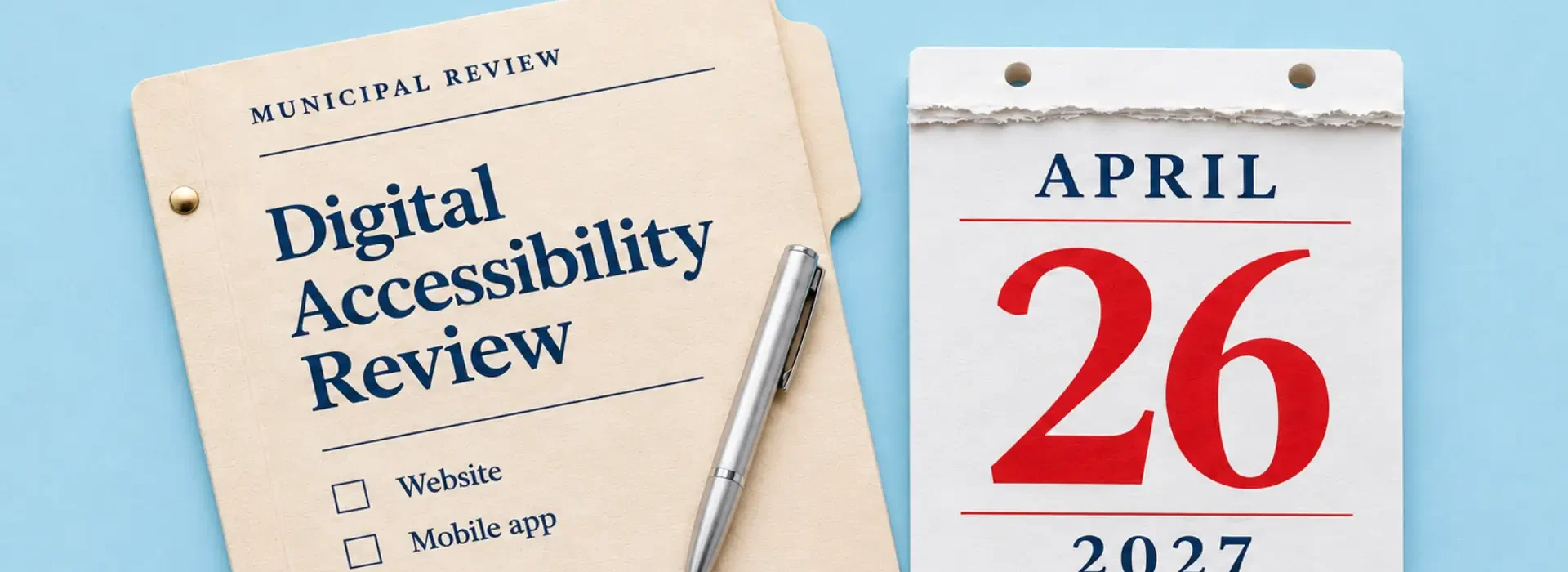
The ADA Title II web accessibility rule sets a technical standard for state and local governments. Covered web content and mobile apps generally must meet the Web Content Accessibility Guidelines (WCAG) 2.1 Level AA. In April 2026, the U.S. Department of Justice extended the compliance deadlines to April 26, 2027, or April 26, 2028, depending on the public entity. These dates apply to the new technical requirements. State and local governments already have a duty to provide accessible services and communicate effectively with people with disabilities.
When is the ADA Title II web accessibility deadline?
The deadline depends on the public entity’s population and whether it is a special district government. Agencies using a checklist prepared when the rule was published in 2024 should update their project schedules to reflect the DOJ’s 2026 extension.
| Public entity | Deadline to meet the technical requirements |
|---|---|
| State or local government with a population of 50,000 or more, other than a special district government | April 26, 2027 |
| State or local government with a population below 50,000, other than a special district government | April 26, 2028 |
| Special district government, regardless of population | April 26, 2028 |
A city with exactly 50,000 residents falls in the 2027 group. A city department should look to the government it belongs to when determining its date. The number of people who visit its website, download its app, or use an individual program does not establish its deadline. The DOJ fact sheet explains how to determine population and addresses entities such as school districts that may need additional guidance.
Which government websites, mobile apps, and online services are covered?
The rule reaches the digital services a state or local government provides or makes available, including through arrangements with outside organizations. Covered entities include cities, counties, public schools and universities, courts, libraries, and transit authorities. A city can therefore have accessibility responsibilities for a service even when residents leave the city’s domain to use it.
Consider a parks department that publishes swimming lessons on its website. A parent reads the schedule on a city page, chooses a class in a vendor’s booking system, signs a waiver, and pays through a checkout screen. An audit limited to the department’s website could miss the point where the parent actually gets stuck. The most useful question for the parks director is straightforward. Can a parent complete registration and tell whether their child has a place?
Apply the same reasoning to building permits, utility payments, public records requests, and mobile 311 reports. For each service, record where the resident starts, which systems they pass through, and what confirms success. That list gives web teams a clearer testing scope and gives procurement staff a way to identify which vendors need to participate.
What does WCAG 2.1 Level AA mean in practice?
The Web Content Accessibility Guidelines, developed by the World Wide Web Consortium, describe how to make digital content accessible. Level AA conformance includes the applicable Level A and AA criteria. Those criteria address practical questions about how people perceive information, operate controls, understand instructions, and use assistive technology.
| When a resident needs to… | What the agency should test |
|---|---|
| Choose a permit inspection date | Can someone using a keyboard open the calendar, select an available date, and see where keyboard focus moves? |
| Read a boil-water advisory | Does the page identify the affected streets in text, including for residents who cannot distinguish the shaded areas on a map? |
| Correct a benefits application | Does the form identify the field with an error and explain how to fix it without relying on a red border alone? |
| Follow a recorded council meeting | Do accurate captions convey the discussion, including speakers and meaningful sounds where needed? |
| Submit a request in a mobile app | Does the screen reader announce the purpose of each control and communicate the submission result? |
These questions make good acceptance tests because the outcome is observable. A tester can report, for example, that focus disappeared when the calendar opened and that pressing Tab moved directly to the footer. An engineer can reproduce that failure. A general ticket saying “calendar needs accessibility improvements” leaves both the repair and its verification open to interpretation.
Which Government Digital Services Should Be Reviewed?
Government organizations should evaluate their complete digital service ecosystem, including:
- Official government websites and departmental portals.
- Resident and citizen service portals.
- Online registration and application systems.
- Government payment and billing platforms.
- Public information and document libraries.
- Government mobile applications.
- Online appointment scheduling and service request systems.
The accessibility requirements can also extend to digital content provided through contractors or other contractual arrangements with government entities.
Which content qualifies for an exception?
The DOJ identifies five limited exceptions. Two involve material agencies often have in large quantities. Archived web content must meet all the archive conditions, including age, purpose, placement in a designated archive, and remaining unchanged after archiving. Preexisting electronic documents, such as older PDFs or spreadsheets, may qualify, but an older form still used to apply for a service generally needs to be accessible.
The other categories cover certain content posted independently by third parties, certain individualized documents protected by a password or other security, and social media posts made before the entity’s compliance date. The distinction between an independent contributor and a contractor matters. A visitor commenting on a public message board plays a different role from a vendor the city hired to operate its permit portal. A sign-in screen also does not exempt an entire portal.
For a records team, a good first question is, “What does someone need this file for today?” Last year’s festival flyer and a ten-year-old application still required for a fee waiver serve different purposes. Document the reason for each exception decision and give staff a clear way to respond when someone requests accessible material. Effective communication obligations still apply when an item qualifies for an exception.
How should agencies prepare for the compliance deadline?
1. Start with services that have consequences for residents
Ask department heads to identify transactions where a barrier could cost someone money, delay a benefit, or prevent them from meeting a deadline. Include infrequently used services with serious consequences, such as appealing a citation. Then ask front-desk staff what residents routinely call about. A clerk who repeatedly completes the same online form for callers may know about a problem that website analytics cannot explain.
2. Audit complete tasks on desktop and mobile
Choose a realistic starting point, such as a search result for “renew my business license.” Follow the route through sign-in, document upload, payment, and receipt. Combine automated checks with keyboard and screen reader testing. Include at least one unsuccessful attempt. Enter an invalid date or omit a required attachment. This reveals whether residents can understand what went wrong, preserve their work, and recover independently.
3. Fix shared components and verify the result
If the same inaccessible address field appears in twelve forms, assign the repair to whoever owns the shared component. Then retest it in representative forms, including a mobile layout. Keep a short record of the original barrier, affected services, and verified result. For residents, the meaningful milestone is being able to submit an address. For managers, it is knowing which services now work and which still need attention.
4. Give vendors a task to demonstrate
At procurement or renewal, ask the vendor to demonstrate a transaction your residents actually perform. For utility billing, that could mean finding an overdue balance, selecting a payment amount, and retrieving the confirmation using a keyboard. Request any available accessibility conformance report, ask which product version it covers, and agree on who will correct and retest defects. The demonstration gives procurement staff specific evidence to evaluate alongside the written response.
5. Make accessibility part of everyday publishing
Give content editors a short checklist tied to their own work. A clerk publishing an agenda needs to check heading order, link descriptions, and the reading order of the attached packet. An emergency communications officer needs a way to publish affected locations in text when issuing a map. Assign someone to receive resident feedback and verify fixes after release. These routines help agencies maintain access as staff, vendors, and content change.
How App Maisters Government Can Help
App Maisters Government helps public agencies build and modernize websites, resident portals, and mobile apps with accessibility built into design and development. For a permit portal, that can mean designing forms residents can navigate by keyboard, writing error messages that explain how to correct missing information, and testing whether a screen reader announces a successful submission. We can help your team turn WCAG 2.1 Level AA requirements into specific features and acceptance criteria for your next redesign.
Conclusion
The ADA Title II web accessibility rule gives state and local governments a clear standard for their websites and mobile apps. As agencies prepare for the applicable 2027 or 2028 deadline, a practical place to start is with services residents depend on most. Follow a utility payment, permit application, or benefits renewal from the first instruction to the final confirmation. Testing those steps with people who use assistive technology helps agencies identify where residents get stuck, prioritize repairs, and verify that people can complete essential tasks independently.
Frequently Asked Questions
What accessibility standard must state and local government websites meet?
Under the ADA Title II web accessibility rule, covered web content and mobile apps generally must meet the Web Content Accessibility Guidelines (WCAG) 2.1 Level AA. This includes applicable Level A and AA requirements for features such as keyboard navigation, form labels, color contrast, and video captions.
What are the ADA Title II web accessibility compliance deadlines?
State and local governments with populations of 50,000 or more generally have until April 26, 2027. Governments with populations below 50,000 and all special district governments, regardless of population, have until April 26, 2028. These deadlines apply to the technical standard. Existing ADA duties, including effective communication, already apply.
Are government mobile apps covered if the agency already has an accessible website?
Yes. The rule covers both web content and mobile apps that a public entity provides or makes available. A city that offers parking payments through its website and a mobile app should evaluate both. In the app, that includes checking whether a resident using a screen reader can select a parking zone, pay, and confirm when the session expires.
Who is responsible for accessibility when a vendor runs a government portal?
The public entity remains responsible for the accessibility of digital services it provides through a vendor arrangement. For example, if a county hires a company to process permit applications, the county’s responsibility extends to that application process. Agencies can ask vendors to demonstrate a complete transaction and agree on who will fix and retest any barriers.
Do older PDFs and forms on government websites need to be accessible?
It depends on how the document is used. An older PDF may qualify for an exception if it was available before the agency’s compliance date. However, a form residents still need to apply for a benefit, renew a license, or participate in a public program generally must meet the standard. Even when an exception applies, the agency may need to provide an accessible format upon request.
How can an agency check whether residents can use its online services?
Start with a complete task, such as paying a utility bill. Combine an automated scan with keyboard and screen reader testing, and invite residents with disabilities to try the process. Check whether they can find the bill, correct an entry, submit payment, and recognize the confirmation. Record where the process breaks down and repeat the same task after the repair.