
IT Staff Augmentation vs. Managed Services: What’s Right for Your Government Agency?
A critical modernization project is greenlit. Budget is approved. Leadership is aligned. Then reality hits: the agency doesn’t have the in-house talent to execute it, and the federal hiring process could take six to nine months time the project doesn’t have.
This scenario plays out across county IT departments, state health agencies, and federal offices every budget cycle. Legacy systems need modernizing, cybersecurity threats are escalating, and citizen expectations for digital services keep climbing, but public sector IT teams remain chronically understaffed. According to workforce studies cited by public-sector CIOs, government agencies routinely report double-digit vacancy rates in critical IT roles, from cloud architects to cybersecurity analysts.
The result is a strategic fork in the road: bring in IT staff augmentation to extend your existing team, or hand off entire functions through managed services. Both models solve the talent gap but they solve it differently, and choosing wrong can mean blown budgets, stalled modernization, or compliance risk. This guide breaks down both models with the practical, decision-ready detail agency leaders need heading into 2026.
Key Challenges Facing Government IT Teams
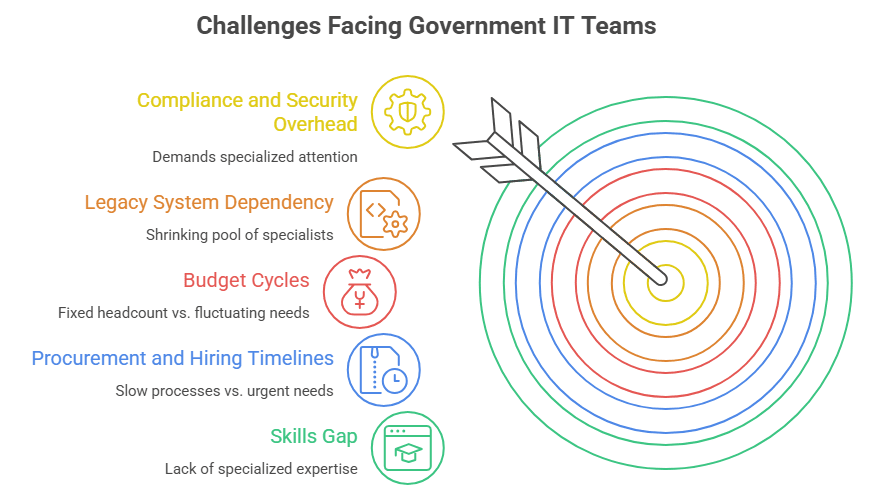
1. The skills gap is widening, not closing: Cloud migration, AI integration, and zero-trust security require specialized expertise that’s expensive and slow to hire through traditional government channels.
2. Procurement and hiring timelines don’t match project urgency: A federal or state hiring cycle can take months; a ransomware threat or FedRAMP deadline doesn’t wait.
3. Budget cycles create staffing whiplash: Headcount is fixed annually, but project needs spike and shrink throughout the year; full-time hires don’t flex with that reality.
4. Legacy system dependency: Many agencies still run decades-old infrastructure that only a shrinking pool of specialists understands, while newer staff are trained on cloud-native tools.
5. Compliance and security overhead: FedRAMP, FISMA, CJIS, and state-level frameworks demand continuous, specialized attention that generalist IT staff often can’t provide alongside daily operations.
Emerging Tech Trends Shaping the Decision
Heading into 2026, a few shifts are changing how agencies think about IT resourcing:
- AI-augmented service delivery: Managed service providers increasingly use AI for predictive infrastructure monitoring, automated ticket triage, and anomaly detection, reducing downtime before it affects citizen-facing services.
- Cloud-first mandates: Continued push toward FedRAMP-authorized cloud platforms means agencies need hybrid teams who understand both legacy on-prem systems and modern cloud architecture.
- Zero-trust security frameworks are now baseline expectations, requiring niche security talent that’s difficult to hire and retain in-house.
- Outcome-based contracting is replacing simple staff-hour billing, pushing managed services providers to guarantee uptime, response times, and security postures rather than just supplying bodies.
- Hybrid workforce models blending core government IT staff with augmented specialists and outsourced managed functions are becoming the norm rather than the exception.
Solving the Problem: Step-by-Step Framework
Step 1: Map your project against control and duration needs
Ask: Does this initiative need direct day-to-day oversight from agency leadership, or can outcomes be defined and handed off? Short-term, leadership-controlled projects lean toward staff augmentation. Ongoing, outcome-defined functions lean toward managed services.
Step 2: Audit your internal skill gaps
Identify precisely which skills are missing: cloud engineering, cybersecurity, data migration, legacy system maintenance, rather than assuming a blanket “we need more IT people” approach.
Step 3: Assess compliance exposure
For functions touching FISMA, CJIS, or FedRAMP-regulated data, evaluate whether a managed services partner with existing compliance infrastructure reduces risk faster than augmenting your own team.
Step 4: Model the budget across both approaches
Staff augmentation typically shows up as flexible operational spend tied to specific projects. Managed services often convert variable IT costs into predictable monthly line items. Run both models against your actual project timeline.
Step 5: Pilot before you commit agency-wide
Start with one high-need function, a cloud migration sprint, or a help desk overhaul under either model before scaling the approach across the agency.
Step 6: Build governance into the contract, not after it
Whichever model you choose, define SLAs, security clearances, data handling protocols, and escalation paths upfront. This is where many agencies lose control post-engagement.
Staff Augmentation vs. Managed Services: Side-by-Side
| Factor | IT Staff Augmentation | Managed Services |
|---|---|---|
| Control | Agency directs day-to-day work | Provider owns outcomes and process |
| Best for | Specific projects, skill gaps, surge capacity | Ongoing functions (help desk, network ops, security monitoring) |
| Speed to deploy | Fast days to weeks | Moderate requires transition planning |
| Budget model | Variable, tied to hours/roles | Predictable, often fixed monthly fee |
| Compliance ownership | Shared; agency retains most responsibility | Provider typically assumes more compliance burden |
| Scalability | Easy to scale up/down per project | Scoped by contract; changes require renegotiation |
| Internal knowledge retention | High embedded with agency team | Lower unless contractually addressed |
Real-World Use Cases
Case 1: State health agency, legacy system modernization: A state health department needed to migrate a 15-year-old case management system to the cloud within a single fiscal year. Rather than hiring full-time cloud architects it wouldn’t need long-term, the agency used government IT staff augmentation to embed contract cloud engineers directly into its existing team. The internal team retained ownership and institutional knowledge while closing the specific skills gap for the migration window.
Case 2: County government, 24/7 network operations: A county government struggled to staff around-the-clock network monitoring with a small internal team prone to burnout. It shifted to a managed services model for network operations and cybersecurity monitoring, converting an unpredictable staffing cost into a fixed monthly service with guaranteed response times a common pattern among federal government IT staffing solutions now favoring outcome-based contracts.
Case 3: Federal agency, hybrid model: A federal office combined both approaches: augmented staff for a time-boxed data center consolidation project, and a managed services contract for ongoing helpdesk and endpoint security. This blend reflects where many agencies are heading, using augmentation for defined initiatives and managed services for steady-state operations.
Best Practices & Expert Tips
- Don’t default to one model agency-wide. The strongest public sector IT strategies mix both, matched function-by-function to control needs and duration.
- Vet for security clearance readiness, not just technical skill. A provider or augmented team member without existing public trust or clearance processing can add months to onboarding.
- Negotiate knowledge transfer explicitly. With managed services in particular, require documentation and knowledge-sharing clauses so the agency isn’t permanently dependent on one vendor.
- Evaluate the IT staffing benefits public sector agencies actually need: flexibility, compliance familiarity, and speed rather than defaulting to whichever model was used last cycle.
- Treat government IT infrastructure staffing as a continuous strategy, not a one-time procurement decision. Reassess annually as project pipelines shift.
Common Mistakes to Avoid
- Choosing based on cost alone: The cheaper model upfront can cost more in rework, delays, or compliance gaps.
- Skipping the compliance conversation until after contracting: Retrofit security and clearance requirements are expensive and slow.
- Assuming managed services means “hands off”: Agencies still need internal oversight to manage vendor performance against SLAs.
- Over-augmenting instead of building internal capability: Perpetual augmentation without a plan to build institutional knowledge leaves agencies permanently reliant on external talent.
- Ignoring transition planning: Whether onboarding augmented staff or offboarding a managed services function, poor transition planning is the top cause of project delays in public sector IT engagements.
Conclusion: What's Next for Government IT Staffing
There’s no universal right answer between staff augmentation and managed services; only the right answer for a specific project, compliance profile, and budget cycle. The agencies moving fastest into 2026 aren’t picking one model and sticking with it forever; they’re building flexible, hybrid IT workforce strategies that pull the right resourcing model for the right function, project by project.
As AI-driven monitoring, cloud-native infrastructure, and zero-trust frameworks continue reshaping public sector technology, the demand for specialized, security-cleared IT talent will only intensify. Agencies that build a clear framework now, matching control needs, compliance exposure, and budget models to the right staffing approach, will be far better positioned to modernize without the delays and risk that come from reactive hiring.
Whether your agency needs targeted government IT staff augmentation to close a skills gap on a critical project, or a full managed services partnership to stabilize ongoing operations, the goal is the same: reliable, secure, mission-ready IT capability that scales with your agency’s needs.
App Maisters Government works exclusively with public sector agencies to design and deliver both staff augmentation and managed services models tailored to federal, state, and local IT requirements.
Frequently Asked Questions
What's the difference between IT staff augmentation and managed services for government agencies?
Staff augmentation embeds contract IT specialists directly into your existing team under your agency’s day-to-day direction. Managed services hands off an entire IT function, like network monitoring or help desk, to a provider who owns the outcomes, SLAs, and process.
Is IT staff augmentation cost-effective for government agencies?
Yes, for project-based needs. It avoids the overhead of full-time hires (benefits, pension contributions, long-term headcount commitments) while letting agencies scale specialized talent up or down as project scope changes.
Can staff augmentation help agencies meet FedRAMP or CJIS compliance requirements?
It can, but compliance ownership stays largely with the agency since augmented staff work under your existing security and governance framework. Agencies need to vet contractors for clearance readiness and ensure they follow internal compliance protocols from day one.
How long does it take to onboard augmented IT staff vs. a managed services provider?
Staff augmentation typically faster days to a few weeks since you’re adding individuals into an existing structure. Managed services usually take longer to stand up because it involves transition planning, process handoff, and SLA negotiation.
Can a government agency use both staff augmentation and managed services at the same time?
Yes, and it’s increasingly the norm. Many agencies use augmentation for time-boxed projects (like a cloud migration) and managed services for steady-state operations (like 24/7 network monitoring or cybersecurity), building a hybrid workforce strategy.
What are the biggest risks of choosing the wrong IT staffing model for a government project?
The most common risks are budget overruns from mismatched cost structures, compliance gaps from unclear ownership of security responsibilities, and stalled projects from poor transition planning between internal teams and external talent.