Understanding the CLOUD Act: What Government Agencies Need to Know
Government IT leaders are rapidly embracing the cloud for modernization and efficiency. In fact, 73% of enterprises now use a hybrid cloud model, and agencies are prioritizing cloud modernization, data sharing, and integrated security. These shifts deliver clear benefits of cloud computing from pay-as-you-go cost savings to instant scalability. For example, moving archives to the cloud allows agencies to reduce capital expenditure on hardware… significantly reducing infrastructure costs, and cloud backups yield much faster recovery during outages.
Yet as agencies migrate data to US-based cloud services, they must navigate new legal terrain. The Clarifying Lawful Overseas Use of Data Act (CLOUD Act) fundamentally updates how law enforcement accesses cloud data. Modernizing decades-old rules, the CLOUD Act gives U.S. authorities authority to request data from U.S. providers regardless of where it’s stored. At the same time it authorizes bi-lateral agreements so foreign partners with strong privacy protections can obtain evidence more quickly. In practice, this means U.S. law enforcement can issue warrants to compel cloud providers for records even if the servers are overseas, and partner nations can do likewise under streamlined agreements.
Understanding these changes is crucial for government agencies. Agencies routinely store sensitive citizen data, communications, and records in the cloud. Under the CLOUD Act, if investigators seek agency data in the cloud, U.S. companies must comply with valid warrants or subpoenas. Meanwhile, agencies also face strict compliance obligations of their own from records retention laws to Freedom of Information Act (FOIA) requests. Effectively managing cloud data archiving for compliance helps meet those demands while staying ahead of legal requests. As one analysis notes, agencies grapple with unprecedented information growth and increasingly stringent regulatory oversight, making cloud archives a revolutionary solution that meets scalability, accessibility, and compliance needs.
What Is the CLOUD Act and Why Does It Matter?
Congress passed the CLOUD Act in 2018 as an amendment to the Stored Communications Act. Its purpose was to improve procedures for both foreign and U.S. investigators in obtaining access to electronic information held by service providers. In essence, it brings 20th-century law into the cloud era. The key provisions include:
- Expanded Data Access: U.S. law enforcement can serve warrants or subpoenas on U.S.-based providers for data anywhere in the world. For example, if the FBI has a warrant, Microsoft or AWS must turn over a U.S. user’s emails even if they are stored in Ireland.
- Executive Data-Sharing Agreements: The Act allows the U.S. government to enter bilateral agreements with other countries that have robust protections for privacy and civil liberties, letting foreign investigators use their own legal processes to get data on U.S. companies for serious crime investigations. The first such agreement was with the United Kingdom.
- Privacy Safeguards: Providers and courts retain the right to challenge requests if they violate foreign privacy laws. The law also emphasizes maintaining high levels of protection of privacy and civil liberties even while speeding access to data.
For agency leaders, the takeaway is that the CLOUD Act streamlines cross-border data access. Agencies must recognize that hosting records in the cloud means U.S. authorities have a faster, legally backed mechanism to obtain them if needed. This does not remove agency responsibilities for privacy and compliance if anything, it heightens them.
Implications for Government Agencies
Accountability for Data in the Cloud
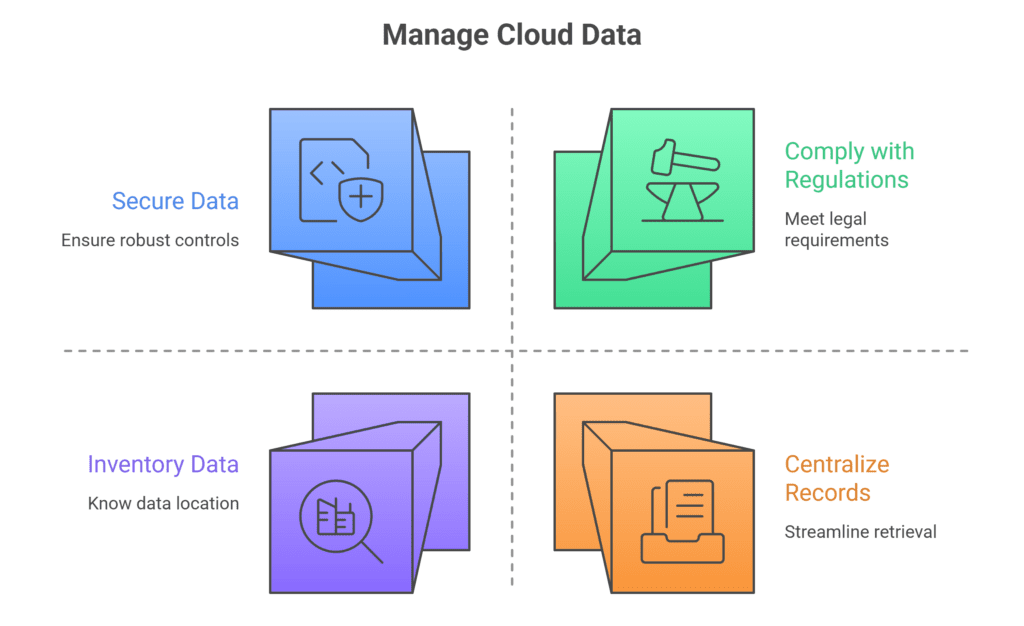
Agencies often handle law enforcement data, public safety records, or confidential citizen information. Under the CLOUD Act, any such data stored by a U.S. cloud provider could be subject to a warrant without an international treaty delay. Agencies should thus inventory what data lives where, and ensure robust controls (encryption, access logging) are in place. Even routine archived records might be accessed if an investigation touches them.
Records Retention and FOIA
Government agencies have statutory retention requirements and must respond to FOIA/state open-records requests promptly. Cloud archiving can help by centralizing and indexing records. As Smarsh notes, FOIA compliance demands efficient and consolidated data archival and retrieval systems. A cloud archive with full-text search and metadata tagging enables agencies to locate relevant records quickly. For example, if investigators seek years-old emails or reports, a properly indexed cloud archive can surface the data far faster than hunting on-site tapes. Implementing rigorous data retention policies in the cloud (automatically deleting or locking records per regulations) also ensures agencies meet retention laws while controlling storage costs.
Security and Compliance
Deploying cloud archives with strong security is key. Leading providers embed features like advanced encryption, multi-factor authentication, and continuous monitoring in fact, these often surpass what individual on-prem data centers can implement. Many cloud solutions already comply with critical frameworks (e.g. HIPAA, CJIS) and are FedRAMP certified. For federal agencies, using FedRAMP cloud services is typically mandatory to ensure data protection. State and local entities should look for GovRAMP accreditation (the analogous program for state/local), which is largely aligned with FedRAMP standards.
Collaboration and Cloud Strategy
Today’s agencies frequently use multiple cloud platforms (IaaS, SaaS, etc.) to meet different needs. Gartner projects that all cloud segments will grow, with public cloud spend reaching $597 billion in 2023. In practice, most large organizations end up with hybrid or multi-cloud environments (73% use hybrid and many use multiple public clouds). For government, this means implementing multi-cloud management for government to enforce consistent security policies and monitor spending across all providers. A unified management approach prevents shadow IT, ensures encryption standards are uniform, and helps pinpoint where sensitive data resides which is critical when legal holds may target distributed data.
Cloud Data Archiving for Compliance
Given the CLOUD Act and growing data volumes, cloud data archiving has become a compliance imperative. Agencies generate petabytes of records from video and GIS data to public records and must store them securely for years or decades. Cloud archives offer virtually unlimited scalability: agencies can dial storage up or down on demand rather than over-provision hardware. This flexibility is vital, for example, when a sudden spike in data (as with bodycam footage or pandemic-era records) outpaces on-prem capacity.
Key advantages of cloud archiving for government compliance include:
- Scalability & Flexibility: Remote cloud storage automatically scales with usage. Agencies need not guess future data growth; they pay only for used capacity.
- Cost-effectiveness: By moving archives offsite, agencies eliminate most capital outlays for disks and tapes. Operational costs power, cooling, maintenance drop. Cloud providers often use predictable subscription pricing, simplifying budget forecasts.
- Accessibility & Disaster Recovery: Authorized personnel can retrieve archives securely from anywhere, which is crucial for FOIA responses and field operations. Multiple geo-replicated copies ensure that if one data center fails, others can immediately serve data maintaining continuity of government functions.
- Advanced Search and E-Discovery: Modern cloud archives include powerful indexing and search tools. Teams can quickly filter by keyword, date, or metadata to find records. For example, legal e-discovery features let agencies collect and review data sets for investigations or litigation, saving time and legal costs.
- Security & Compliance Controls: Contrary to the myth that “the cloud is risky,” in reality cloud archives can enhance security. Providers continuously update encryption, auditing, and identity controls. They also offer built-in compliance features: automated retention schedules, immutable archives (unchangeable logs), and detailed audit trails. As one expert notes, leveraging these tools allows agencies to “achieve a higher level of data protection and regulatory compliance” than with in-house systems.
By adopting cloud archives, agencies address core compliance needs. They ensure that when investigators invoke the CLOUD Act and request data, records are retrievable and protected. This falls under the broader category of data archiving for government maintaining trusted archives of government data in the cloud so records aren’t lost or scattered.
Security Frameworks: FedRAMP, GovRAMP and Beyond
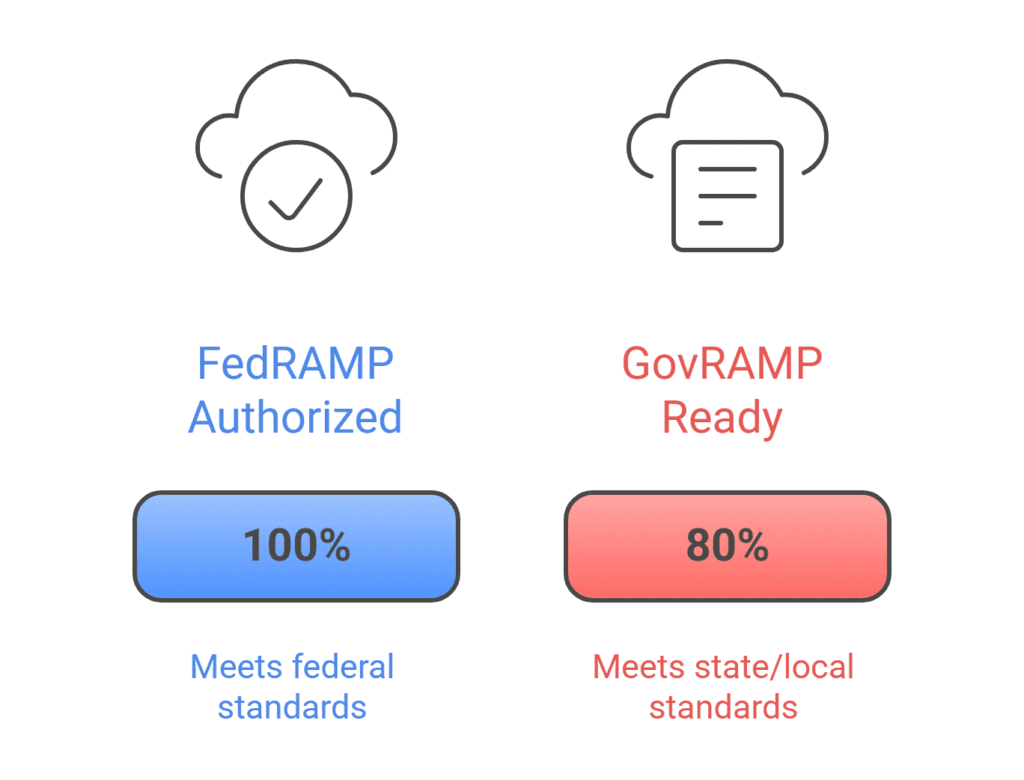
Any government cloud strategy must meet rigorous security standards. FedRAMP (Federal Risk and Authorization Management Program) sets baseline controls for federal cloud deployments, and most federal contracts require FedRAMP authorization. In practice, choosing FedRAMP cloud services is wise: providers vetted under FedRAMP have implemented NIST-based controls, encryption at rest and in transit, physical security at data centers, and ongoing auditing. As Smarsh highlights, many cloud archiving solutions comply with FedRAMP right out of the box.
For state and local entities, GovRAMP serves a similar role. According to GovRAMP (formerly StateRAMP) guidance, GovRAMP “applies to state and local agencies, while FedRAMP is for federal. Both share core principles like standardized controls, independent assessment, and continuous monitoring”. In other words, a FedRAMP authorization often satisfies or accelerates GovRAMP requirements. Agencies should verify that any cloud archive or service they use meets the appropriate level of FedRAMP/GovRAMP typically Moderate or High for their data sensitivity.
Beyond FedRAMP vs GovRAMP, agencies must also consider data sovereignty and local laws. Some states or partner countries may require certain data to be stored onshore. The CLOUD Act touches on these issues indirectly: the European Data Protection Supervisor has warned that the CLOUD Act can conflict with GDPR, leading some countries to impose stricter data localization. Government CIOs should monitor such trends. In any case, government cloud security means enforcing least-privilege access, multi-factor authentication, and encryption keys management all of which leading cloud providers support.
Best Practices and Next Steps
In light of the CLOUD Act and evolving cloud norms, government agencies should take a proactive stance. Key actions include:
- Perform a Data Inventory: Catalog the types of data held in the cloud (emails, citizen records, GIS, surveillance video, etc.) and note legal requirements (retention periods, classification). This informs what controls and encryption are needed.
- Engage FedRAMP/GovRAMP Providers: Whenever possible, use FedRAMP-authorized cloud services and archives. This ensures compliance with federal standards. For state/local use, look for GovRAMP readiness. As one GovRAMP resource notes, a FedRAMP-certified provider already has met and often exceeded the GovRAMP baseline.
- Implement Retention Policies in the Cloud: Leverage built-in cloud features to automate data retention and disposal. For instance, set rules that move data older than X years to cold storage or securely delete it once past legal retention. Automated retention helps enforce the retention schedules mandated for government records without manual tracking.
- Ensure Searchability: Configure your cloud archive so that records remain searchable. Index all communication platforms and data sources so staff can quickly respond to FOIA or legal discovery requests.
- Plan for Legal Data Requests: Develop clear procedures for handling warrants or cross-border requests. Know which personnel are authorized to coordinate with law enforcement, and ensure contracts with cloud providers specify how they will handle such requests under the CLOUD Act.
- Train Your Teams: Educate IT and records officers on how the CLOUD Act and related laws (like MLAT processes) work. Regular training ensures everyone understands the importance of securing data and responding to legal orders.
- Leverage Multi-Cloud Management: If you use multiple clouds (e.g. AWS, Azure, GCP, plus private clouds), deploy a multi-cloud management platform or governance framework. These tools can enforce consistent encryption, identity, and logging across clouds simplifying audits and security enforcement in a heterogeneous environment.
- Focus on Resilience (CMS): Finally, integrate your cloud strategy into emergency and continuity planning. A cloud-enabled Crisis Management Solution ensures that critical data and communications remain available during natural disasters, cyber incidents, or other crises. By replicating archives across regions and enabling remote access, cloud archives keep emergency operations running.
Conclusion and Call to Action
The CLOUD Act represents a landmark shift for digital data governance. For government agencies, it underscores the need to modernize records management and ensure cloud adoption is both secure and compliant. By understanding the CLOUD Act’s provisions and proactively managing cloud archives, IT leaders can safeguard citizen data, satisfy legal obligations, and harness cloud efficiency.
AppMaiters is a trusted partner for government cloud consulting. We help agencies implement FedRAMP cloud services and tailor government IT solutions (including resilient Crisis Management Solutions and robust data archiving) that align with the CLOUD Act and other regulatory requirements. Contact us today to learn how your agency can stay secure, compliant, and prepared in the cloud era.
Frequently Asked Questions
What is the CLOUD Act in simple terms?
The CLOUD Act is a U.S. law that allows law enforcement to legally request cloud-stored data from U.S.-based service providers, even if that data is stored outside the United States. It modernizes data access rules for the cloud era.
Does the CLOUD Act apply to government agencies?
Yes. Government agencies that store data with U.S.-based cloud providers may be subject to lawful data requests under the CLOUD Act, especially when providers receive valid warrants or subpoenas.
How does the CLOUD Act impact data stored overseas?
Under the CLOUD Act, U.S. authorities can request data from U.S. cloud providers regardless of the physical location of the data. This removes delays previously caused by international data-sharing processes.
Is cloud data archiving compliant with government regulations?
Yes, when implemented correctly. Cloud data archiving for compliance supports records retention, audit trails, encryption, and eDiscovery, helping agencies meet legal, regulatory, and FOIA requirements.
Why is cloud data archiving important for government agencies?
Government agencies generate massive volumes of records that must be retained securely for years. Cloud data archiving provides scalable, cost-effective storage while ensuring accessibility, security, and compliance.
How does cloud data archiving support compliance and audits?
Cloud data archiving for compliance enables automated retention policies, immutable records, and advanced search capabilities, making audits, investigations, and legal discovery faster and more reliable.
Does the CLOUD Act override data privacy laws?
No. The CLOUD Act includes safeguards that allow providers to challenge requests that conflict with foreign privacy laws. Agencies must still comply with applicable data protection and privacy regulations.
How can agencies ensure government cloud security under the CLOUD Act?
Agencies should use FedRAMP or GovRAMP authorized cloud services, encrypt data at rest and in transit, enforce access controls, and maintain detailed audit logs across all cloud environments.
What role does App Maisters play in CLOUD Act compliance?
App Maisters helps government agencies design and implement secure, compliant cloud architectures, including cloud data archiving, FedRAMP-aligned solutions, and governance strategies aligned with the CLOUD Act.
How can agencies prepare for legal data requests under the CLOUD Act?
Agencies should maintain clear data inventories, implement compliant archiving solutions, and work with cloud consulting experts like App Maisters to establish response-ready governance frameworks.
Is cloud data archiving suitable for crisis and continuity planning?
Yes. Cloud-based archives support disaster recovery and Crisis Management Solutions by ensuring critical government data remains accessible during cyber incidents, natural disasters, or system outages.