
Incident Response Planning for Government Agencies: A Practical Checklist
When ransomware hit St. Paul, Minnesota, in July 2025, the city declared a state of emergency and watched billing, emergency coordination, and citizen services go dark for more than two weeks. The attackers did not need a zero-day or a nation-state budget. They needed one unpatched edge device and a city that had never rehearsed what to do next.
That gap between “we have a policy document” and “we know exactly who does what in the first 60 minutes” is where most public sector agencies lose. If you are a CIO, IT director, or emergency management lead searching for how to build an incident response plan that actually holds up under pressure, this checklist is built for you. It is practical, current, and focused on the decisions you will have to make in the moment, not the theory you will read after.
The Problem: Government is Target, And Clock is Faster Than Ever
Public sector organizations have become one of the most attacked segments online, and the trend is accelerating. Comparitech logged 208 ransomware incidents against government bodies in the first half of 2025, a 65 percent jump over the same period a year earlier, with the United States absorbing the largest share of any country. The reason is simple economics. Agencies run essential services citizens cannot live without; they operate under intense public pressure to restore access fast, and they often defend those services with fragmented tooling and thin security teams.
The cost is not hypothetical. Sophos found the average recovery bill from a single ransomware incident, before any ransom is even considered, now sits near 1.53 million dollars. Across 525 documented government attacks, downtime and lost services alone exceeded 1.09 billion dollars. And the damage lands on real people: the 2025 PowerSchool breach exposed personal data belonging to tens of millions of students and teachers, and separate state Department of Human Services incidents in early 2026 exposed benefits and financial data for close to a million residents.
Three factors make this harder in 2026 than it was even a year ago:
- Speed: Unit 42 research shows attackers now exfiltrate data in as little as 72 minutes, roughly four times faster than the prior year. A plan that assumes you have a day to react is already obsolete.
- Double extortion: Modern crews steal data before they encrypt it. Clean backups restore your systems but do nothing to stop a leak, which changes your legal and disclosure obligations entirely.
- AI on offense: Ransomware groups are wiring agentic AI into reconnaissance, victim prioritization, and even negotiation, compressing the effort and time per attack.
Emerging Technology Trends Reshaping Incident Response
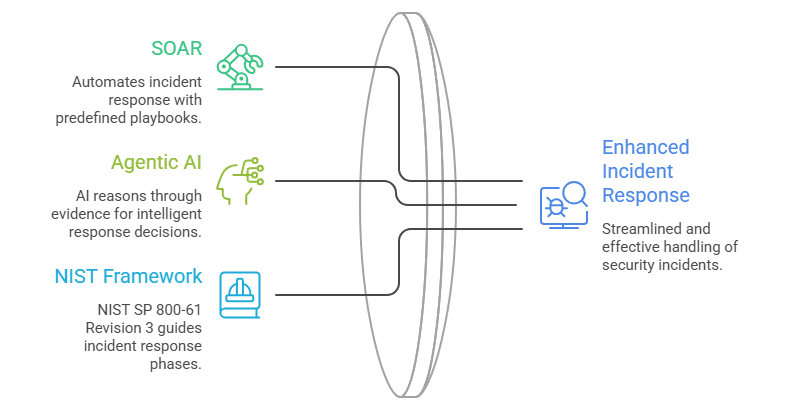
The defensive side has changed just as fast. Three shifts matter most for agencies planning now.
From reactive to automated (SOAR): Security orchestration, automation, and response platforms execute predefined playbooks the instant a trigger fires: quarantine a phished mailbox, isolate an endpoint, block a malicious indicator at the firewall. The value is measured in minutes saved per case and in consistency under stress. Yet CISA guidance cited across the industry notes that roughly 85 percent of organizations still run predominantly manual security processes, which is exactly the speed gap attackers exploit.
From automation to reasoning (agentic AI): The market is moving past rigid scripts toward AI that reasons through evidence rather than matching a rule. Where SOAR says “if phishing, then quarantine,” agentic AI evaluates why a process launched, correlates it across telemetry, and recommends or executes a graded response. Organizations adopting AI-driven response have reported mean-time-to-remediate reductions of up to 70 percent, according to figures from Gartner’s SOAR market guidance.
From tooling to framework: NIST SP 800-61 Revision 3 anchors all of this in four phases: Preparation, Detection and Analysis, Containment and Eradication, and Recovery. Every automation you deploy should map cleanly to one of those phases so your plan stays auditable and defensible.
The Practical Checklist: Step By Step
Use this as a working blueprint. Each step pairs a concrete action with the modern capability that makes it faster.
| Phase | What to do | Modern enabler |
|---|---|---|
| 1. Prepare | Name your incident commander, legal, comms, and continuity leads before an incident. Establish FBI and CISA contacts now. | Documented RACI, tabletop exercises |
| 2. Prepare | Inventory assets and patch edge devices and VPNs on a fixed cadence. | Continuous vulnerability scanning tied to CISA KEV |
| 3. Detect | Centralize logs and automate triage so real threats surface above the noise. | XDR, AI-driven anomaly detection |
| 4. Analyze | Score and classify alerts by impact; map activity to MITRE ATT&CK. | Agentic AI enrichment |
| 5. Contain | Isolate affected systems within minutes to stop spread and preserve evidence. | SOAR playbooks with one-click rollback |
| 6. Eradicate | Remove persistence, reset credentials in a controlled sequence, close the entry vector. | Automated identity-anomaly workflows |
| 7. Recover | Restore deliberately from tested, offline backups. Do not rush systems back online. | Immutable cloud backups, staged restore |
| 8. Report | Meet mandatory disclosure windows and notify affected residents. | Automated audit trails and evidence logging |
| 9. Review | Run a blameless post-incident review and feed lessons back into playbooks. | AI-generated incident timelines |
A few notes on execution. On containment, the goal in the first objective of any ransomware event is to isolate quickly, then bring leadership, legal, and risk into the room so decisions about restoration and disclosure are coordinated from the start. On automation scope, start with the boring, low-risk plays: phishing triage, indicator blocking, and patch-ticket creation on newly exploited vulnerabilities. Avoid automating mass credential resets or privileged-account lockouts on day one, because the failure mode there is locking out your own leadership mid-crisis. And if you cannot point to a working rollback for an automated action, you do not have automation; you have a liability.
Real-World Use Cases
The two-week outage that a tested plan would have shortened: St. Paul’s July 2025 emergency shows what happens when containment and recovery are improvised. Services stayed down for weeks. Contrast that with agencies that maintained manual continuity procedures during the New Britain, Connecticut incident in early 2026: the network was disrupted for more than 48 hours, but emergency response and essential services kept running on backup and manual processes because someone had planned for exactly that.
The vulnerability that sat open for a month: Verizon’s 2025 data breach analysis found that exploitation of vulnerabilities drove 20 percent of initial access, with edge devices and VPNs representing 22 percent of exploitation targets, and the median time to fully remediate an edge vulnerability running 32 days. A patch cadence tied to the CISA Known Exploited Vulnerabilities catalog closes that window before an attacker walks through it.
The regulation that forces readiness: New York’s 2025 cybersecurity law now requires state and local agencies to report incidents within 72 hours and mandates annual cyber awareness training. If your plan cannot produce a documented timeline and notification within that window, it will fail an audit before it fails a citizen.
Best Practices And Expert Tips
- Rehearse, do not just write: A plan that has never survived a tabletop is a hypothesis. Run scenarios quarterly and rotate who plays incident commander.
- Pair human judgment with machine speed: Let AI handle volume, triage, and documentation. Keep analysts on the high-stakes calls where context matters.
- Assume data is already gone: Build your communications and legal response for double extortion, not just encryption.
- Fund the boring layers: Layered defense beats any single control. User training does not fix an unpatched appliance, and multi-factor authentication does not stop every delivery attempt.
- Bake compliance into the workflow: Platforms that log every detection and containment decision with an audit trail turn disclosure from a scramble into a report you can generate on demand. This matters most for agencies carrying ISO 27001 and similar obligations.
Common Mistakes to Avoid
The recurring failures are predictable, which is good news, because that makes them preventable.
- No named owners: “IT will handle it” is not a plan. Assign roles before the incident.
- Backups that were never tested, or never isolated: A backup an attacker can encrypt is not a backup.
- Rushing recovery: Restoring in a hurry reinfects systems. Restore from trusted sources deliberately.
- Treating the ransom as the cost: Downtime and recovery routinely dwarf the ransom, and paying does not guarantee your data is unlocked or unpublished.
- Skipping the post-incident review: The agencies that improve are the ones that treat every incident as input to the next playbook.
Conclusion and Future Outlook
The threat landscape for 2026 is not a continuation of last year; it is an acceleration. Attacks are more selective, more targeted, and more expensive, even as raw volume plateaus in some quarters. Government agencies may face fewer attacks, but not safer ones. The defenders who win will be the ones who move from static PDF plans to living, tested, automation-backed response programs anchored in the NIST lifecycle.
Looking ahead, expect agentic AI to handle more of the containment and recovery workload autonomously, expect stricter and faster disclosure mandates to spread state by state, and expect identity-first defense to become the baseline as credential-driven attacks keep climbing. The agencies that prepare now, with clear ownership, tested backups, and intelligent automation, will be the ones still serving citizens when the alert fires.
App Maisters Government helps federal, state, local, and education organizations build exactly this kind of resilience. As an SBA 8(a) and ISO 9001 and 27001 certified digital transformation partner with more than 12 years of public sector experience, our teams deliver cybersecurity solutions for government incident response, real-time enforcement, and crisis management and mass notification tools purpose-built for public safety. We work with agencies to strengthen local government cybersecurity and protect citizen data and to harden government portals against ransomware and service disruption.
Ready to pressure-test your incident response plan before an attacker does? Talk to our government technology team.
Frequently Asked Questions
What is an incident response plan for a government agency?
It is a documented, rehearsed set of procedures defining who does what across the detection, containment, recovery, and reporting of a cybersecurity incident, aligned to a framework such as NIST SP 800-61 Revision 3.
Why are government agencies targeted by ransomware so often?
Agencies that run essential services that citizens depend on face intense pressure to restore them quickly and frequently operate with limited security staff and older tooling, which makes them attractive, high-visibility targets.
How fast do we need to respond to a modern attack?
Faster than most plans assume. Attackers now exfiltrate data in as little as 72 minutes, so containment measured in minutes, not hours, is the goal.
Should our agency pay the ransom?
Recovery and downtime costs usually exceed the ransom; payment does not guarantee data is unlocked or kept private, and several states have banned ransom payments. Coordinate any decision with legal, leadership, and law enforcement.
What role does AI play in incident response?
AI accelerates triage, correlates threats across systems, drafts incident documentation, and can execute graded containment, with reported mean-time-to-remediate reductions of up to 70 percent when paired with human oversight.
What is the difference between SOAR and agentic AI?
SOAR runs predefined playbooks triggered by rules. Agentic AI reasons through evidence to recommend or take context-aware action, going beyond fixed scripts.
How often should we test our incident response plan?
At least quarterly through tabletop exercises, rotating the incident commander role, and after every real incident through a blameless post-incident review that updates your playbooks.