
What are the Main Types of AI Algorithms & Explained How They Work
Artificial intelligence algorithms form the backbone of modern AI systems. These algorithms are sets of mathematical rules that allow machines to learn from data and make decisions. In practice, AI algorithms work by ingesting training data and adjusting internal parameters to minimize errors. This data-driven learning process enables machines to perform tasks like recognizing images, predicting outcomes, or categorizing information. Understanding how do AI algorithms work is crucial: supervised models learn from labeled examples, unsupervised models find patterns in unlabeled data, and reinforcement models adapt based on reward feedback.
AI algorithms are increasingly used across government IT departments for tasks like data analysis and decision automation. For CIOs and CTOs in the public sector, selecting the right AI model means knowing the types of AI algorithms available and how each operates. Different algorithms have different strengths some excel at classification, others at clustering or control. By matching an algorithm to the problem (for example, fraud detection, resource optimization, or citizen service recommendation), agencies can greatly improve outcomes and efficiency.
Main Categories of AI Algorithms
AI algorithms are typically grouped into three major categories: supervised learning, unsupervised learning, and reinforcement learning. Each category works differently:
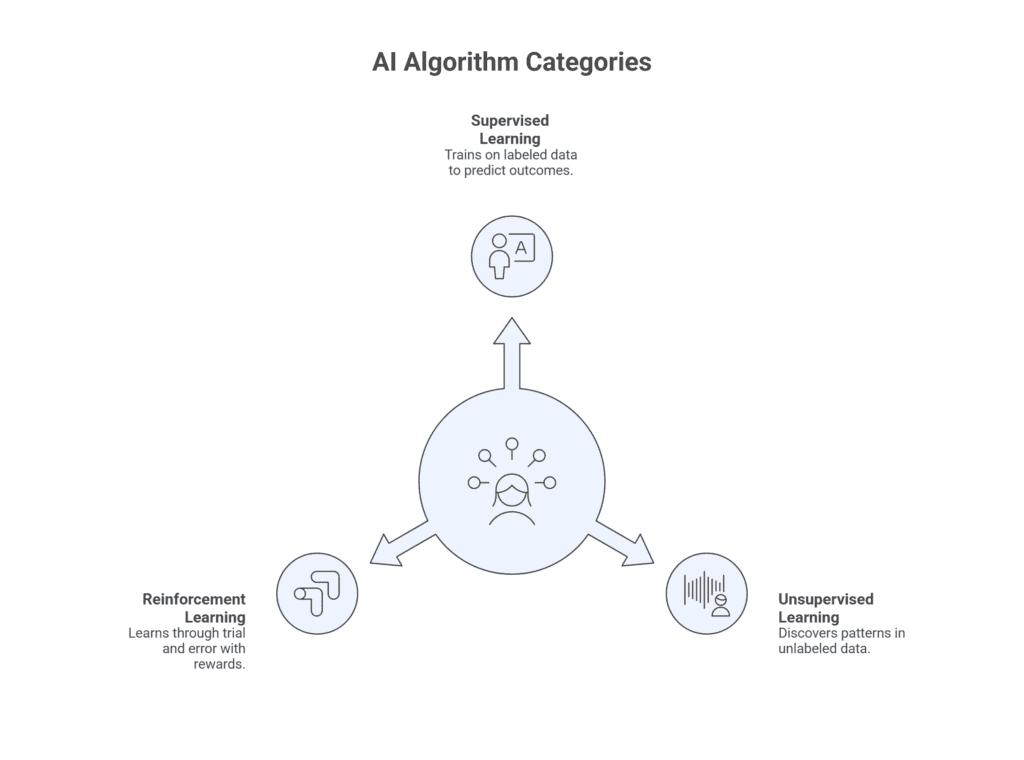
Supervised Learning
These algorithms train on labeled data (inputs paired with the correct outputs). They learn a mapping so they can predict the label of new inputs. Common tasks include classification (e.g. “spam” vs “not spam”) and regression (predicting a numeric value). Supervised methods are widely used in government for tasks like classifying tax audit cases or predicting service demand. Examples of supervised algorithms include decision trees, support vector machines (SVMs), neural networks, and linear regression. For instance, a tax authority might use a supervised model to flag fraudulent returns by training on past cases.
Unsupervised Learning
These algorithms work on unlabeled data, discovering hidden structure without given answers. They identify patterns, groupings, or anomalies within data. In government contexts, unsupervised learning can cluster citizens by service usage or detect anomalies in network traffic logs. Popular unsupervised techniques include k-means clustering (to find similar groups), principal component analysis (for dimensionality reduction), and autoencoders (for anomaly detection). For example, an agency might use clustering to segment areas with similar healthcare needs or to detect unusual spending patterns in a budget.
Reinforcement Learning
These algorithms learn by interacting with an environment. They take actions and receive feedback in the form of rewards or penalties, then adjust to maximize long-term reward. Reinforcement learning is common in robotics and control problems. In a civic setting, an example might be an AI system that optimizes traffic light control through trial-and-error simulation. Notable reinforcement algorithms include Q-learning, SARSA, and policy gradients. For instance, a transportation department could use reinforcement learning to automatically adjust train schedules or traffic signals to improve flow.
Each category has unique advantages. Supervised models often achieve high accuracy when labeled data is abundant. Unsupervised methods are powerful for exploration when labels are unavailable. Reinforcement models excel in dynamic decision-making. Often, these approaches overlap (for example, deep learning neural nets can be used in both supervised and reinforcement settings), and hybrid methods (like semi-supervised learning) combine elements of each.
How AI Algorithms Work
So, how do AI algorithms work at a high level? At their core, AI algorithms rely on data and mathematical optimization. They start with an initial model (e.g. random weights in a neural network) and iteratively adjust it to better fit the data. For supervised learning, the algorithm minimizes the difference between its predictions and known labels. For unsupervised learning, the algorithm looks for structure (like minimizing variance within clusters). For reinforcement learning, it maximizes cumulative reward through trial and error. In all cases, the algorithm’s “intelligence” comes from the patterns it learns in data.
For example, a supervised image classifier might adjust its internal weights until it correctly identifies different vehicle types 95% of the time. An unsupervised clustering model might group similar map locations together without any labeled input. A reinforcement agent playing a simplified traffic simulation might learn that certain sequences of traffic-light signals minimize congestion over time. In practice, this learning process often involves data preprocessing (cleaning and formatting data), model training, and evaluation. High-quality data and careful tuning are essential; as the adage goes, “garbage in, garbage out.”
Supervised Learning Algorithms
Supervised learning is perhaps the most widely used category of AI algorithms. These models require a dataset where each example is tagged with the correct answer (label). During training, the algorithm uses these labels to guide learning. For instance:
- Classification algorithms (e.g. decision trees, SVMs, neural networks) assign inputs to categories. A government application might be an email filter (flagging phishing attempts) or an image recognizer (identifying damaged infrastructure from photos).
- Regression algorithms (e.g. linear or logistic regression) predict continuous or ordered values. For example, they could forecast budget overruns or predict the probability of equipment failure.
Examples of supervised learning algorithms include decision trees, support vector machines, gradient-boosted trees, and deep neural networks. These algorithms often require feature engineering (choosing input variables) and tuning (e.g. adjusting tree depth or learning rates). In government IT projects, supervised learning could power any number of tasks: fraud detection in financial aid by learning from past fraud cases, sentiment analysis on citizen feedback to improve services, or predictive maintenance for public transit vehicles.
Unsupervised Learning Algorithms
Unsupervised learning algorithms tackle problems without labeled outputs. Instead, they find patterns or groupings in raw data. Key types of unsupervised methods include:
- Clustering: Algorithms like k-means or hierarchical clustering group data into clusters of similar items. In a city health department, clustering might identify neighborhoods with similar disease incidence rates, aiding targeted interventions.
- Dimensionality Reduction: Techniques like Principal Component Analysis (PCA) reduce complex data to core factors. Governments can use PCA to visualize or compress large datasets (e.g. census data) into key components.
- Anomaly Detection: Methods (including autoencoders) find outliers. For example, an anomaly detector can flag suspicious network activity as a potential cyber threat without any pre-labeled attacks.
Common unsupervised algorithms include k-means clustering, principal component analysis, and autoencoders. These are useful in government for exploratory data analysis. For instance, an agency might use clustering to segment the population by risk factors or unsupervised learning to flag unusual spending in procurement data. Unsupervised AI can also preprocess data (e.g. compressing images or extracting features), feeding into supervised pipelines.
Reinforcement Learning Algorithms
Reinforcement learning (RL) algorithms learn optimal behaviors through trial and error. An RL agent makes decisions, observes outcomes, and receives rewards or penalties. Over many iterations, it converges on strategies that maximize total reward. Key aspects of RL:
- Exploration vs. Exploitation: RL balances trying new actions (exploration) with using known good actions (exploitation).
- Policy and Value Learning: The agent develops a policy (what action to take in each state) and estimates expected rewards (value functions).
- Exploration vs. Exploitation: RL balances trying new actions (exploration) with using known good actions (exploitation).
Applications in a government context might include optimizing traffic light schedules (reward = reduced congestion), managing energy use in public buildings (reward = lower energy cost), or training simulations for emergency response (reward = minimized casualties). While RL requires careful setup (defining states and rewards), it enables agents to handle complex, dynamic tasks. By “learning from the environment,” RL can adapt in ways that traditional rule-based systems cannot.
AI in Government Use Cases
Government agencies have rapidly adopted AI across domains. A 2025 report found over 1,700 use cases of AI in U.S. federal agencies, more than doubling year-over-year. About 46% of these are “mission-enabling” projects (finance, HR, IT, procurement, cybersecurity). Examples include:
- Administrative Automation: Agencies use AI assistants to answer routine questions. For example, the Department of Labor deployed an AI assistant to help staff search procurement documents.
- Health and Safety: The CDC uses AI to accelerate investigations of multi-state foodborne illness outbreaks, reducing time and labor.
- Fraud Detection: The Veterans Benefits Administration uses AI to detect fraudulent changes in direct-deposit information, protecting benefits.
- Citizen Services: Predictive algorithms can help schedule DMV appointments or analyze public sentiment to improve service delivery.
- Benefit Services: The Social Security Administration employs AI to help disability adjudicators improve the speed and consistency of their decisions.
These practical examples show AI implementation on government tasks to improve efficiency, decision-making, and service quality. In fact, agencies highlight enhanced anomaly detection and better decision support as key benefits of their AI projects.
Modern IT teams often integrate AI into existing platforms. Nearly half of federal AI projects are developed in-house or on existing enterprise data platforms, enabling rapid deployment. For CIOs, this means that choosing algorithms is as much about integration as about model accuracy. Leveraging the right artificial intelligence for government solution can streamline processes for instance, an AI model for document classification can reduce manual workload in case processing, or AI-driven analytics can help optimize urban transportation resources.
Emerging Trends: Agentic AI and Cybersecurity
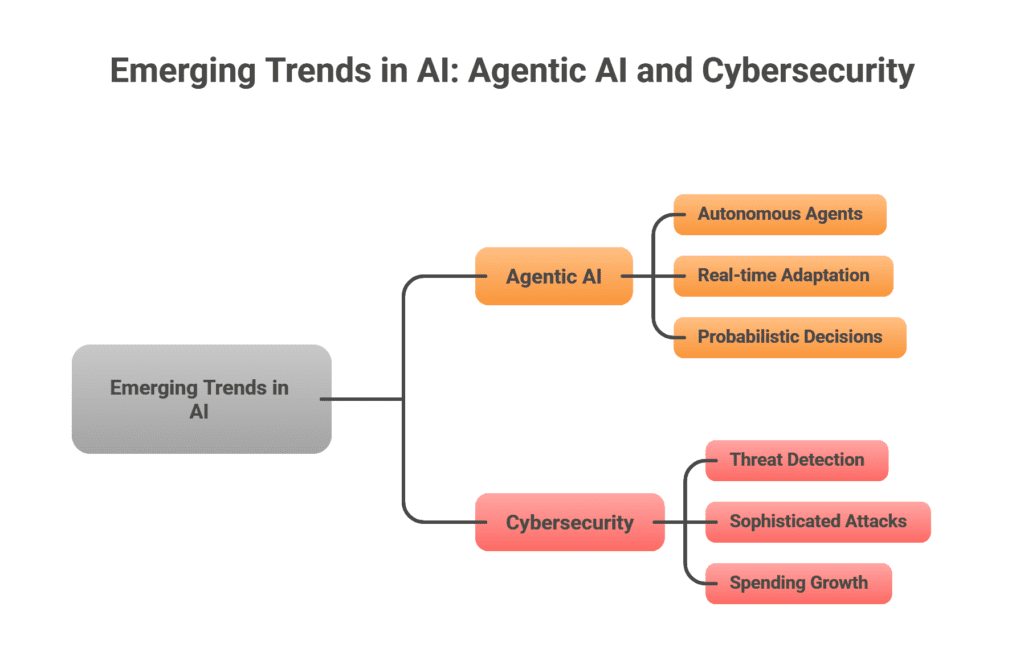
The AI landscape continues to evolve. Two notable trends are agentic AI and the growing role of AI in cybersecurity.
Traditional AI systems and Robotic Process Automation (RPA) follow predefined rules to perform tasks. By contrast, Agentic AI refers to autonomous agents that can set and pursue their own sub-goals, adapting to changes in real time. Unlike fixed-rule automation, agentic AI can interpret new information and make probabilistic decisions. This means an agentic system might be given the goal of “improve overall security,” and it would autonomously determine sub-tasks (e.g. patch management, anomaly scanning) to achieve that goal. Governments looking to Enhance Agentic AI capabilities may integrate advanced models (like large language models) or richer knowledge bases. Understanding the differences between Agentic AI vs Traditional AI is critical for strategy: agencies must assess when they need human-in-the-loop control and when they can trust AI agents to operate with minimal oversight.
AI is both a tool and a target in cybersecurity. On one hand, AI-driven analytics can detect threats faster than human teams. On the other, malicious actors use AI for sophisticated attacks (deepfakes, automated intrusion). Industry data highlights this arms race. Gartner projects that global spending on AI-enhanced cybersecurity will double by 2026 from roughly $25.9 billion in 2025 to about $51.3 billion in 2026. This AI cybersecurity 2026 shift underscores how critical intelligent defenses are becoming. For government CIOs, this means planning for AI in security: adopting AI-based intrusion detection and fraud detection tools, while also ensuring models are robust against adversarial manipulation.
Best Practices and Considerations
When applying AI algorithms in government, certain best practices are key:
- Data Quality & Ethics: Use high-quality, relevant data. Check for biases (e.g. demographic skews) and ensure privacy. Government data may be sensitive, so compliance with regulations is crucial.
- Explainability: Choose models that can be audited. For critical public services, having interpretable AI helps build trust. Simpler algorithms or explainable AI techniques are often preferred in government settings.
- Governance: Establish an AI governance framework. Document how algorithms make decisions, and have processes for oversight and intervention. According to federal guidance, any AI that affects citizens’ rights or safety requires impact assessments and human review.
- Integration and Training: Ensure new algorithms work with legacy systems. Train staff on AI tools so they understand limitations. Collaborative tools that combine AI and human expertise typically yield the best results.
In summary, the types of AI algorithms supervised, unsupervised, and reinforcement each have roles to play. Choosing the right algorithm means matching it to the task (e.g. using clustering for pattern discovery or reinforcement learning for dynamic control). For government agencies, these choices translate into more efficient services, better decision-making, and enhanced security.
Understanding these algorithms empowers agency leaders to leverage AI effectively. By integrating appropriate AI models into their IT solutions for government sector, public organizations can automate routine tasks, gain predictive insights, and offer smarter digital services.
Explore how App Maisters can help your agency adopt the right AI strategies. Our experts specialize in tailored artificial intelligence for government solutions, from pilot projects to full-scale deployments. Contact us to learn how the right AI algorithms can transform your operations and drive innovation in the public sector.
Frequently Asked Questions
What are AI algorithms in simple terms?
AI algorithms are sets of rules that enable machines to learn from data, identify patterns, and make decisions without being explicitly programmed for every scenario. They power tasks like prediction, classification, and automation.
What are the main types of AI algorithms?
The main types of AI algorithms include supervised learning, unsupervised learning, and reinforcement learning. Each type is designed to solve different problems based on how data is labeled and how learning occurs.
How do AI algorithms work?
AI algorithms work by analyzing data, learning patterns, and optimizing outcomes through mathematical models. Over time, they improve accuracy by minimizing errors or maximizing rewards based on feedback.
Which type of AI algorithm is best for government use?
There is no single best option different government use cases require different algorithms. Supervised learning works well for fraud detection, unsupervised learning for pattern discovery, and reinforcement learning for dynamic decision systems.
What data is required to train AI algorithms for government?
AI algorithms require high-quality, structured, and compliant data. Government agencies typically use operational, historical, and anonymized datasets aligned with privacy and regulatory standards.