
Gemini vs. ChatGPT: Which AI Model Better Serves Government Agencies
Government technology leaders are rapidly exploring generative AI in government to improve services and efficiency. According to a Google Public Sector survey, nearly 90% of federal IT leaders report planning to use AI or already doing so. Common use cases include document processing (54%), workflow automation (40%), and decision support (34%). Major agencies have even struck deals to deploy large language models. In 2025 the U.S. General Services Administration arranged for ChatGPT Enterprise to be available to every federal agency for a nominal $1 fee (for one year), while Google’s Gemini for Government package covering Gemini models, Google Cloud services, and AI agents was offered at roughly $0.47 per agency. These initiatives (part of the White House AI Action Plan) aim to accelerate AI services for government. Yet they raise important questions: which model OpenAI’s ChatGPT or Google’s Gemini better fits government needs? This analysis compares the two on architecture, security, functionality, and real-world use, referencing expert reports and market research throughout.
AI in Government: Widespread Adoption, High Stakes
Government agencies are no longer tentative about AI many see it as essential. A Google Cloud study found that “the question is no longer if the federal government will adopt AI, but how fast”, with nearly 90% of respondents already using or planning to use AI. However, adoption in public services comes with caution. Gartner predicts fewer than 25% of governments will deploy generative AI in citizen-facing services by 2027, citing fear of public failure and trust issues. Instead, most agencies are starting with internal projects: roughly half of surveyed governments plan to pilot GenAI solutions for back-office tasks within two years. When agencies do implement AI, it’s usually on mission-critical domains for example, internal document handling, data analysis, and translation where accuracy and security are paramount.
Both ChatGPT and Gemini have attracted big-name use cases in government. Google reports the U.S. Department of Defense’s AI office (CDAO) chose Gemini for Government to power its GenAI.mil platform, helping 3+ million civilian and military personnel streamline admin tasks like drafting memos and summarizing policies. NASA has deployed a Gemini-based Crew Medical Officer Digital Assistant for astronaut health, and the FDA is experimenting with agentic AI tools across its workforce. On the OpenAI side, ChatGPT tools are already in use at agencies: for example, the U.S. Air Force Research Lab uses ChatGPT Enterprise to organize resources and teach coding, and Los Alamos National Lab is studying how frontier GPT models can aid scientific research. Minnesota’s state translation office now uses ChatGPT to speed up and improve document translations, and an AI pilot in Pennsylvania found that ChatGPT Enterprise saved civil servants about 105 minutes per day on routine tasks.
These examples illustrate a key point: both Gemini and ChatGPT are being positioned as tools for State & local government technology solutions as well as federal use. ChatGPT (via Azure or OpenAI channels) is being embraced by agencies already using Microsoft cloud and Office 365, while Gemini (via Google Cloud) appeals to agencies on GCP or Google Workspace. Many agencies will likely use both platforms for different missions, but each has strengths and trade-offs in the public sector context.
ChatGPT for Government: Microsoft’s AI Partner
OpenAI’s ChatGPT (built on GPT-4 and GPT-5 series) is a conversational AI chat interface designed for a broad range of tasks. In January 2025, OpenAI launched ChatGPT Gov, a version tailored for U.S. government use. Unlike the public ChatGPT website, ChatGPT Gov can be deployed in an agency’s own cloud environment (Microsoft Azure Commercial or Azure Government), giving IT teams full control over security and compliance. OpenAI explicitly highlights that agencies can manage stringent requirements from IL5 to FedRAMP High by self-hosting in Azure. In other words, ChatGPT Gov is engineered to meet the same defense and intelligence security standards (CJIS, ITAR, etc.) that agencies demand.
Under this model, agencies essentially get ChatGPT Enterprise functionality through their cloud. They can create custom “ChatGPTs” (task-specific bots), upload documents, and use GPT-4o (the flagship model) for summarization, coding, image interpretation and more. The ChatGPT Gov platform includes administrative controls (single sign-on, user management, usage policies) so CIOs can monitor usage across an agency.. Crucially, ChatGPT Gov inherits the same large language models as OpenAI’s enterprise offering, with access to GPT-4o and even GPT-5.1 for those on paid plans.
Usage numbers to date show significant uptake. OpenAI reports that 90,000 users across 3,500+ government organizations have sent over 18 million messages on ChatGPT since 2024. Agencies have found concrete productivity gains: as noted, Pennsylvania pilots saw workers reclaiming ~105 minutes per day by offloading routine tasks to ChatGPT. Agencies also value ChatGPT’s ecosystem of tools and integrators. The platform can use Azure’s search and Bing web browsing tools to access up-to-date information, and agencies can integrate it with Microsoft 365 (Word, Excel, Outlook) via Power Platform or Copilot technology. In practice, this means a government employee could have ChatGPT draft an email summary of a long report, code a short script in Python, or answer a regulatory question using the latest data on the web, all within a secure enterprise space.
However, privacy concerns are often raised with ChatGPT’s centralized model. Critics note that, by default, ChatGPT conversations are routed through OpenAI’s servers, and user queries might not be covered by typical privacy laws. In other words, anything an employee types into ChatGPT could potentially be stored and used for analysis (unless restricted by enterprise policies). This has led some to warn that indiscriminate use of ChatGPT in government could expose sensitive data. Agencies counter this by using the Gov/Azure-hosted version and by implementing retrieval-augmented generation (RAG) workflows: only non-sensitive data is sent to the model, and factual sources are retrieved from agency databases. In fact, GovTech analysis cautions that “off-the-shelf AI solutions like ChatGPT and Gemini are often too error-prone for effective use in the public sector” and recommends gating inputs to trusted corpora. This underscores that, while ChatGPT offers great convenience, agencies must carefully architect how it’s used in critical workflows.
Google Gemini for Government: Google’s AI Platform
Google’s answer to ChatGPT is Gemini, a family of AI models developed by Google DeepMind. Gemini is designed from the ground up to handle not just text but also images, video, audio and code in one system. In practice, that means you can show Gemini a photograph or diagram and ask it to interpret it or generate related content, without needing separate tools. In late 2025 Google introduced Gemini 3 Pro, which achieves state-of-the-art results on many benchmarks. Google claims Gemini 3 Pro has “PhD-level reasoning” and outperforms OpenAI’s GPT-5.1 on many tests. For example, in one benchmark it scored 23.4% on complex math problems vs only 1% for GPT-5.1. Its multi-modal skills are also striking Gemini can analyze a video and explain its contents, or take a hand-drawn diagram and write code to illustrate it.
For government, Google has packaged these capabilities into its Gemini for Government offering. Launched in 2025 under the GSA OneGov initiative, it combines Gemini models with Google Cloud’s infrastructure (Vertex AI, Workspace, etc.), all FedRAMP High authorized. The offering includes not just the large models but an entire “AI Agent Gallery” of pre-built agents (for tasks like research or idea generation), plus connectors to agency data and enterprise search. According to Google, agencies can even use Vertex AI to fine tune (or “ground”) the Gemini models on their own documents, further reducing risk of hallucination. Importantly, Gemini for Government also bundles Google Workspace and tools like NotebookLM, so it fits smoothly if an agency already uses Gmail, Docs or Cloud Storage.
Google touts this stack approach: as CEO Sundar Pichai said, “Gemini for Government gives federal agencies access to our full stack approach to AI innovation, including tools like NotebookLM and [Veo] powered by our latest models and our secure cloud infrastructure”. In effect, a government user can open Gmail or Google Docs and have Gemini’s intelligence available at the cursor, or launch an AI agent to pull data from spreadsheets and websites. Pilot projects echo this: the DOT is rolling out Gemini-powered Google Workspace features for federal staff, and NASA’s Crew Medical Assistant uses Gemini’s capabilities to diagnose and summarize astronaut symptoms. These examples highlight Gemini’s advantage in connecting AI to Google’s ecosystem.
Architectural and Functional Comparison
Both models share the underlying transformer technology, but they diverge in design philosophies and ecosystems. ChatGPT (GPT-4o/5.1) has evolved from a text-only conversational engine into a highly multimodal system with integrated tools (like web browsing, data analysis, and plugins). It excels at maintaining coherent conversation over many turns and generating human-like narrative text. In practice, ChatGPT “produces writing that feels conversational and polished” and is strong at coding, STEM problems, and step-by-step explanations. It is often the “go-to” model for creative tasks or detailed tutorials.
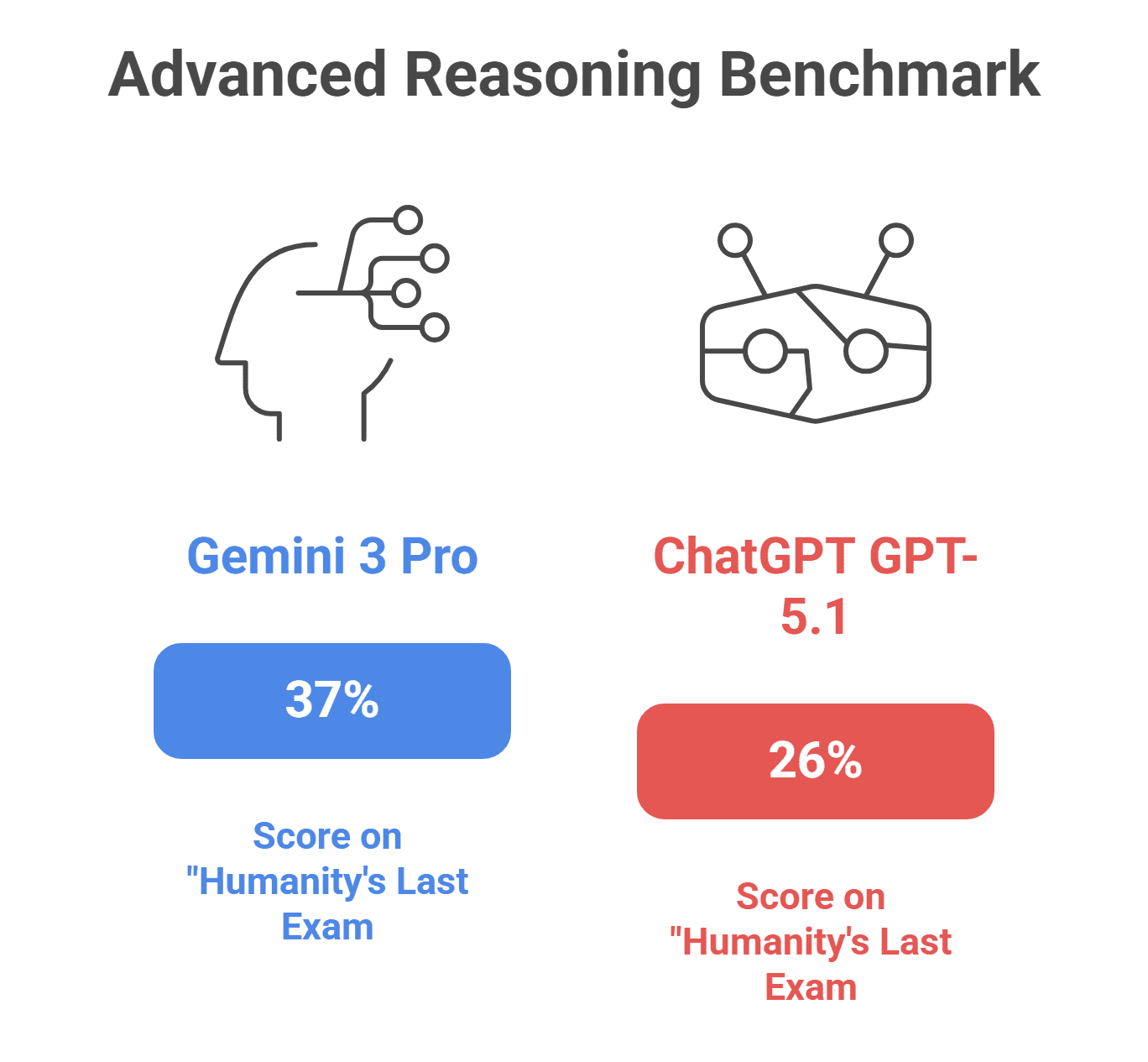
Gemini, on the other hand, was natively multimodal from day one. Its architecture treats text, images, video and audio as equal inputs. This lets Gemini perform cross-modal reasoning: for instance, it can “interpret a sketch and generate working code, or analyze a video and explain its scientific concepts”. Gemini tends to give more concise, data-oriented answers, which can be ideal for professional or technical documentation. In benchmark tests, Gemini 3 Pro leads ChatGPT GPT-5.1 by wide margins on logic and reasoning: for example, Gemini scored ~37% on the advanced “Humanity’s Last Exam” benchmark vs ~26% for GPT-5.1. Its multimodal benchmark scores are similarly strong (87.6% on a video-understanding test vs 80.4% for GPT-5.1). A DataCamp analysis noted Gemini’s one-million-token context window and powerful reasoning (“chart-topping performance”), whereas ChatGPT’s strengths are clarity of dialogue and creative output.
In short: ChatGPT’s strengths are its conversational fluency, rich ecosystem of plugins/custom GPTs, and integration with Microsoft tools and APIs. Gemini’s strengths are its advanced reasoning, native handling of multimedia inputs, and tight integration with Google’s cloud services (Search, Workspace, Vertex). Both platforms offer rich productivity features e.g. ChatGPT can generate a business letter or debug code interactively, while Gemini can pull charts from Google Sheets or images from Google Photos. Both support developer tools (OpenAI API vs Google AI Studio/Antigravity) for building custom agents.
The choice may come down to context. An agency heavy on Google technologies might leverage Gemini’s ecosystem seamlessly. For example, Gemini’s Deep Research agent can scour public websites and internal data, returning answers with citations a boon for research tasks. ChatGPT, meanwhile, ties naturally into Azure and Microsoft 365. Agencies using Office can get ChatGPT-powered writing assistance directly in Word or Outlook via Microsoft’s Copilot offerings. One key difference is data freshness: Gemini can tap into Google Search results for live information, whereas ChatGPT relies on Bing browsing tools or an organization’s own up-to-date data feeds.
 Cost is another factor. Both Google and OpenAI have sought to make their products affordable to the public sector. Google’s deal was ~$0.47 per agency per year (on top of existing Workspace subscriptions), while GSA offered ChatGPT Enterprise at $1 per agency for the first year. Outside of these deals, agencies using commercial services pay either subscription (Google AI Pro vs ChatGPT Plus/Enterprise) or cloud usage fees. Both companies emphasize that in their enterprise plans, customer data is not used to train the models, addressing privacy concerns.
Security, Trust, and Risk Management
For government use, security and compliance can be deciding factors. Both Gemini and ChatGPT are available in FedRAMP-authorized forms: Gemini via Google Cloud’s FedRAMP High certification, and ChatGPT via Azure Government (FedRAMP High and IL5). Each platform also supports common cyber protections (IAM, threat detection, encryption). Google highlights that its offering includes “robust, built-in Advanced Security features” like identity management, threat protection and advanced compliance. OpenAI notes that ChatGPT Gov is built on Azure, where agencies can apply controls like single sign-on and data isolation. In practice, both companies work with GSA and agencies to meet policy requirements (the OneGov deals are explicitly structured to align with federal procurement and AI governance guidelines).
Still, inherent risks of LLMs remain. Both ChatGPT and Gemini can “hallucinate” i.e. confidently assert incorrect information. Government commentators have pointed out that even a small error rate is unacceptable in critical services. (For reference, one test showed Gemini 2.5 hallucinating only 1.1% of the time, which is relatively low but not zero.) To mitigate this, agencies often adopt retrieval-augmented generation (RAG): the model is only allowed to draw on a vetted knowledge base or indexed document corpus, rather than the raw Internet. This is explicitly suggested by GovTech analysis: “By gating the information LLMs can use, agencies can reduce hallucinations born of inaccurate information.” In other words, they tune the models with trusted data to ensure answers are verifiable. Both Azure and Google platforms support this: ChatGPT can connect to internal data sources on Azure, and Gemini for Government can use Vertex AI to ground the model in agency documents.
Privacy and data sovereignty are also issues. As noted, OpenAI warns that chat logs could potentially be subject to discovery or public record requests. Google similarly states that enterprise customers’ data won’t be used for model training without consent. Agencies will likely place extremely sensitive queries into specialized on-premise or private cloud models anyway. In sum, government ai implementation requires robust governance frameworks. Gartner advises that while agencies should experiment with GenAI, they should do so “aligned to their risk appetite” and with human oversight. Both ChatGPT and Gemini can be part of that controlled rollout.
Summary: Which is Best for Government?
In many ways, ChatGPT and Gemini are complementary rather than outright competitors in the public sector. ChatGPT brings a mature, conversation-focused AI with an extensive developer ecosystem and Microsoft integration. It’s ideal for agencies that value narrative flexibility, creative writing, or those already invested in Azure/Microsoft tools. Gemini offers cutting-edge multimodal intelligence and tight Google Cloud integration, which could benefit data-heavy agencies and those needing image/video analysis or Google Drive/Docs collaboration.
At present, Google seems to have the edge on raw benchmarking performance (Gemini 3 Pro’s top-of-the-line scores and unique “Deep Think” mode), while OpenAI has a head start in enterprise AI installations across government. However, metrics are only one part of the story: user experience, trust, and support are also critical. For a given agency, factors like existing cloud contracts, developer familiarity, and compliance posture will guide the choice. In practice, many agencies may use both. For example, a defense lab might use Gemini for automated image analysis and flight mission planning, while using ChatGPT for drafting reports and coding support.
Ultimately, the better model is the one that fits the agency’s mission and constraints. Leaders are advised to define their use cases clearly and pilot both platforms to see which yields better results. In all cases, strong governance restricting outputs to vetted sources, human-in-the-loop review, and continuous monitoring will be essential. As one analyst put it, when the mission matters “accuracy is king”. With careful implementation, agencies can harness the best of generative AI in government from both Gemini and ChatGPT to serve their citizens effectively.
Frequently Asked Questions
What is the difference between Gemini vs ChatGPT for government use?
Gemini focuses strongly on multimodal understanding and deep integration with Google Cloud. ChatGPT is widely adopted and connects naturally with Microsoft environments. Both can support secure, compliant AI services for government.
Which AI model is more secure for public sector agencies?
Security depends on deployment and governance, not only the model. Both platforms offer FedRAMP-aligned environments and enterprise controls. Agencies must still design careful data access and human review processes.
How can generative AI improve government operations?
It reduces manual work, speeds document review, and improves response times.
Teams use it for research, drafting, translation, and automation.
That leads to faster and more consistent public service delivery.
Is Gemini vs ChatGPT a replacement for government staff?
No. These tools assist employees, not replace them. They handle repetitive tasks so teams can focus on complex decisions. Human validation remains essential.
Can AI models connect with internal government databases?
Yes, through secure architectures like retrieval-based approaches. This allows answers grounded in approved agency information. It also reduces the risk of hallucinations.
How are agencies using chatbots today?
A modern chatbot for government can guide residents, answer policy questions, and route service requests. It improves access while lowering call center pressure. Many deployments now include generative AI capabilities.