Top Cyber Threats Facing Government Agencies
Government agencies today are under constant digital siege. In fact, public-sector organizations worldwide saw an average of 2,632 weekly cyberattacks in Q2 2025 – a 26% increase year-over-year. Agencies hold massive amounts of sensitive data and run critical infrastructure, so attackers of all kinds (cybercriminals and nation-state actors alike) target them relentlessly. To keep citizen services running and data safe, governments must adopt robust cybersecurity solutions for government networks. This means treating government cyber threats as a top priority, using real-time monitoring and modern defences to stay one step ahead of hackers.
Some of the top cyber threats against government include:
- Ransomware attacks: Criminals encrypt data and demand payment. (For example, the 2025 St. Paul, MN, and Nevada state attacks saw city and state networks paralyzed for weeks.)
- Supply-chain and software vulnerabilities: Malicious code in trusted updates (like SolarWinds) or unpatched bugs (e.g. zero-days in enterprise software) that slip past defences.
- State-sponsored espionage: Advanced Persistent Threat groups backed by foreign governments target strategic data and communications (see recent Microsoft SharePoint breaches affecting DOE, DHS, HHS and a 150% surge in Chinese cyberespionage).
- Phishing and social engineering: Deceptive emails and communications trick officials into revealing credentials or installing malware (often scaled up with AI tools).
- Legacy/IoT vulnerabilities: Outdated systems and unsecured IoT devices in city utilities, courts, or transport can be entry points (as seen when a Florida water plant on Windows 7 was briefly compromised).
- Insider threats: Careless or malicious insiders with access to government networks or data.
Ransomware: A Major Government Threat
Ransomware government incidents have exploded recently. A Zscaler threat report found attacks on government agencies more than tripled in one year. In other words, ransomware attacks on government systems jumped roughly 235% from April 2023 to April 2025. Criminal groups like LockBit, Conti and “Scattered Spider” now publish gigabytes of stolen government data when ransoms aren’t paid. These attacks often shut down essential services: for example, the City of St. Paul (Minnesota) declared a state of emergency in July 2025 when hackers disabled its networks for over a month. Similarly, an August 2025 ransomware breach in Nevada took 10% of the state’s websites offline for weeks. These cases show how ransomware government incidents can cripple operations. Worse, many groups now exfiltrate data before encryption, then extort victims publicly, heightening the risk of sensitive leaks.
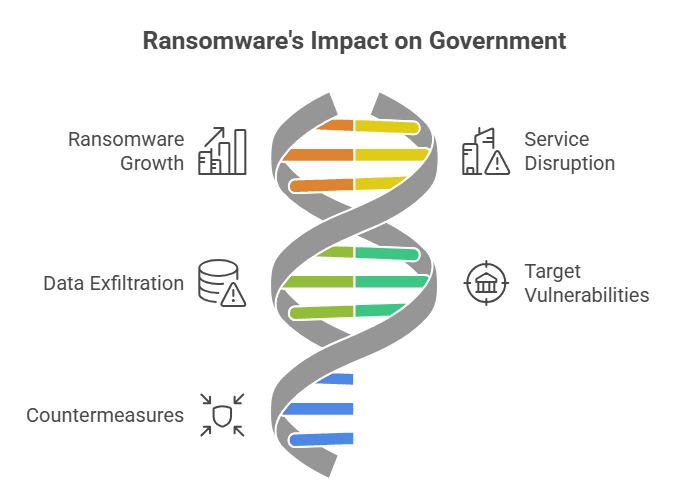
Government agencies are prime ransomware targets for several reasons: they oversee critical services (utilities, health, elections), often operate on tight budgets or with legacy IT, and feel public pressure to restore services quickly. In fact, one report notes governments “check all the boxes” for attackers wanting a fast payout. To combat this, many jurisdictions are tightening rules: for example, New York State now mandates that local governments report cyber incidents and disclose any ransom paid within strict timelines. Other countries, like the UK, are even moving to ban public-sector ransom payments outright.
State-Sponsored Espionage and APT Attacks
Government agencies also face highly skilled state-sponsored threats. Adversarial regimes (China, Russia, Iran, North Korea, etc.) conduct espionage and pre-positioning attacks on government networks. A recent U.S. report noted that Chinese state-backed actors have compromised more than 400 organizations by exploiting a flaw in Microsoft SharePoint, including high-level U.S. agencies. Another analysis found PRC cyber espionage surged 150% in 2024 over 2023. Notorious campaigns like “Salt Typhoon” breached nine major telecom providers in 2024 part of a broader effort to monitor or disrupt critical infrastructure.
Similarly, Russian-affiliated attackers have targeted federal courts and other agencies; Iranian actors spike activity around geopolitical events; and North Korea has even placed operatives in IT jobs to steal government secrets. In short, foreign intelligence services view government data and communications as high-value targets. These world powers increasingly leverage AI-driven tools, too. Security analysts warn that threat actors are “embracing AI” to automate reconnaissance, craft highly convincing phishing emails, and even develop self-running malware. In fact, the push toward AI cybersecurity threats 2026 (deepfake phishing, automated network scanning, agentic attack programs) means agencies must expect faster, more adaptive adversaries.
Supply-Chain and Software Vulnerabilities
Another top concern is attacks via trusted systems. The infamous SolarWinds supply-chain breach (2019–2020) showed how inserting malware into official software updates can infect thousands of agencies at once. Over 18,000 organizations including government bodies were impacted in that campaign. This highlights that government data security can be compromised even through legitimate vendors. Likewise, software flaws and unpatched zero-days in widely used platforms pose systemic risk. In late 2025, for example, a breach at networking vendor F5 Networks (source of the BIG-IP appliance) prompted CISA to issue an emergency patch directive for all federal systems.
Even routine IT tools can become threat vectors. The 2021 Colonial Pipeline attack began when hackers used credentials from an unused VPN account that lacked multi-factor authentication. Although Colonial is a private utility, the lesson is clear: any stale or poorly secured access point in a government network is a ticking time bomb. In short, agencies must maintain government it solutions that emphasize continuous monitoring, asset inventory, and swift patch management.
Phishing, Insider and Legacy Risks
Behind the scenes, everyday tactics still outnumber blockbuster breaches. Phishing emails and credential theft are primary entry methods for many breaches. Studies repeatedly show that human factors clicking malicious links or reusing passwords are prevalent. (Even NIST emphasizes that identity stolen or weak credentials remains a “key battleground” for attackers.) Training government staff to recognize scams is crucial.
Meanwhile, legacy systems and forgotten devices continue to jeopardize security. For example, in 2021 hackers remotely accessed a Florida water treatment plant by exploiting Windows 7 and weak passwords briefly altering chemical levels in the water supply. Many local governments still run unsupported software on utility or administrative machines, creating easy targets. The surge in IoT (smart traffic cameras, industrial sensors, etc.) further expands the attack surface. Each connected device not updated or segmented from core networks can be a backdoor into sensitive systems.
Managing and Mitigating Threats
What can governments do? The solution lies in comprehensive management of cyber threats in government a multi-layered defensive strategy:
- Risk Assessment & Planning: Agencies should follow established frameworks (NIST Cybersecurity Framework, ISO 27001) and conduct regular risk audits. This helps prioritize the highest threats (e.g. critical services like elections or utilities).
- Continuous Monitoring: Deploy Security Operations Centers (even virtual ones) and Risk Intelligence Platforms that ingest threat feeds. Real-time logs and alerts allow early warning of intrusions. For example, the recent F5 breach led CISA to mandate patches for all federal networks. That kind of swift, centralized action comes from strong monitoring and governance.
- Patch and Vulnerability Management: Known exploits must be closed immediately. Emergency directives (like the CISA notices after F5 and Cisco zero-days in 2025) are effective tools. State & local governments should track these advisories and update software without delay.
- Zero Trust and Segmentation: Assume internal networks can be compromised. Use zero-trust models where every user and device is continuously verified. Segment critical systems so that a breach in one area doesn’t cascade.
- Multi-Factor Authentication (MFA): Enforce MFA on all accounts, especially those with remote or admin access. As shown by Colonial Pipeline, an inactive account without MFA allowed massive disruption.
- Employee Training: Conduct frequent phishing simulations and cybersecurity hygiene training. Government employees at all levels need to be alert to suspicious messages. Even high-profile breaches often start with a click on a malicious link or credential reuse.
- Incident Response Plans: Have tested playbooks for breaches. Backup data off-network and establish alternative communication channels (so agencies can keep working if main systems go down). For example, local governments have begun stockpiling “air-gapped” tools to keep essential services running under attack.
- Information Sharing: Participate in ISACs (Information Sharing and Analysis Centers) and public–private partnerships. Sharing indicators of compromise helps everyone react faster. In tight situations, federal–state coordination can compel rapid fixes, as seen when the U.S. Treasury system breach was reported by a vendor only days late.
- Community and Public Engagement: Cybersecurity isn’t just an IT issue; it’s a community one. Local governments often launch programs for Defending Your Community Against Cyber Threats by educating citizens (e.g. encouraging secure personal devices) and coordinating with businesses. When an entire community is informed about phishing or ransomware, the overall risk drops.
By combining these measures, government agencies can turn defense into a competitive advantage rather than a liability. Indeed, the shifting threat landscape from sophisticated supply-chain hacks to AI-powered strikes means no agency can afford complacency.
Frequently Asked Questions
What are the biggest cyber threats to government agencies?
Ransomware, supply-chain attacks, state-sponsored espionage, phishing, legacy/IoT vulnerabilities, and insider threats are the top risks. Cyber emergencies are now common across U.S. states.
How common are cyberattacks on government networks?
Very common. In 2025, 44 U.S. states reported major incidents, and attacks on public-sector networks rose 26% globally. Ransomware attacks on governments are now routine.
Why are government agencies targeted by hackers?
Governments hold sensitive data and critical services. Hackers pursue espionage, financial gain, and leverage over citizens or infrastructure.
What is ransomware in the context of government?
Ransomware encrypts data or locks systems until a ransom is paid, disrupting services. Government attacks often involve sensitive data theft and have surged in recent years.
How can governments manage and mitigate cyber threats?
Use strong frameworks (NIST, ISO), patch systems promptly, enforce MFA, segment networks, monitor threats, train staff, and maintain clear incident response plans.