
Transforming Healthcare with Generative AI and Predictive Analytics
Healthcare is undergoing a dramatic shift as generative AI in healthcare and advanced predictive analytics become mainstream. These AI technologies can reduce clinician burden, improve patient outcomes, and cut costs by mining vast datasets for insights. For example, a recent report notes that 85% of health organizations now use AI, with 82% reporting strong ROI. Generative models can even design drugs the first drug fully created by generative AI has entered human trials. Predictive analytics, meanwhile, analyzes patient data to forecast risks and tailor treatments. Together, these approaches promise a new era of proactive, personalized healthcare.
Generative AI refers to AI systems (often large language models or GANs) that create new content from learned patterns. Predictive analytics uses machine learning on historical data to predict future outcomes, like disease progression or hospital admissions. In healthcare, blending both lets providers not only anticipate patient needs but also automatically generate treatment plans, reports, or patient communications.
Generative AI in Healthcare
Generative AI is unleashing creative solutions in medicine. These AI models from GANs to transformer LLMs generate new data, images, or text. For instance, GANs can simulate virtual patient populations to augment scarce data, enabling accurate modeling of rare diseases. Below are key generative AI use cases in healthcare:
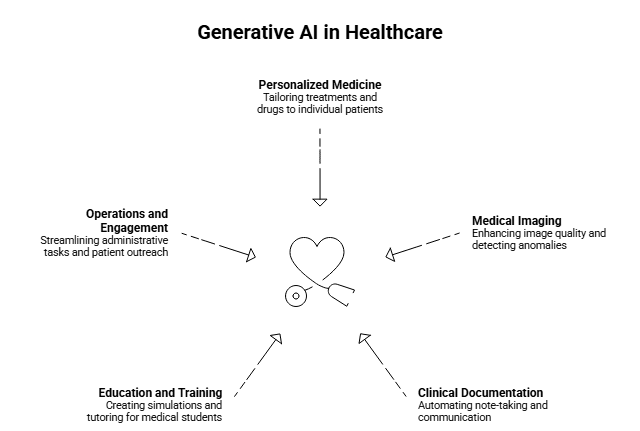
- Personalized Medicine & Drug Design: Generative AI can craft individualized treatment plans and molecules. The GENTRL model, for example, designs drugs tuned to a patient’s biology. In fact, the first drug created entirely by AI has already entered clinical trials. These models also analyze genetic and wearables data to predict medication responses, leading to tailored prescriptions.
- Medical Imaging & Diagnostics: AI generates synthetic medical images (X-rays, MRIs, etc.) to train diagnostic tools. Advanced models (like GANs or VAEs) enhance image quality and detect anomalies such as early diabetic retinopathy. This improves radiology workflows and enables earlier disease detection.
- Clinical Documentation & Virtual Assistants: Generative language models (e.g. GPT-4) can draft patient notes, discharge summaries, or empathetic replies to patient messages. For example, GPT-4 has been shown to draft patient portal responses that reduce physician burnout. Automating tasks like coding and billing via AI also frees up staff for patient care.
- Education and Training: AI-generated simulations and tutoring are transforming medical education. In nursing schools, AI-driven simulations recreate complex clinical scenarios for students. Universities are integrating AI (ai use in universities) into research and teaching, accelerating breakthroughs in health technology.
- Operations and Engagement: AI can even create personalized patient education materials and streamline administrative workflows. Custom content (e.g. health tips or reminders) can be auto-generated to improve patient engagement. Automating revenue cycle tasks such as claim coding dramatically cuts workload. In marketing and public relations, AI crafts tailored messages that enhance patient outreach and satisfaction.
These examples show generative AI use cases in healthcare are broad from the lab to the clinic and the classroom. By continuously learning, these models can adapt to new data, driving improvements in care and efficiency. Importantly, healthcare leaders must guide these innovations with strong governance to address ethics, privacy, and bias concerns.
Predictive Analytics in Healthcare
Predictive analytics in healthcare uses AI to transform data into foresight. By crunching EHRs, imaging, genomics, and device data, ML algorithms forecast outcomes and risks with high accuracy. Hospitals and health systems are already deploying these tools. For example, UC San Diego Health implemented a deep learning model on EHR data to predict sepsis early in patient care. Below are key predictive analytics in healthcare use cases:
- Risk Prediction & Early Warning: AI predictive analytics can alert clinicians to high-risk patients before events occur. Models forecast things like hospital readmissions, surgical complications, or deteriorating vitals. They can even predict outbreaks by analyzing population trends. In practice, ML models have achieved 84–85% accuracy predicting 30-day readmission and hernia recurrence over a multi-year follow-up.
- Personalized Treatment Plans: By analyzing patient history and outcome data, predictive analytics helps tailor therapies. AI can suggest the best treatment protocols for a given patient profile, or identify those who will respond poorly to standard therapies. This “precision medicine” approach was highlighted as a core benefit of AI predictive models.
- Resource Optimization: Predictive algorithms assist hospitals in planning staffing, bed capacity, and supply needs. They forecast patient volume (e.g., ER arrivals or ICU demand) so resources are allocated efficiently. During pandemics or seasonal surges, these tools help public health officials prepare responses in advance.
- Public Health & Population Insights: Public health agencies use predictive analytics to model disease spread and intervention outcomes. For instance, AI can project flu season intensity or COVID-19 case trajectories, enabling early containment measures. AI in public health from risk prediction to disease forecasting has proven vital during the COVID-19 crisis.
- Outcome Evaluation: Clinics use predictive models to evaluate treatment effectiveness and improve protocols. By studying which factors correlated with success or failure in large datasets, providers continuously refine care guidelines.
Overall, AI predictive analytics in healthcare empowers a shift from reactive to proactive care. As one review notes, these tools forecast patient outcomes with precision beyond traditional methods, and continuously improve with new data. By integrating predictions into clinical workflows, organizations can intervene earlier, reduce adverse events, and improve recovery rates.
Government, Public Health, and Education Applications
Healthcare leaders and policymakers are especially interested in applying AI at scale. Governments are engaging in government AI consulting to safely integrate these technologies in health programs. For example, agencies may commission a Digital Health Platform that uses predictive models to allocate resources or identify at-risk populations.
- Public Health Agencies: Agencies like the CDC leverage AI for population health surveillance. AI-driven spatial modeling and outbreak prediction helped manage COVID-19 spread. AI in public health includes analyzing social media to counter misinformation and using machine learning for contact tracing and risk modeling. However, implementation varies by region, often constrained by infrastructure and data-sharing policies.
- Government Health Programs: Initiatives such as the Ryan White HIV Platform can benefit from these advances. By applying predictive analytics, such platforms could flag patients at risk of treatment failure or identify service gaps early. Integrating generative AI might automate reporting for case managers, letting them focus on patient care rather than paperwork.
- Academic and Research Institutions: AI use in universities for healthcare research is booming. University hospitals are early adopters of AI-driven imaging analysis and predictive studies. They also develop new AI models in partnership with industry. This cross-collaboration helps translate breakthroughs (like novel drug targets from generative models) into clinical practice
- Government Services and Apps: Generative AI in the government sector is poised to transform citizen services. Imagine health chatbots in state apps that provide tailored guidance, or virtual assistants summarizing policy changes for clinicians. Similarly, government mobile app development teams are exploring AI features for telehealth apps, appointment scheduling, and remote monitoring.
- Policy and Ethics: As AI permeates health policy, governments are drafting guidelines for safety and privacy. Consultants advise on data governance, ensuring models respect patient privacy while delivering insights. Strong governance frameworks (for data use, bias mitigation, and transparency) are essential to public trust.
These examples show that both federal and local entities see AI as a strategic asset for health. From government AI consulting on secure system design to digital health platform innovations, public sector use of AI can amplify care quality and equity. At the same time, stakeholders emphasize robust regulation and education to maximize benefits while safeguarding data.
Future Outlook and Challenges
Generative AI and predictive analytics hold enormous promise, but challenges remain. Data privacy and security must be ensured as more patient data feeds these systems. Ethical oversight is critical: models should be audited to avoid bias or inequity in care. Interoperability of health records is another hurdle predictive models need clean, standardized data to perform well.
Yet, the momentum is clear. AI-driven innovation is already saving clinicians time, for example by cutting documentation work 21–30%. Healthcare professionals anticipate that these tools will only become more powerful. Over the next decade, we expect AI predictive analytics in healthcare to become integral to clinical decision-making, and generative AI use cases in healthcare to expand from lab to bedside. By combining sophisticated analytics with creative generative models, health systems can move from one-size-fits-all to truly personalized, anticipatory care.
Ready to embrace the future of health technology? Our team specializes in government AI consulting, mobile app development, and cutting-edge digital health solutions. Whether it’s building a secure Digital Health Platform or enhancing an existing service like the Ryan White HIV Platform, we can help you apply generative AI and predictive analytics to improve care delivery. Contact us to bring these transformative technologies to your healthcare organization and lead the AI-driven revolution in health.
Frequently Asked Questions
What is generative AI in healthcare?
Generative AI refers to AI models that create new data. In healthcare, this means generating realistic patient images, text, or even simulated medical scenarios. For example, a generative model might create synthetic MRI scans for training or draft patient education based on medical records. These AI systems learn patterns from real medical data and then produce new examples that aid research or automation.
What is predictive analytics in healthcare?
Predictive analytics uses statistical and machine learning techniques on health data to forecast outcomes. It might analyze electronic health records, genetics, or wearables to predict a patient’s risk of complications, likely response to treatment, or chances of hospital readmission. By identifying trends hidden in large datasets, predictive analytics helps clinicians make data-driven decisions. For instance, it can flag high-risk patients early for preventive care.
What are the benefits of predictive analytics in healthcare?
Predictive analytics brings tangible improvements: early detection of illnesses, personalized medicine, and operational efficiency. Hospitals using predictive models catch complications sooner, reducing emergency admissions. Clinics personalize care by anticipating how patients will respond to therapies, improving recovery rates. And healthcare systems optimize resources for example, AI-based scheduling tools have cut staffing costs significantly by matching personnel to predicted patient volumes. Studies even show AI-powered analytics reduce hospital readmissions and clinician burnout.
Is generative AI safe for public health programs and government agencies?
When paired with strong governance, privacy controls, and audits, generative AI in healthcare can support public programs. Agencies often require HIPAA compliance, ISO 27001, or SOC 2-style controls before deployment.
How do hospitals get started with generative AI and predictive analytics?
Start with a pilot that targets a clear pain point (e.g., sepsis prediction or documentation). Use interoperable data, run a privacy impact assessment, and validate results in real workflows.
What public-sector benefits come from using AI in public health?
AI in public health improves outbreak detection, resource planning, and population-level risk mapping. Governments can scale predictive tools on Digital Health Platforms for faster, data-driven responses.