
How So Government Agencies Staff IT Infrastructure Roles
Government IT infrastructure projects today are mission-critical, underpinning everything from security and data services to citizen engagement in local government platforms. Yet surveys confirm chronic talent shortages. For example, a 2022 NASCIO report found nearly 90% of state CIOs cite IT staff shortages (especially in cybersecurity, app development, and analytics) as a major concern. Similarly, a 2023 federal survey reported 78% of government entities face an IT hiring shortage the highest of any industry. At the same time, agencies need to modernize: staff are needed for cloud migrations, network redesigns, and other digital transformation projects that private firms tackled years ago. In short, government IT infrastructure roles from network engineers and system administrators to cloud architects and cybersecurity analysts are in high demand but hard to fill.
This gap shows up in everyday government work. A 2023 survey of state and local tech leaders found many report vacancies in “traditional IT roles the database administrators, the system administrators… the people who you need in order to make your network work”. At the county level, 68% of respondents said they need help with application development and integration, while 61% lack data/business-intel staff and 63% lack process-improvement talent. State and city IT heads echoed those needs: for example, 93% of state agencies said they need more application-building expertise (compared to 53% of cities). These shortages put pressure on agency agendas CIOs report that urgent needs like cloud strategy, digital services and citizen-facing applications are stalling for lack of staff. Put bluntly, without enough skilled people, even well-funded government IT infrastructure projects can flounder and expose agencies to security risk.
Staffing strategies and workforce planning
To overcome these shortages, agencies use a multi-pronged approach. Hiring and developing internal talent remains a foundation: governments increasingly cultivate employees through training, internships, and more flexible career tracks. Many IT leaders are opening up a range of IT roles to those with certifications and other qualifications, rather than requiring a four-year degree. For instance, some states now accept two-year degrees or industry certificates instead of bachelor’s degrees, widening the applicant pool. Agencies also strengthen retention (offering remote work, hybrid schedules, and DEI initiatives) so that existing staff stay longer and mentor newcomers.
When internal hiring can’t meet demand, contract and contingent staffing fill gaps. This may include temporary workers on GSA schedules, contracts under Statements of Work (SOW), or full-time-equivalent consultants. Many governments keep open contracts or master agreements with staffing firms that specialize in the public sector. These government IT infrastructure staffing services providers maintain rosters of cleared, vetted professionals (network engineers, cloud specialists, security experts, etc.) ready to deploy. As one industry analysis notes, staffing companies … maintain a network of qualified professionals and can match agencies with candidates who are prepared to contribute from day one. In practice, an agency can quickly augment its team for a cloud migration or cyber audit by tapping such firms, without running a full recruiting cycle.
Some agencies also partner for managed services or outsourcing of infrastructure operations. Rather than staff every role in-house, a government might contract out 24/7 network monitoring or data-center hosting to an experienced vendor. During a disaster or peak demand, agencies rely on these arrangements to scale up quickly. For example, emergency response centers often bring in outside IT teams to manage communications and restore systems under pressure. However, as surveyed CIOs caution, managed services are handled with care: many agencies prefer to build a more robust and resilient in-house team, and others worry about vendor risk especially in sensitive areas like cybersecurity.
Below is a summary of key staffing approaches:
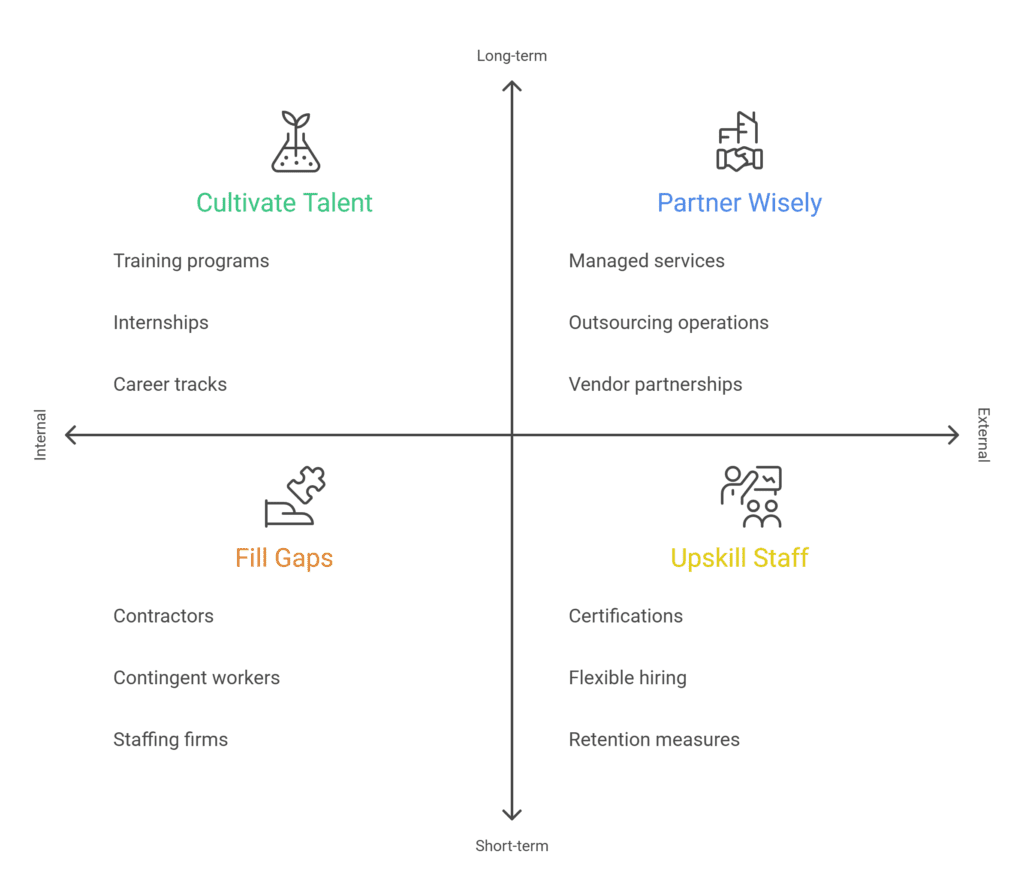
- Internal recruitment and training: Build talent pipelines by partnering with universities, creating internship/apprenticeship programs, and valuing certifications. (Example: North Dakota’s CIO emphasized flexibility in hiring, saying “if it doesn’t require a four-year degree, let’s look at that”.)
- Staffing contracts and vendors: Use dedicated public sector IT infrastructure staffing solutions, including MSPs or subcontractors, to provide short- or long-term personnel. Contracts can be structured around outcomes (e.g. network uptime) rather than time.
- Consultants and project-based hires: For specialized projects (cloud migrations, network redesign, new data centers), engage IT infrastructure consulting services for government. These firms offer strategic and technical expertise as well as people helping plan and even execute modernization while training agency staff.
- Managed Services/outsourcing: Outsource specific infrastructure operations (such as help desk, monitoring, or disaster recovery) when continuous coverage is needed. This approach must be balanced against the need for in-house knowledge and security control.
- Talent retention measures: Improve benefits, career paths, and work flexibility to keep existing IT staff from jumping to the private sector. Many agencies now prioritize remote or hybrid options and professional development, recognizing that today’s tech workers value those more than straight salary.
The role of consulting and staffing services
Outside expertise plays a critical role in staffing government IT infrastructure. Agencies often engage specialized it infrastructure consulting services for government to assess technology needs and advise on workforce planning. For example, before launching a cloud-first initiative, an agency might bring in consultants to design the new architecture and identify required skills. These consultants can help the agency build a hiring plan or subcontractor plan aligned to technical goals. McKinsey, for instance, notes that sourcing is key to building the right team: a modern IT project needs both in-house core experts and external specialists (integrative architects vs. niche domain experts). In practice, firms offering infrastructure consulting often also supply staff effectively bridging strategy with execution.
Similarly, government IT infrastructure staffing services are an established category. These firms focus on the public sector’s unique needs (security clearances, compliance standards, legacy systems) and help agencies recruit accordingly. They may offer managed staffing programs or dedicated “centers of excellence” for IT roles. As one review explains, staffing partners keep a network of qualified professionals ready to address sudden needs. This means when an agency issues an RFP for, say, a network engineer or DevOps engineer, the staffing firm can quickly put forward candidates with prior cleared experience. In addition, good staffing firms aid with onboarding and compliance issues guiding agencies through labor laws and hiring processes across state lines.
Engaging these external services lets procurement and IT leaders scale rapidly for new initiatives. For example, a state emergency management agency might line up a team of contract sysadmins and security analysts when implementing a new data center migration, then wind it down as project phases complete. Or a local government could supplement its small IT department with a fractional CISO or cloud architect from a consulting firm. In every case, the goal is to match critical infrastructure projects with talent sources that can move faster than traditional civil-service hiring.
Aligning staffing with modernization and policy goals
Staffing decisions are increasingly tied to broader technology goals. The push toward digital transformation in the public sector including cloud adoption, data analytics, and citizen-centric services is reshaping role requirements. Gartner predicts that many future government IT roles (for AI, IoT, etc.) don’t even exist today, so agencies must plan ahead. Congress and oversight bodies also press for modernization: laws like FITARA or the creation of offices for AI and data signal that infrastructure must be both agile and secure.
To adapt, procurement execs should consider which skills are strategic. Can the agency train current staff in cloud networking, or should it hire network architects? McKinsey advises agencies to set clear objectives for modernization (e.g. cost savings, improved service) and then build teams accordingly. Often this means blending: retain a few in-house experts on your modernized stack (integrative architects, senior security analysts) while sourcing others externally. Leveraging government IT staffing consulting expertise helps make those tradeoffs. For example, a CIO might hire a consulting firm to analyze their current data center inventory, then recommend a staffing plan to migrate to the cloud with minimal disruption.
Importantly, technology upgrades depend on people: better infrastructure only boosts capabilities when skilled staff can operate it. This is true even at the local level: for citizen engagement in local government, responsive online portals, mobile apps, and social platforms require backend support. If a town deploys a citizen portal but has no one to maintain the servers or databases, user trust will suffer. Thus agencies are directed to align staff plans with digital service goals. In practice, that alignment may involve cross-training existing employees so a network admin learns cloud management or hiring for emerging roles like data engineer or DevOps specialist.
Best practices for staffing and procurement
Successful agencies pair staffing strategy with strong procurement execution:
- Plan ahead with workforce data: Conduct skills inventories and future-demand forecasts. Identify which IT infrastructure roles are hardest to fill and critical for upcoming projects. (For example, many agencies now track vacancies in cloud and cybersecurity roles as key metrics.) Then set up multiple hiring pipelines: internships, partnerships with local colleges, and continuous recruitment for evergreen positions.
- Use flexible contracting methods: Break large infrastructure projects into smaller procurements when possible, or use Statement-of-Work (SOW) and IDIQ contracts for staffing. This keeps obligations aligned with outcomes (e.g. “we need this network fully configured by Q3”) rather than fixed hours. Contracts can explicitly allow ramping up or down so agencies aren’t stuck paying idle staff.
- Engage staffing and consulting vendors early: As soon as modernization plans form, bring in your staffing advisor. Firms that specialize in public sector IT infrastructure staffing solutions can help define job descriptions, locate niche skills, and even manage clearance transfers. By integrating these partners into the acquisition team, agencies avoid last-minute scrambling for talent.
- Emphasize training and retention: Allocate budget for staff certifications and career development (cloud certifications, security training, etc.). Promote internally to senior technical roles whenever possible. This not only fills needs but improves morale, as employees see a clear path. Many agencies now publicize “grow-your-own” stories (e.g. a tech hired as a contractor later became a full-time systems engineer) to attract applicants.
- Align with security and compliance from day one: In any staffing plan, ensure candidates meet clearance or regulatory requirements. Using vetted staffing services helps many firms pre-screen candidates for federal IT roles. Also consider co-employment or managed service models to minimize risk: for critical infrastructure work like handling citizen data, some agencies mandate that only designated cleared staff perform the tasks, even if working for a contractor.
Across federal, state, and local government, technology is only growing more central to every mission. In Forrester’s view, U.S. government tech spending is projected to exceed $350 billion in the next few years, emphasizing new tools and platforms. That investment must be matched with investment in people. By taking a strategic, multi-channel approach to hiring combining direct hires, contractors, managed services, and consultation government IT leaders can staff their IT infrastructure to meet both today’s needs and tomorrow’s innovations.
Ready to strengthen your team? Contact our experts to discuss tailored government IT infrastructure staffing and consulting solutions. We specialize in connecting public agencies with cleared infrastructure professionals, from cloud architects to cybersecurity specialists, so you can execute your mission with confidence and agility.
Frequently Asked Questions
Why is it hard for government agencies to fill IT infrastructure jobs?
Users want to understand hiring barriers such as slow processes, rigid pay scales, and competition with the private sector all of which contribute to shortages in technical talent. Research shows government hiring processes can take 119+ days, which often means candidates accept other offers during that time.
What challenges do state and local governments face in recruiting IT professionals?
Query themes include lack of recruitment infrastructure, limited employer branding, budget constraints, and slow hiring processes. These internal factors often make government IT roles less attractive compared to the private sector.
How does staff shortage impact government IT modernization and service delivery?
Users ask how staffing gaps delay cloud migrations, degrade digital services, or increase burnout. Surveys report more than 70% of IT officials struggle with staffing tied directly to modernization barriers.
What strategies help government agencies recruit and retain IT talent?
Searchers are interested in skills-based hiring reforms, hybrid/remote work models, contractor partnerships, and staff augmentation as solutions. Federal hiring modernization reforms now prioritize practical skills over only degrees.
Why does public sector IT continue to struggle even when budgets are available?
Questions often touch on bureaucratic hiring rules, long approval chains, and lack of recruitment marketing, which slow access to critical infrastructure talent even in well-funded agencies.