
How Digital Records Management Helps Government Stay FOIA-Compliant
Government agencies face mounting transparency requirements under the Freedom of Information Act (FOIA). FOIA mandates that agencies preserve and produce official communications upon request and generally respond within 20 business days. In practice this means any email, social media post, text or document the government creates can be subject to a public records request. For example, in FY2023 federal agencies received over 1.1 million FOIA requests (a 30% increase over the prior year). Manually gathering and reviewing paper or siloed digital files to meet these requests is extremely time-consuming. Digital records management offers a solution by capturing and organizing all official records in one system, dramatically speeding retrieval and ensuring FOIA compliance.
The FOIA Challenge in Modern Governance
Legacy filing systems and disconnected data sources make FOIA compliance difficult. Paper files, email archives, text messages, and social media often live in separate inboxes and devices. When a records officer must fulfill a FOIA request, they may have to dig through stacks of papers or search multiple accounts and formats. This delays response times and risks missing records. A recent survey found that many government records managers lack confidence in handling FOIA requests involving modern communications like SMS or collaboration platforms (e.g. Teams, Slack). In short, the complexity and volume of today’s records can quickly overwhelm manual workflows.
Organizations across government recognize this pain point. A unified digital system that automatically archives every official communication from emails and documents to instant messages and social media posts transforms FOIA records management. In one illustrative finding, agencies that embrace smart archiving report faster FOIA turnarounds and more confidence in their data governance. By moving away from paper and point solutions, agencies can dramatically reduce FOIA backlog and meet deadlines with ease.
What Is Digital Records Management?
Digital records management refers to systems and practices that securely capture, organize, and preserve government documents and communications. Rather than storing files in cabinets or disparate servers, records are ingested into a centralized repository with rich indexing and search. A modern system will:
- Capture All Communications: Every official channel is preserved. Automated archiving tools ingest email, chat messages, SMS, mobile apps, social media posts, and even website content. By “capturing every official communication” and keeping it fully searchable, the system ensures nothing is missed. For example, an agency’s internal chat on Slack or a tweet from its official Twitter account are both treated as FOIA records.
- Index and Search at Scale: Powerful indexing engines tag records with metadata (dates, senders, keywords) so any staffer can run an advanced search. This indexing makes retrieval “fast and easy” a user is “just a keyword search away from finding that important document”. A high-performance system can scan millions of records in seconds, applying dozens of criteria to zero in on exactly what’s needed. Speedy search means FOIA requests that once took days or weeks can now be handled in minutes.
- Automate Classification & Retention: Machine learning and rules engines categorize and tag records automatically. Documents are routed into retention schedules and disposition workflows from day one. In practice, agencies “configure retention and deletion policies in the system upfront… Most archives support rule-based tagging and schedule-driven disposition” to minimize manual tasks. Proper configuration ensures that, for example, once an email is 7 years old it is purged if the law allows, or preserved permanently if it is designated a historical record.
- Provide Secure, Compliant Storage: Records are stored with encryption, role-based access, and full audit trails. Every access, view or edit is logged, creating an immutable history of who did what. As one case study noted, a jurisdiction’s on-premise records system (with FIPS-compliant encryption and detailed audit logs) helped it easily meet FOIA and state-level record retention requirements. Strong security and audit capabilities not only protect sensitive data but also serve as proof of compliance if audited.
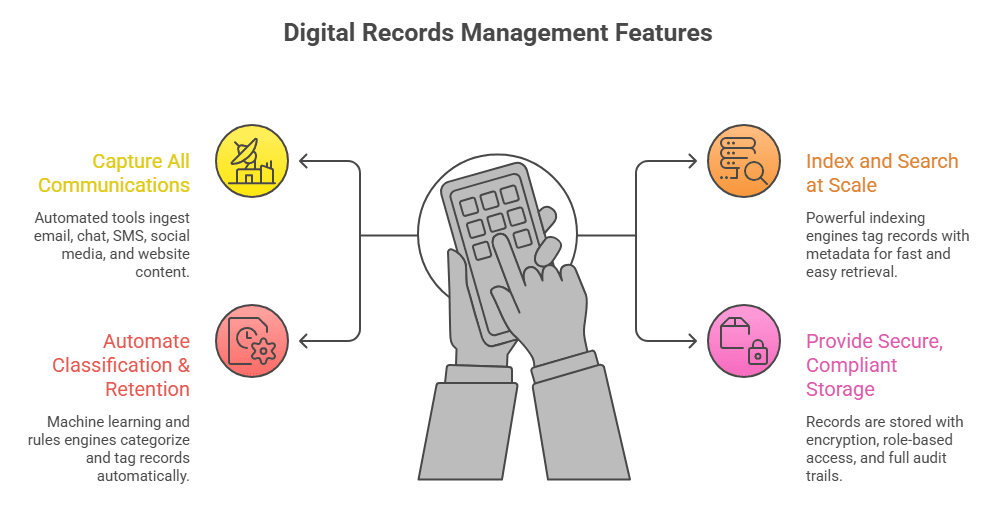
By combining these features, digital records management turns chaotic information piles into a structured, searchable archive. Records officers spend less time hunting and more time processing. As one expert summarized: efficient public records management software “turns compliance into a streamlined, even automated process”.
Key Benefits for FOIA Compliance
Implementing digital records management yields tangible advantages for public agencies:
- Faster FOIA Responses: With indexing and search, agencies can answer requests in minutes instead of weeks. Studies show well-managed digital archives allow “faster retrieval times” and instant access to requested records. Automated search cuts response times dramatically, freeing staff to handle high-value tasks.
- Complete Transparency and Accuracy: Automation greatly reduces human error. Records automatically tagged and held according to law means fewer missed or misfiled documents. An accurate, unified archive ensures every relevant file is found, preventing incomplete or over-broad releases. This builds public trust: agencies that respond quickly and accurately to FOIA requests bolster confidence in government transparency.
- Regulatory Compliance: Out-of-the-box retention schedules and audit trails help meet all legal mandates. Built-in compliance features ensure adherence to regulatory mandates such as FOIA and NARA record retention guidelines. In practice, the system can enforce state and federal retention rules, so records are kept as long as required and no longer. This level of control dramatically reduces the risk of legal penalties for non-compliance.
- Audit Readiness: Full logs of every record’s history mean agencies are always prepared for legal or legislative audits. If sued or queried, officials can produce a forensic trail of exactly how a document was handled. Docsvault’s case study noted that with audit trails enabled, the office was able to meet FOIA and retention requirements with confidence.
- Cost and Space Savings: Going digital cuts paper and storage costs. Agencies save money on physical archiving and staffing needed to find paper files. Digital systems typically use offsite or cloud backups, which both lower expenses and guard against disaster loss. Over time, efficient records management “reduces manual labor and storage costs” while avoiding the expense of data bloat.
- Improved Information Security: Centralized digital vaults are easier to secure than endless filing cabinets or distributed file shares. Encryption, multifactor login and network monitoring protect records in transit and at rest. Many modern archives even leverage blockchain or tamper-proof logs so no record can be altered undetectably. This bolsters both FOIA compliance and overall data security.
Together, these benefits turn FOIA compliance from a burdensome audit into a byproduct of good information governance. The transformation is clear: agencies with solid digital records management report much faster FOIA turnarounds and far fewer headaches during inspections.
Features to Look For in a FOIA-Ready System
When evaluating records management solutions, CIOs and records officers should look for these capabilities:
Comprehensive Capture:
The system must ingest every channel the agency uses. This includes email, office documents, chats, SMS, social media, public websites, and more. By centralizing all records, one search can find an email in one click instead of manually pulling from multiple platforms.
Advanced Search & Retrieval:
A high-performance search engine is critical. The system should support full-text and metadata filtering, letting you query by date, sender, keywords, etc., across millions of records. Look for solutions that tout sub-second search performance or “blazing fast” results. Bulk export and redaction tools are also helpful for preparing FOIA disclosures in bulk.
AI-Powered Classification:
Automated tagging and machine learning classification can dramatically reduce manual workload. Leading products use AI to categorize records on ingestion (e.g. labeling as “personnel file” or “financial report”), making search smarter. As one report notes, harnessing AI for automated categorization and retrieval can revolutionize how you manage public records.
Strong Security & Audit Trail:
Ensure the system offers encryption, role-based permissions, and multi-factor authentication. Every access should be logged. Some solutions even provide blockchain-based immutability, guaranteeing that once a record is archived it cannot be retroactively altered without detection. A robust audit trail is vital for proving FOIA compliance.
Automated Retention Schedules:
The platform should allow you to configure disposal or archival rules per record type. For example, automatically destroy a record when its legal retention expires, or flag it for long-term preservation. Automation prevents accidental destruction or indefinite hoarding of records.
Cloud or Hybrid Architecture:
Modern solutions often offer cloud deployments that scale with your needs. The cloud makes it easier to store massive archives and collaborate. App Maisters, for example, helps agencies migrate to FedRAMP-compliant cloud environments, laying the foundation for secure, scalable FOIA processing. (On-premises options can also be found for agencies that require full data sovereignty.)
By ticking off these features, agencies ensure that their records system truly supports FOIA. As one guide put it, the right archiving system should feel like a natural extension of your government IT solutions, one that records communications transparently without burdening your staff.
Implementation Best Practices
Rolling out digital records management requires planning and change management. Some best practices include:
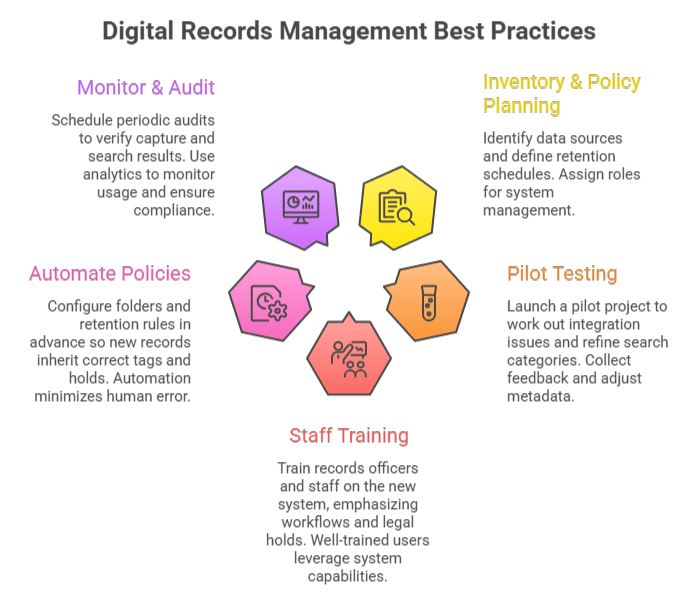
- Inventory & Policy Planning: Start with a full records inventory: identify all data sources (emails, legacy archives, mobile devices, cloud apps, etc.) and define retention schedules for each type of record. Clearly assign roles (who manages the system, who authorizes deletion, etc.).
- Pilot Testing: Launch a pilot project with one department or record type first. This helps work out integration issues and refine search categories. Collect feedback on search results and adjust metadata schemes before a full roll-out.
- Staff Training: Train records officers and department staff on the new system. Emphasize workflows like tagging, e-discovery searches, and requesting records exports. Make sure legal teams know how to place legal holds in the system when needed. Well-trained users are key to leveraging the system’s capabilities.
- Automate Policies: Configure as much as possible in advance. Define folders and retention rules so that new records inherit the correct tags and holds. For example, use rule-based automation so that all police reports older than the maximum public retention period are flagged for disposal. Automation minimizes the chance of human error.
- Monitor & Audit: After go-live, schedule periodic audits of the archive. Verify that all channels are being captured correctly and that searches return expected results. Use the system’s analytics to monitor usage patterns, identify gaps, and ensure policy compliance. Regular review keeps the archive healthy.
Following these steps makes the transition smooth. With the new system in place, FOIA responses become a routine search and pull, rather than a disruptive scramble.
Case Study: Digital Transformation in Action
Real-world examples show the impact of digitizing FOIA records management. For instance, a U.S. elections office modernized its permit and document workflows by scanning 95% of paper permits within one year. Officials can now instantly retrieve permits by applicant, location or date. Automated workflows cut approval times from days to minutes, while detailed audit logs let the office “easily meet FOIA and state-level record retention requirements”. The result: retrieval times 50% faster, compliance strengthened, and filing costs slashed.
Similarly, another agency introduced an enterprise content management system (a kind of digital archive) and saw major efficiency gains. With a centralized digital repository, staff became “just a keyword search away” from needed files. Built-in compliance features (retention and access controls) ensured every FOIA request could be answered confidently. In short, going digital turned a logistical burden into a routine operation.
These successes underline a key point: digital records management is now a best practice for government transparency. It not only speeds FOIA compliance, but also supports broader goals like audit readiness and public trust. Agencies that invest in modern records systems report smoother operations and higher satisfaction from citizens demanding information.
Conclusion and Next Steps
FOIA laws demand accountability, and digital records management is the tool that makes compliance practical. By automating capture, search, retention and security, agencies can meet FOIA requests faster and with greater accuracy. This fits into the wider pattern of smart government technology trends from AI and cloud computing to citizen-centric services that demand modern IT foundations. Agencies that keep their records management systems up to date are better positioned to fulfill every transparency requirement.
At App Maisters, our government IT solutions include content management, archiving, and digital workspaces tailored for public agencies. Our platforms integrate retention rules and audit logs so that FOIA compliance happens automatically. To explore how digital records management can transform your agency’s FOIA processes, contact us for a demo or consultation. Our experts can help design a solution that fits your unique needs from local government software to federal IT programs and keeps you ahead in the age of open records.
Learn more about our solutions and take the first step toward streamlined FOIA compliance today.
Frequently Asked Questions
How does digital records management support FOIA compliance?
Digital records management centralizes all official communications into one searchable archive. This improves foia records management by speeding up retrieval, reducing errors, and helping agencies meet legal response deadlines.
What is FOIA records management?
FOIA records management refers to the policies, tools, and systems used to preserve and produce public records under FOIA laws. It ensures agencies can locate and release requested records accurately and on time.
How long do government agencies have to respond to a FOIA request?
Most federal agencies must respond within 20 business days. Delays can occur if records are large in volume or require legal review, but agencies must communicate status updates.
What records are subject to FOIA?
Emails, reports, contracts, memos, text messages, and other official communications may be subject to FOIA. If a record relates to public business, it may need to be preserved and produced upon request.
How can agencies improve FOIA response times?
Agencies can improve response times by implementing digital records management with advanced search and automated indexing. Automation reduces manual review and helps teams retrieve records in minutes instead of days.
What are FOIA record retention requirements?
Retention requirements vary by record type and agency guidelines. A structured foia records management strategy ensures records are kept for the required period and disposed of properly when allowed.
What is the best records management system for government agencies?
The best system includes secure cloud storage, automated retention schedules, role-based access control, and full audit trails. It should align with federal IT solutions standards and support both local and federal compliance needs.
Can digital records management reduce FOIA backlog?
Yes. A centralized system allows staff to search across millions of records instantly. This reduces backlog, improves transparency, and strengthens public trust.