How K‑12 Schools Are Using Technology to Help Students Learn Better
Imagine a fifth-grade teacher standing in front of 30 students each at a completely different reading level, each processing information differently, and each competing with the distraction of a digital world built to capture their attention. Now multiply that across 130,000 public schools in the United States serving nearly 50 million students.
The gap between how today’s students learn and how most schools still teach is growing wider every year. According to the Nation’s Report Card (NAEP), fewer than 35% of eighth-graders are proficient in reading or math. Post-pandemic learning loss has set millions of students back by months in some districts, entire academic years. Meanwhile, teacher burnout and chronic understaffing have left school systems stretched razor-thin.
The solution isn’t simply more funding or more teachers though both matter. Increasingly, forward-thinking school districts are turning to k-12 educational technology solutions to close these gaps, personalize instruction, and make every classroom more effective, equitable, and engaging.
This isn’t a vision of the future. It’s happening right now.
Key Challenges Facing K‑12 Education Today
Before unpacking the solutions, it’s worth naming the problems with precision because administrators who misdiagnose the challenge will invest in the wrong tools.
- The Personalization Gap: Traditional classrooms operate on a one-size-fits-all model. A student who masters algebra in two weeks sits idle while others catch up. A student struggling with reading comprehension rarely gets the targeted intervention they need. The result: both groups disengage.
- Teacher Capacity and Burnout: The average U.S. teacher spends over 10 hours per week on administrative tasks grading, lesson planning, progress reporting tasks that technology can now largely automate. Without relief, districts lose teachers faster than they can hire them.
- The Digital Equity Divide: Rural and low-income districts often lack the infrastructure, devices, and broadband access that wealthier districts take for granted. The pandemic exposed this divide brutally. In 2025, it remains unresolved.
- Engagement and Attendance: Chronic absenteeism affects roughly 26% of U.S. students, according to recent Department of Education data. When students don’t see school as relevant or engaging, they stop showing up physically or mentally.
- Data Blindness: Most school administrators are making decisions about curriculum, staffing, and intervention without actionable, real-time data. They’re flying blind on outcomes that directly affect student futures.
Emerging Tech Trends Solving These Problems
The good news: a wave of powerful, purpose-built technologies is transforming what’s possible inside a K‑12 school building.
AI in Education
Artificial intelligence is no longer an experimental novelty in schools it’s becoming foundational infrastructure. AI in k-12 education now powers adaptive learning engines that adjust content difficulty in real time, intelligent tutoring systems that answer student questions at 2 a.m., and early-warning systems that flag students at risk of falling behind before a teacher might notice.
Cloud-Based Learning Platforms
Cloud infrastructure has made it possible for a student in rural Mississippi to access the same quality instructional tools as a student in Silicon Valley. Cloud-native platforms also allow seamless collaboration between teachers, students, and parents regardless of physical location.
Learning Analytics and Data-Driven Instruction
Data-driven teaching tools are giving educators a superpower they’ve never had before: the ability to see, in real time, which students are struggling, which concepts aren’t landing, and which instructional approaches are producing results. This transforms teaching from an art of intuition into a science of evidence.
Immersive Learning (AR/VR)
Augmented and virtual reality are making abstract concepts tangible. A student who can walk through the Roman Forum, dissect a virtual frog, or simulate a chemical reaction understands at a depth that a textbook simply cannot reach.
Mobile-First Learning Apps
The proliferation of smartphones and tablets has made the learning app for students one of the most powerful delivery mechanisms in modern education. The best apps meet students where they are on the devices they already use and deliver micro-learning, gamified challenges, and immediate feedback.
Step-by-Step Solutions: Implementing EdTech That Actually Works
Deploying technology in schools without a strategy is a fast path to wasted budgets and teacher frustration. Here’s a proven implementation framework for school district administrators.
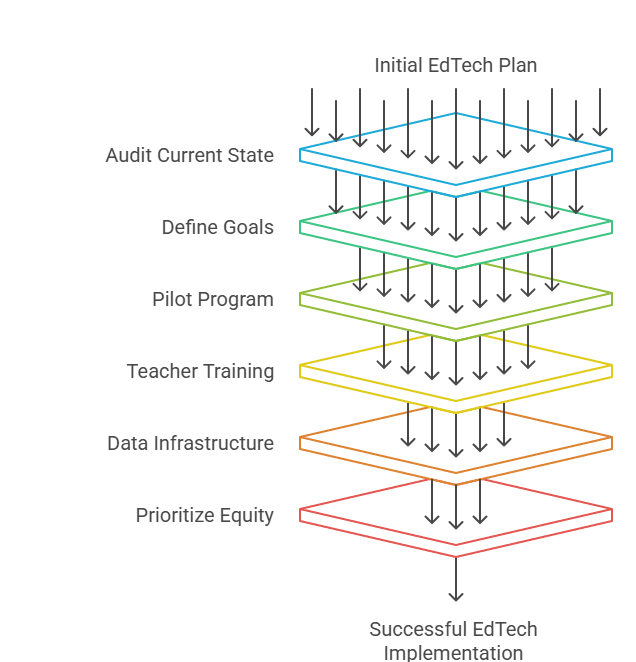
Step 1: Audit Your Current State Before purchasing any platform, conduct an honest assessment. What devices do students have access to? What’s the current broadband capacity? What data systems are already in place? A technology roadmap built on faulty assumptions fails before it starts.
Step 2: Define Student Outcome Goals Technology is a means, not an end. Define the specific student outcomes you’re targeting reading proficiency by third grade, algebra mastery by eighth grade, graduation rates. Every technology investment should trace back to one of these goals.
Step 3: Pilot Before You Scale Select two or three classrooms or schools for a structured pilot. Use pre- and post-assessment data to measure impact. Involve teachers as co-designers, not just end users. What works in the pilot informs the district-wide rollout.
Step 4: Invest in Teacher Training The single biggest predictor of edtech success is teacher adoption. Allocate at least 20% of your technology budget to professional development. Teachers who understand why a tool exists and how it serves their students are the ones who actually use it.
Step 5: Build a Data Infrastructure Implement a unified data dashboard that pulls from your SIS (Student Information System), LMS (Learning Management System), and assessment platforms. Make this data accessible to teachers, principals, and district leaders in a digestible, actionable format.
Step 6: Prioritize Equity Every technology rollout must include a plan for students without home internet access or personal devices. This means device lending programs, mobile hotspot partnerships with carriers, and offline-capable applications.
Step 7: Measure, Iterate, and Share Results Build in quarterly review cycles. Share what’s working and what isn’t transparently across the district. A culture of continuous improvement, supported by data, turns a good edtech program into a great one.
Real-World Use Cases: Districts Leading the Way
Los Angeles Unified School District (LAUSD) — AI-Powered Tutoring LAUSD has piloted AI tutoring assistants integrated directly into their LMS, providing students with personalized feedback on writing assignments and math problems outside of school hours. Early results showed measurable improvements in student completion rates and reduced teacher grading load by over 30%.
Rural Georgia School District — Closing the Digital Divide A consortium of rural Georgia counties partnered with a state broadband initiative and deployed Chromebook-based digital transformation in k-12 schools programs. Combined with cloud-hosted adaptive learning platforms, schools reported a 15-point gain in standardized reading scores over two academic years.
Chicago Public Schools — Early Warning Systems Chicago implemented a predictive analytics platform that identifies students showing early signs of chronic absenteeism or academic disengagement. Counselors receive automated alerts, enabling intervention weeks earlier than traditional systems allowed. Chronic absenteeism in pilot schools dropped by 18% in year one.
New York City — Gamified Learning Apps NYC’s Department of Education partnered with a mobile learning provider to deploy a learning app for students focused on middle-school math. The app’s gamified structure streaks, badges, real-time challenges produced a statistically significant improvement in student engagement and voluntary practice time.
Best Practices & Expert Tips
Align technology to pedagogy, not the other way around. The best edtech implementations start with an instructional philosophy and then find tools that support it. Districts that start with “What can this tool do?” instead of “What do our students need?” almost always underperform.
Create a district-level EdTech Steering Committee. Include teachers, IT leaders, curriculum directors, and parent representatives. Technology decisions made in isolation whether by IT or curriculum departments alone lack the cross-functional buy-in needed for sustainable adoption.
Leverage tech tools for student engagement beyond academics. Social-emotional learning platforms, digital check-ins, and peer collaboration tools matter as much as academic content delivery. Engagement is the prerequisite to learning.
Don’t ignore interoperability. Every new platform should integrate cleanly with your existing data ecosystem. Siloed tools create data gaps and administrative burden. Demand open APIs and compliance with education data standards like Ed-Fi or IMS Global.
Think about public sector digital transformation holistically. K‑12 technology doesn’t exist in a vacuum. The most successful districts connect their edtech strategy to broader community and government digital initiatives broadband expansion, workforce development, and social services integration.
Common Mistakes to Avoid
- Buying technology without teacher input. Teachers are the end users. Involving them in the selection process dramatically increases adoption and effectiveness.
- Treating implementation as a one-time event. Technology rollouts require ongoing support, refreshed training, and regular evaluation. A platform that isn’t continuously supported becomes shelfware within 18 months.
- Chasing trends over evidence. Not every tool that gets a TED Talk is ready for a classroom. Demand peer-reviewed efficacy data or third-party evaluation reports before committing district-wide budgets.
- Neglecting cybersecurity and student data privacy. School data breaches are rising sharply. Every k-12 educational technology solution must be evaluated against FERPA, COPPA, and state-level student privacy laws. Cutting corners here creates legal and reputational risk.
- Ignoring the human side of digital transformation in k-12 schools. Change management is as important as technical implementation. Acknowledge teacher anxiety, communicate the why behind changes, and celebrate early wins publicly.
Conclusion: The Future of K‑12 Education Is Intelligent, Equitable, and Already Here
The classrooms that will produce tomorrow’s engineers, artists, doctors, and civic leaders look fundamentally different from the classrooms of twenty years ago. AI in education is moving from pilot to standard practice. Data-driven teaching tools are making it possible, for the first time, to ensure that no student falls through the cracks undetected. And the rise of mobile-first, personalized learning is putting genuinely world-class instruction within reach of every student regardless of zip code.
The districts that will win the next decade aren’t the ones with the biggest budgets. They’re the ones with the clearest strategy, the strongest teacher partnerships, and the discipline to measure what matters.
The future of K‑12 education isn’t coming. It’s being built right now one classroom, one dataset, one student at a time.
How App Maisters Can Help
Government App Maisters is a digital transformation solutions company specializing in public sector digital transformation including purpose-built platforms for K‑12 school districts, government agencies, and education authorities.
From custom learning app for students development to district-wide data analytics infrastructure, App Maisters brings deep expertise in designing technology solutions that are scalable, equitable, and built around the real-world needs of educators and administrators.
Whether your district is beginning its edtech journey or looking to scale proven solutions across hundreds of schools, App Maisters delivers the strategy, engineering, and ongoing support to make it work not just in theory, but in classrooms.
Ready to transform how your students learn? Contact App Maisters today.
Frequently Asked Questions
How is technology used in K‑12 education?
Technology in K‑12 education is used to personalize learning, automate teacher administrative tasks, and improve student engagement. Tools like AI tutoring systems, cloud-based learning platforms, and data analytics dashboards help schools deliver better outcomes for every student.
What is the best learning app for students in K‑12?
The best learning apps for K‑12 students combine adaptive content, gamification, and real-time feedback such as Khan Academy, Duolingo for Schools, and IXL Learning. The right app depends on the subject, grade level, and specific learning goals of the student or district.
How does AI help students learn better?
AI helps students learn better by adapting content to their individual pace and skill level in real time. AI-powered tutoring tools can answer questions instantly, identify learning gaps early, and recommend targeted practice giving each student a personalized learning experience at scale.
What are k-12 educational technology solutions?
K‑12 educational technology solutions are digital tools and platforms designed to improve teaching and learning in primary and secondary schools. They include learning management systems (LMS), adaptive learning software, student data analytics tools, and classroom engagement platforms.
How can school districts close the digital equity gap?
School districts can close the digital equity gap by providing device lending programs, partnering with broadband providers to expand internet access, and deploying offline-capable learning apps. Equity must be built into every technology rollout plan from day one not treated as an afterthought.
What is digital transformation in K‑12 schools?
Digital transformation in K‑12 schools means systematically integrating technology into teaching, administration, and student support to improve learning outcomes. It goes beyond adding devices it requires rethinking how data, cloud platforms, and AI-powered tools work together across the entire school system.
How do data-driven teaching tools improve student outcomes?
Data-driven teaching tools give educators real-time visibility into student performance, attendance, and engagement. Teachers can identify struggling students weeks earlier, adjust instruction based on evidence, and measure the impact of every intervention leading to measurably better academic results.
What are the biggest challenges of using technology in schools?
The biggest challenges include unequal access to devices and internet, low teacher adoption due to insufficient training, student data privacy concerns, and the risk of purchasing tools without clear evidence of effectiveness. A strong implementation strategy and ongoing professional development are essential to overcoming these barriers.
How does AI in education benefit teachers, not just students?
AI benefits teachers by automating time-consuming tasks like grading, progress reporting, and lesson differentiation. This frees up hours each week that teachers can redirect toward direct student instruction, mentoring, and relationship-building the parts of teaching that technology can’t replace.
How can tech tools improve student engagement in the classroom?
Tech tools improve student engagement by making learning interactive, personalized, and immediately rewarding. Gamified apps, collaborative digital projects, real-time polling, and adaptive challenges all create the kind of active participation that passive textbook learning cannot achieve.
What should school administrators look for when choosing edtech tools?
Yes, research shows that immersive AR/VR experiences significantly improve comprehension and retention for complex or abstract subjects like science, history, and geography. However, effectiveness depends on how well the VR content is aligned to curriculum standards and supported by teacher-led instruction.
Is AR/VR effective for K‑12 learning?
School administrators should evaluate edtech tools based on evidence of student outcome improvement, ease of teacher adoption, data privacy compliance (FERPA/COPPA), interoperability with existing systems, and vendor support quality. Always pilot before committing to a district-wide rollout.