


agentic ai
LLMOps public sector

What is LLMOps and why the public‑sector should care

LLMOps (Large Language Model Operations) refers to the processes and tools for running advanced AI language models in production. It covers the full lifecycle of LLMs from preparing training data and fine‑tuning the model to deploying it, monitoring its output, and ensuring compliance. Essentially, think of LLMOps as MLOps on steroids for chatbots and other generative AI: it brings together data scientists, DevOps engineers and IT staff to handle data pipelines, model versioning, prompt engineering and performance tracking. By putting these workflows in place, agencies can make sure their AI applications run reliably, safely and at scale.

LLMOps vs MLOps: What’s different?

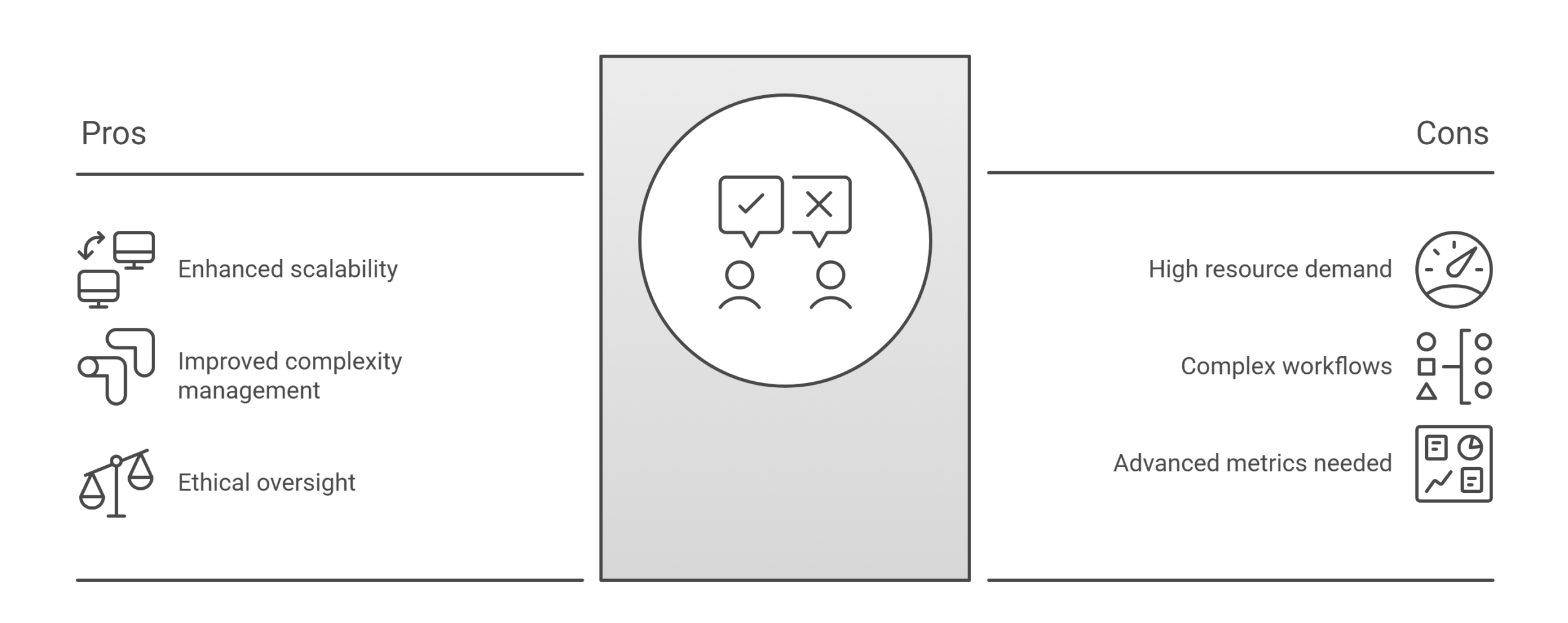
While LLMOps builds on the principles of MLOps, large language models introduce new challenges. LLMs are far larger and more complex than typical ML models training or fine-tuning them can involve billions of parameters and massive datasets. They also generate open‑ended text, so traditional accuracy metrics don’t tell the whole story. For example, LLMs often use metrics like BLEU or ROUGE for text quality, rather than simple accuracy. Moreover, running an LLM at scale usually requires specialized hardware (GPUs/TPUs) and careful cost management. In practice, LLMOps adds steps to the workflow that aren’t needed for smaller models: things like prompt and context management, retrieval‑augmented generation (RAG), continuous human‑in‑the‑loop feedback, and even chain-of-thought pipelines. As one guide summarizes, LLMOps handles scale, complexity, and ethical oversight at a level beyond classic MLOps.
LLMOps vs MLOps What’s different

For example, an LLMOps platform must track prompt versions and guard against hallucination (misinformation), which is far less of a concern for a fixed-output ML model. It must also support Reinforcement Learning from Human Feedback (RLHF) using end-user corrections to fine-tune the model something rarely needed in ordinary ML. In short, LLMOps adapts the familiar CI/CD and monitoring pipelines of MLOps but adds governance, safety checks and scalability specifically for LLMs.

Why LLMOps matters for government agencies

Governments are eager to tap generative AI to improve citizen services, data analysis and internal efficiency. In fact, surveys show public-sector tech leaders recognize the importance of AI: 64% say AI adoption is important, yet only about 26% have fully integrated AI in their organizations. This gap especially with only ~12% having adopted gen‑AI tools means agencies must move carefully and strategically. Successful AI adoption strategies in government hinge on strong governance, security and human oversight. Reports note that federal and state agencies are already expanding AI use to streamline services and decision-making, but unclear ethical frameworks (cited by 48% of leaders) and data infrastructure shortfalls (30%) are top barriers.

LLMOps public sector practices directly address these concerns. By baking in compliance and validation at every step, LLMOps ensures new AI services align with policies and regulations. For example, an LLMOps pipeline can enforce data encryption and privacy checks on all inputs, and require human review of sensitive outputs reflecting the ai governance human validation that agencies need. Similarly, monitoring tools within LLMOps watch for model drift or bias, so officials get alerts if the system begins to misbehave. These safeguards not only mitigate risk, they build trust. After all, public agencies must often justify AI results to oversight bodies. A robust LLMOps framework provides audit trails and reproducibility, making it easier to comply with mandates OMB and NIST guidance both emphasize transparency and accountability.

At the same time, LLMOps helps unlock AI’s benefits for the public sector. Well‑managed LLMs can turbocharge citizen services (e.g. virtual assistants and automated report generation), optimize workflows, and analyze data at scale all key parts of the broader public sector digital transformation. With proper operations, agencies can 24/7 human-like support citizens. For instance, a state revenue department launched an AI chatbot to answer tax and licensing questions anytime, drastically cutting citizen wait times. Another example: an environmental agency’s LLM‑powered agent automated permit review end-to-end, slashing processing time. These use cases wouldn’t be reliable without LLMOps pipelines behind them pipelines that track performance, version the model and data, and allow human editors to step in if needed.

Building blocks of LLMOps for government

Implementing LLMOps in a public agency means setting up a connected workflow. Key components include:

  • Data Management & Privacy: Governments must curate high‑quality, relevant datasets, often across siloed agencies. LLMOps demands strict data pipelines: ingestion, cleaning, de-duplication and secure storage. For example, specialized tools automatically scrub PII and enforce jurisdictional rules before data is used. Ensuring data versioning and lineage (as IBM recommends) means any output can be traced back to source inputs.
  • Model Training & Fine‑Tuning: Agencies can either fine-tune existing foundation LLMs or train custom ones. Fine-tuning on public-sector data is often most cost-effective. AWS experts note that governments should analyze total cost of ownership (TCO) when picking models: larger LLMs (billions of parameters) cost much more to host and serve. LLMOps teams therefore track GPU usage and latency, and may select a smaller model that meets requirements. They also continuously optimize hyperparameters and use techniques like pruning or quantization to reduce compute needs.
  • Prompt and Context Handling: In LLMOps, prompt engineering is a first-class citizen. Teams build and version structured prompts, instructions and knowledge bases (e.g. retrieval databases) that the LLM uses. They test prompts with automated QA to prevent prompt injection or hallucinations. For many government uses (like legal text or regulations), agencies may chain multiple LLM calls with external data (sometimes via tools like LangChain) an approach LLMOps supports via pipelines
  • Deployment & Infrastructure: Government LLMs typically run on cloud platforms or dedicated data centers. LLMOps involves CI/CD pipelines to push model updates and rollbacks safely. It also entails ensuring runtime reliability: automatic load balancing, caching responses, and fallback options if the LLM service is down. Because agencies handle critical services, disaster recovery (backups of models and data) is part of best practices.
  • Monitoring & Evaluation: Perhaps most important is observing the LLM’s behavior in real time. LLMOps tools track metrics like response time, output quality (using both automated tests and human review), and model drift. If an LLM starts producing biased or inappropriate content, alerts are raised immediately. IBM notes that advanced LLMOps prioritize the protection of sensitive information and enable faster responses to audits. In practice, monitoring includes gathering user ratings or corrections as feedback. Many teams embed mechanisms so that when a citizen flags an erroneous answer, it feeds back into the training pipeline reinforcement learning from human feedback.
  • Governance & Compliance: Finally, LLMOps formalizes rules and human oversight. Policies about acceptable use, data residency, and fairness are codified into the pipeline. During development, for instance, model outputs are routinely audited for bias an ethical model development practice. Every change is logged so that agencies can demonstrate GDPR or other compliance. This focus on ai governance human validation building in manual checks is what lets governments meet legal requirements while innovating with AI.

In summary, LLMOps weaves together data curation, model tuning, secure infrastructure and human oversight. It ensures that when an agency deploys an LLM in the field, it performs reliably, respects laws, and can be updated or shut down quickly if anything goes wrong.

Benefits and challenges

With LLMOps in place, governments gain efficiency and risk control simultaneously.
Benefits and challenges

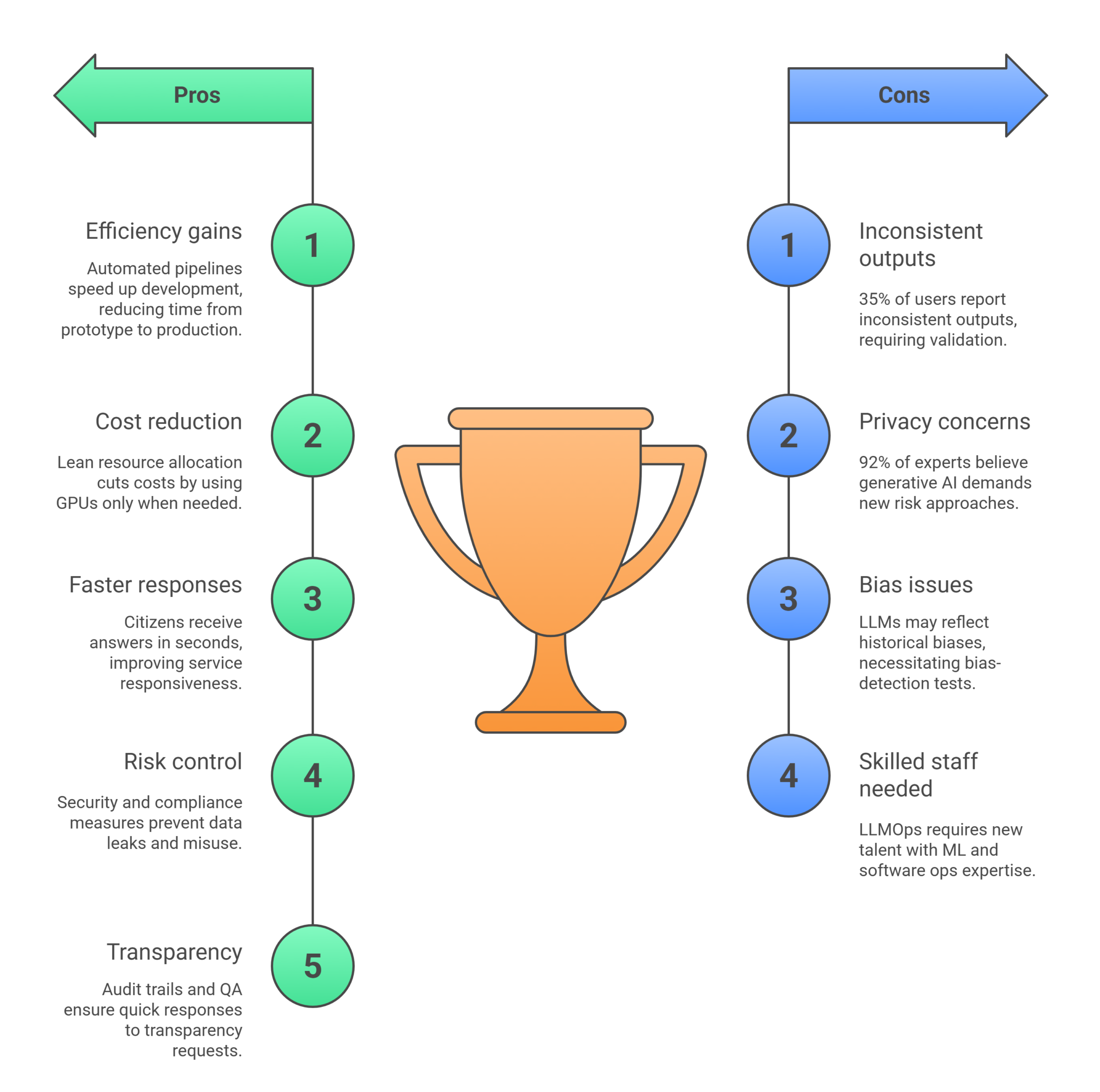
  • Efficiency: Automated pipelines and collaboration tools speed up development, so agencies go from prototype to production faster. LLMOps makes resource use leaner (for example, by allocating GPUs only when needed), which can cut costs. Services become more responsive too citizens get answers in seconds rather than days.
  • Risk Reduction: By prioritizing security and compliance, LLMOps helps prevent data leaks and misuse. Audit trails and consistent QA mean agencies can answer transparency requests quickly. However, deploying LLMs in government is not without hurdles.
  • Reliability: About 35% of users of LLMs report inconsistent outputs as their biggest issue. Governments must validate that answers are accurate, or have humans verify them.
  • Privacy and Security: A Cisco survey found 92% of experts believe generative AI demands new risk approaches. Many (68–69%) worry that LLMs could inadvertently share sensitive data or violate IP laws. This makes LLMOps safeguards (access controls, redaction, encryption) essential in public deployments.
  • Fairness and Bias: LLMs trained on public data may reflect historical biases. Agencies must include bias-detection tests and human review in LLMOps to guard against discrimination.
  • Skilled Staff: Finally, LLMOps requires new talent people who understand both ML and software ops. Agencies may need to train existing staff or partner with providers to fill these roles.

Real-world examples

Consider these scenarios that illustrate LLMOps at work in government-like settings:

  • 24/7 Citizen Support: A state tax department builds a virtual assistant that handles license and tax questions around the clock. Behind the scenes, an LLMOps framework continuously monitors the chatbot’s accuracy and can route tricky issues to a human auditor. The result: faster help for citizens and detailed logs to show regulators that interactions remain compliant.
  • Automated Workflow: An environmental agency deploys an AI agent to process permit applications from start to finish. The LLM pulls applicant data, checks it against multiple databases, and even drafts preliminary approval letters. The LLMOps pipeline ensures that the model is retrained weekly on new data and that any outlier cases are flagged for human review. As a result, permit processing time drops by a large margin, and officers can focus on complex policy issues.
  • Regulated Environment: A law enforcement agency uses AI in digital evidence management. They plan to add an LLM for generating case reports and translations in the future. This tight regulatory context means they built LLMOps with extra security: every LLM-generated report is logged, reviewed, and encrypted. Strict access controls and continual performance audits (e.g. against bias or errors) are in place so that the AI acts as a reliable assistant without compromising privacy.

These examples show that no matter the task, LLMOps underpins success: it turns powerful but complex AI into practical tools that public servants and citizens can trust.

Conclusion: Time for public sector leaders to act

Large language models are reshaping how government can serve the public, but only if they’re managed properly. For public‑sector technology leaders, understanding and implementing LLMOps is now a strategic imperative. By embedding the right processes and tools essentially treating LLMs as production-critical systems agencies can reap AI’s benefits while meeting their unique accountability and security needs. Think of LLMOps as a key part of your government AI adoption strategies and public sector digital transformation roadmap.

If you’re ready to explore how LLMOps can work in your organization, consider our specialized artificial intelligence solutions for government. We can help you design an LLMOps framework with strong governance and human-in-the-loop safeguards. Embracing this approach now and even looking ahead to agentic AI public sector innovations will position your agency to deliver faster, smarter, and more reliable digital services to citizens.


Frequently Asked Questions

What is LLMOps in the public sector?

LLMOps public sector focuses on managing, deploying, and monitoring large language models safely in government environments. It ensures compliance, security, and reliable AI outcomes for public services.

LLMOps government agencies rely on helps reduce risk, control costs, and improve service delivery. It also supports transparency, audits, and human oversight required in the public sector.

LLMOps vs MLOps differs mainly in scale and governance. LLMOps handles large models, prompt management, human validation, and ethical risks that standard MLOps does not fully address.

Deploying LLMs in government is safe when strong LLMOps practices are in place. This includes data security, access controls, bias checks, and continuous human review.

Common use cases include citizen chatbots, document analysis, policy summarization, and internal automation. All rely on LLMOps government agencies frameworks to stay compliant.

LLMOps embeds governance rules, audit trails, and human validation into AI workflows. This aligns with public-sector standards and responsible AI requirements.

Yes. App Maisters delivers LLMOps public sector solutions designed for government agencies. Our services align with security, compliance, and public-sector operational needs.

Yes. With the right architecture, deploying LLMs in government can scale across agencies. LLMOps ensures consistent performance, governance, and monitoring at every level.

blog

Related Articles

Explore insights, trends, and expert opinions on the latest in technology and innovation. Stay informed with our curated articles designed to help you navigate the digital landscape.