


Public agencies are under pressure to modernize and improve citizen services with cutting-edge technology. Yet talent gaps and hiring restrictions often slow government IT projects. In fact, governments worldwide invest nearly $600 billion annually in technology a budget growing 7–9% each year but fewer than one in five public-sector digital initiatives succeed. This means technology leaders and decision-makers must leverage every resource they have. Public sector IT staffing bringing in skilled contract professionals and staff augmentation is a powerful strategy to meet mission goals. By augmenting in-house teams, agencies gain on-demand expertise, flexibility, and speed, making every dollar count while avoiding project bottlenecks.
Government projects face unique challenges like fixed headcounts, tight budgets, and stringent regulations. A Government Business Council survey found that 37% of federal managers rely on contract staff specifically to bypass hiring caps. These managers hire external experts not just to plug gaps, but to deliver high-impact knowledge on short notice. For example, when the U.S. Department of Education needed faster results on a classification system, leaders said, staff augmentation gave us a very flexible hiring model and expertise on demand. In other words, expert contractors helped resolve a short-term crisis without long-term commitments.
Here are the key benefits public agencies gain by partnering for IT staffing:
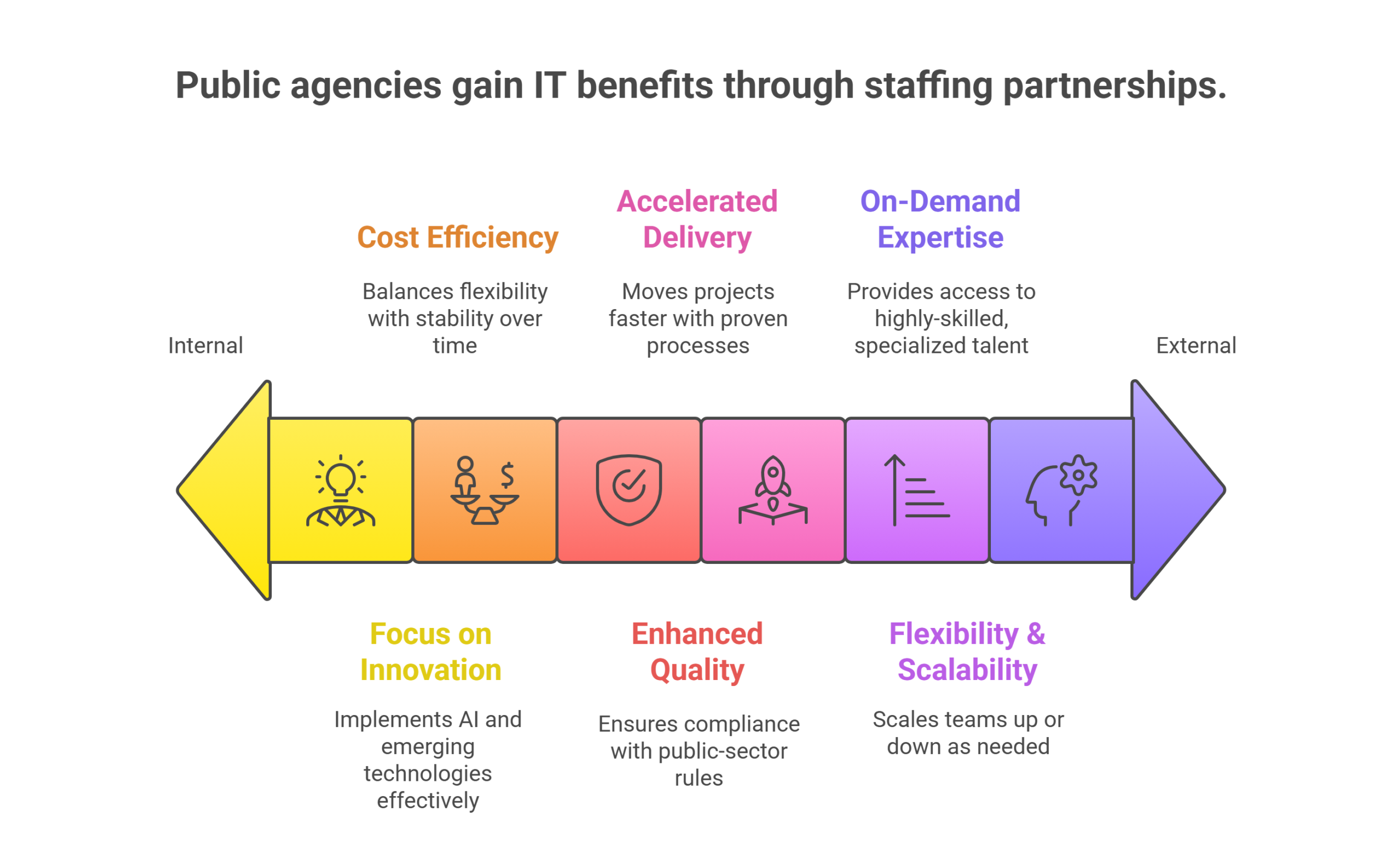
Staffing augmentation provides access to highly-skilled, specialized talent that agencies may lack internally. Instead of investing years in hiring or training, you bring in experts (such as data scientists, cloud architects or cybersecurity analysts) who possess technical knowledge that the agency may lack or be unable to develop in-house within a short period. This rapid infusion of skill is critical for complex projects, from modernizing legacy systems to building new e-services.
Contract staffing lets agencies scale teams up or down as project needs change. For instance, if a new emergency requires additional developers or network engineers, augmentation provides a fast solution. Staff augmentation made sense… when we weren’t sure what our long-term needs would look like, one federal executive noted. This flexible model avoids the risks and overhead of long-term hires for short-lived or pilot projects.
With experienced professionals on board, projects move faster. External IT teams hit the ground running using proven processes and tools. This helps avoid common pitfalls: surveys show that 80% of government IT projects fail due to technical and management issues. Augmented staff help bridge those gaps, reducing delays and keeping initiatives on track. By combining in-house knowledge with outside talent, agencies can hit milestones and deliver services to citizens without costly overruns.
Although contracting staff can have higher hourly rates than full-time hires, it often lowers overall program costs. Agencies can redirect FTE funds to core missions while using contract budgets for peak demands. Over time, this balances flexibility with stability: as one official explained, agencies use contractors for immediate needs and hire FTEs when roles become permanent. Moreover, staffing allows avoiding the costs of a lengthy recruitment process and provides a buffer against budget cuts and headcount limits.
Staff augmentation helps agencies Implement AI and other emerging technologies more effectively. For example, bringing in AI/ML engineers or data analysts lets public-sector teams quickly pilot machine-learning projects or automate services. According to McKinsey, governments are eager to transform faster, innovate smarter, and anticipate the future better with technology. With outside talent in place, agencies can embrace analytics, cloud migration, and even generative AI initiatives without waiting years to build those skills internally.
Staffing firms that specialize in government IT staffing understand public-sector rules around security, privacy, and procurement. This means augmented staff arrive aware of compliance requirements like FISMA, HIPAA, or FedRAMP, reducing risk. In sensitive areas (e.g. defense, healthcare), having contractors vetted for clearances and regulations ensures your project meets standards from day one. Expert partners often provide ready-made processes and performance metrics, helping the agency maintain oversight while still benefiting from outside expertise.
Public-sector agencies face unique constraints. Fixed budgets and hiring caps mean IT gaps can’t always be filled with new FTEs. For example, about 73% of federal grants were managed by HHS’s central unit in 2013 to control costs, illustrating how agencies lean on shared resources. In today’s environment, narrowly focusing on in-house hiring can stall progress or leave skills shortages unaddressed. Staffing and augmentation break this logjam.
By engaging an IT staff augmentation provider, agencies gain on-demand capacity and targeted support. For instance, one Department of Education official observed that using contract staff gave a very flexible hiring model and expertise on demand, exactly when needed to clear backlogs. Similarly, 37% of federal IT leaders reported that headcount limits force them to rely on contractors. In practical terms, this means a city IT department short on cybersecurity staff can quickly onboard niche talent through augmentation, rather than enduring lengthy recruitment.
Beyond headcount, outsourcing specialized tasks to third-party teams often speeds up delivery. Grand View Research reports that the global IT services outsourcing market topped $744 billion in 2024, reflecting the huge appetite for flexible tech support. When governments tap into this trend, they shorten time-to-market. Contractors with proven expertise can avoid common pitfalls (only about 20% of e-government projects meet goals) by applying best practices from other agencies and industries. In effect, augmentation brings lessons learned – reducing trial-and-error.
Modern agencies must adopt public sector technology solutions like cloud platforms, mobile apps, data analytics, and AI to improve services. However, civil servants often lack the deep bench of specialists needed to roll out these innovations quickly. That’s where IT staffing makes a difference. For example, if an agency wants to Implement AI for predictive policing or benefits fraud detection, an IT staff augmentation team can provide data scientists and ML engineers to kickstart the project. Your internal team gains hands-on experience and guidance, while the project meets high technical standards.
Even basic digital services benefit. Consider a legacy backend that needs modernization to deliver citizen portals or telehealth. Contract developers and architects can be added to your existing staff to refactor systems, deploy cloud solutions, or enhance cybersecurity. These roles are often hard to hire permanently due to cost or location constraints, but can be filled rapidly through an augmentation partner.
As McKinsey notes, governments are increasingly focusing on data, analytics, and emerging tech to improve programs. By using skilled contract teams, agencies stay at the forefront of these trends without the ramp-up time of in-house hiring.
Not all staffing solutions are the same. For government work, look for partners experienced in government IT staffing, who understand procurement rules and mission needs. The right partner will:
Using this funnel of assessment → staffing → integration, technology leaders can guide projects from concept to completion. The return on this approach shows up as smoother launches, faster adoption of new tech, and ultimately better public services.
In today’s fast-paced digital world, government agencies cannot afford IT staffing shortfalls or stalled projects. By embracing IT staff augmentation and specialized public sector staffing, agencies gain a competitive edge. The benefits are clear: faster project delivery, access to expert skills, better cost management, and accelerated innovation including AI implementations all while staying compliant with public-sector standards.
Whether you’re upgrading legacy systems, deploying cloud solutions, or exploring AI-driven analytics, the right staffing partner makes success achievable. IT & Staff Augmentation for Government is not just a stopgap it’s a strategic choice that powers public missions with world-class talent.
Ready to transform your next government project with top-tier IT staff? Partner with an agency experienced in government projects. Contact App Maisters our IT & Staff Augmentation for Government team to learn how we can tailor a staffing solution that fits your mission, schedules, and budgets. Let us help you build the skilled team you need to deliver innovative public sector technology solutions and achieve your agency’s goals.