


Public sector leadership faces a powerful inflection point. When most people think about artificial intelligence, they imagine tech startups or corporate innovation labs. Yet, the quiet revolution unfolding across government agencies is far ore consequential: AI in public sector operations is rewriting the rulebook for public trust, service delivery, and societal outcomes.
As we look toward government AI growth in 2026, leaders in government technology must ask: Is the public sector merely experimenting with AI, or is it ready to scale it strategically to accelerate impact? The answer lies not just in cutting‑edge technologies, but in how AI transforms mission‑critical public services, policy outcomes, and citizen experiences.
Recent research underscores a massive shift: the global AI in government and public services market is projected to expand from around USD 22.4 billion in 2024 to over USD 98 billion by 2033, growing at a compound annual growth rate of 17.8%. This reflects sustained adoption across agencies seeking efficiency, responsiveness, and smarter decision‑making.
Governments in North America and beyond are increasingly prioritizing AI investments to modernize legacy systems, automate repetitive processes, and deliver better services all while managing risk and ethical expectations. This momentum is not just private sector hype; public sector usage is climbing rapidly, with adoption scaling into hundreds and thousands of discrete AI use cases across federal, state, and local agencies.
Let’s unpack what this means for 2026 and why this moment is pivotal for both digital modernization and societal trust in government AI.
Many government leaders recognize AI’s transformative power, yet adoption patterns vary significantly across regions and countries. A 2025 Government AI Readiness Index shows North America leading in preparedness to integrate AI into public services, supported by digital policies that encourage experimentation and scaling across agencies.
At the same time, surveys of public sector employees show that nearly half of workers use AI tools weekly, indicating grassroots adoption even where formal strategies lag.
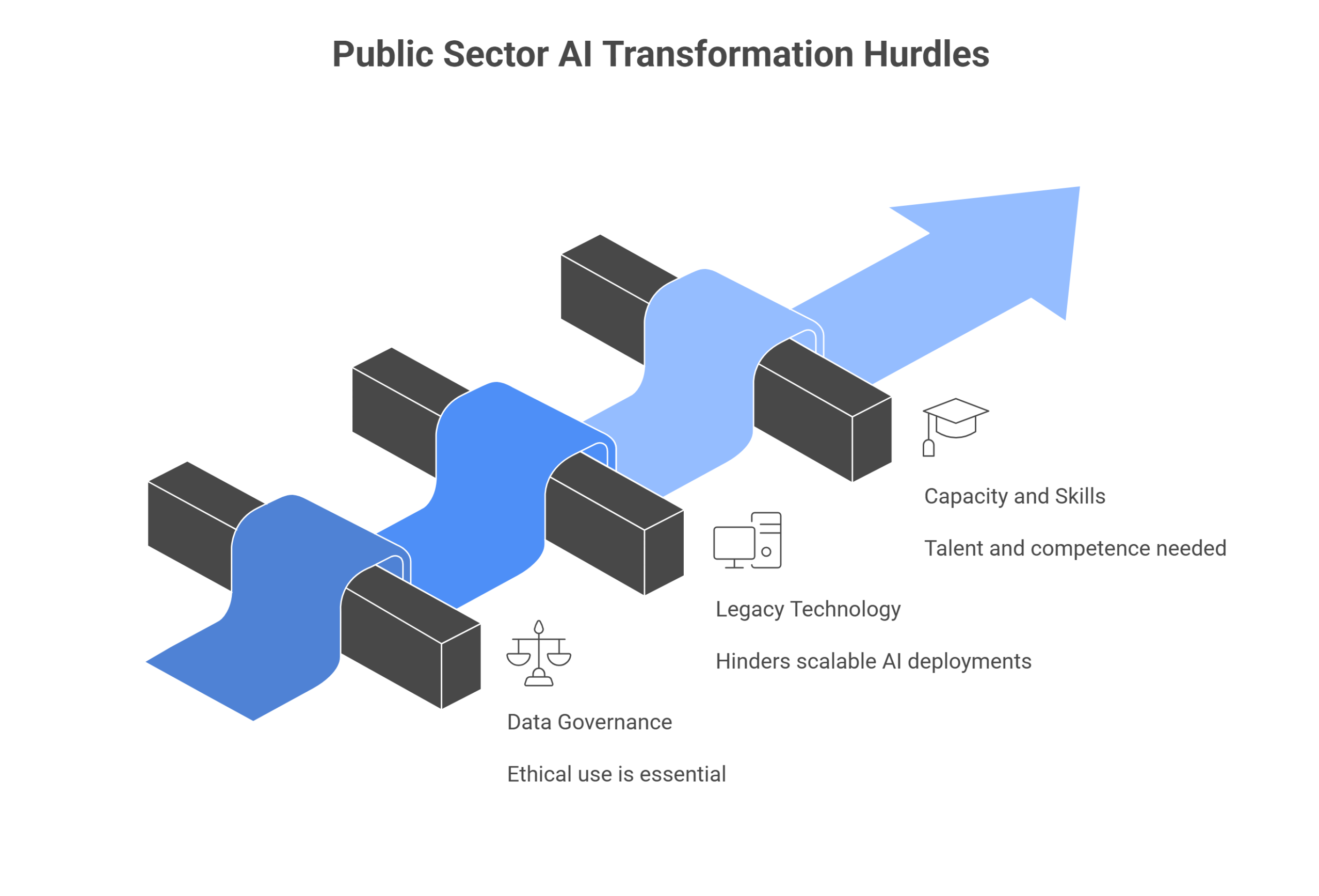
But there’s a gap between enthusiasm and enterprise‑level implementation: while more than 60% of government leaders acknowledge AI’s importance, only about a quarter have fully integrated AI across their organizations. Barriers include data governance, legacy systems, and security concerns challenges familiar to every tech leader in public service today.
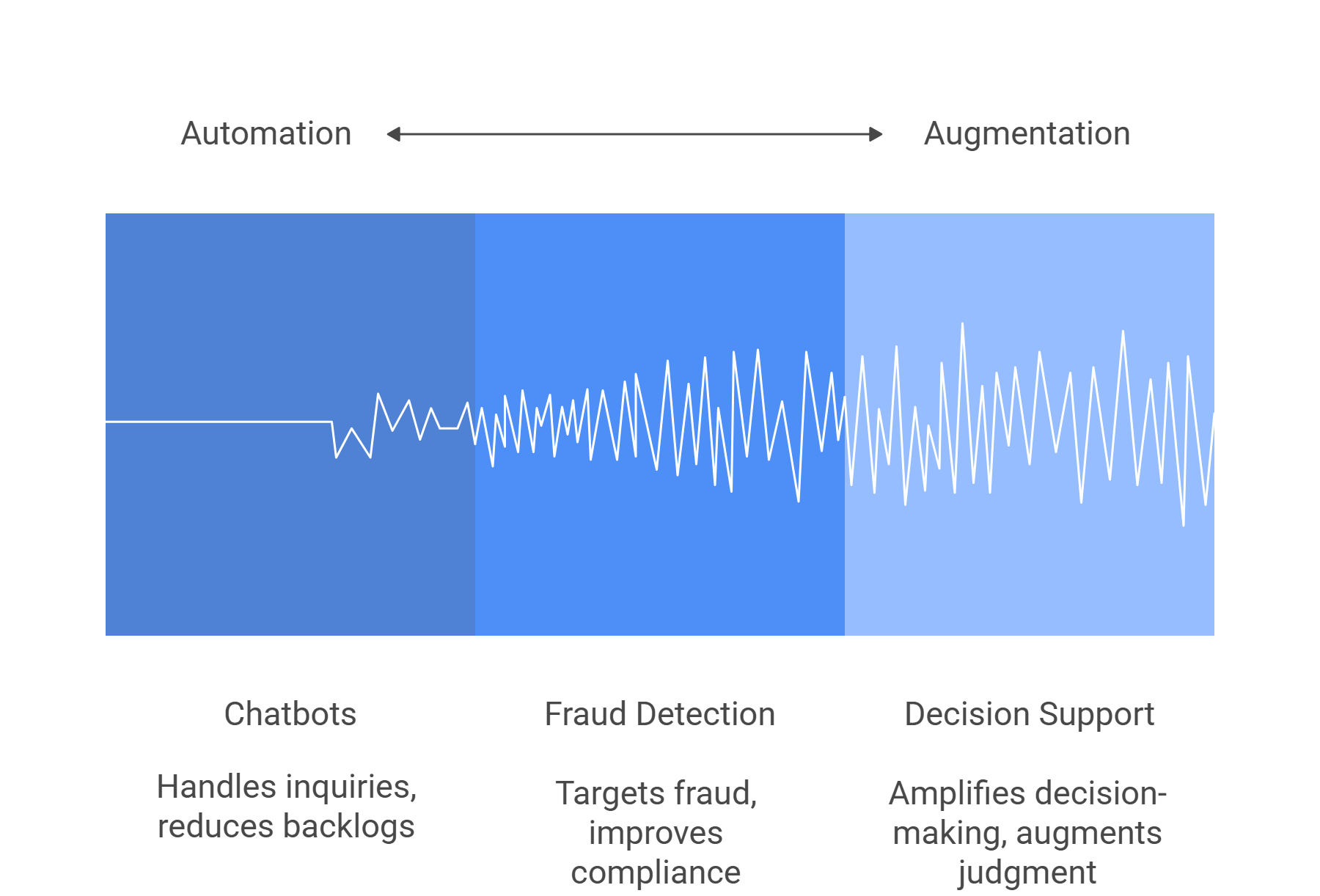
AI isn’t just automating routine tasks; it’s amplifying government decision‑making. Federal agencies in the U.S. reported over 1,100 active AI use cases across mission areas from benefits processing to service delivery reflecting a ninefold increase in generative AI use in just one year.
Data‑driven governance is becoming central to tackling complex public challenges. For example, agencies use AI to target fraud in unemployment insurance systems, reducing leakage and improving compliance. This isn’t hypothetical AI models are already integrated into fraud‑prevention workflows, enhancing accuracy and speed.
Leaders balancing risk mitigation with innovation are turning AI into a public benefit tool by augmenting human judgment rather than supplanting it.
In an era where citizens expect private‑sector‑level digital experiences, government services must compete not with other governments, but with citizens expectations. AI can personalize experiences and reduce friction at every touchpoint.
Chatbot for government implementations are now ubiquitous, handling thousands of routine citizen inquiries from benefits eligibility checks to appointment scheduling with instant responses. These AI service bots improve accessibility while reducing service backlogs.
This shift directly ties to broader digital transformation for government, where Agencies leverage conversational AI to meet 24/7 expectations for service.
AI adoption isn’t just about technology it’s about talent. While AI can handle data intensive tasks, success depends on people who understand both policy context and technical capabilities. Agencies that invest in training and iterative governance frameworks are ahead of those still operating with siloed, manual processes.
Training programs tailored to government officials, like national capacity‑building initiatives launched in countries like India to develop AI governance skills, highlight global efforts to upskill public servants for a future where AI is integral to service delivery and strategy.
In 2026, the most successful government technology leaders will be those who blend AI proficiency with an ethical, human‑centric approach to deployment.
A large federal social services agency implemented predictive analytics models to identify benefit fraud earlier and optimize eligibility processing. By automating initial case prioritization, the agency reduced backlog by over 40%, enabling caseworkers to focus on complex claims requiring human intervention.
This example demonstrates how AI in public sector environments drives efficiency and fairness simultaneously, improving outcomes while managing scarce human resources.
A state public safety department used machine learning models to analyze historical incident data and forecast resource needs during peak periods, such as natural disasters or public events. AI’s predictive insights improved dispatch accuracy, reduced response times, and enhanced interagency coordination without replacing human judgment in operational decisions.
This model illustrates how AI augments critical services where real‑time data and adaptive strategies are essential.
While adoption has accelerated, public sector AI transformation still faces persistent hurdles:
As we approach 2026, the public sector AI transformation will continue accelerating. Gartner now identifies sovereign AI and AI agents among the top technologies shaping future government AI adoption, signaling a shift toward more autonomous, intelligent systems tailored for public needs.
At the same time, OECD data shows that two‑thirds of OECD countries are already using AI to improve public service design and delivery, proof that early adoption is rapidly turning into strategic scaling.
From boosting internal productivity and responsiveness to reshaping citizen engagement, AI in public sector operations isn’t just a technical enhancement it’s a transformation engine. Agencies that embrace AI thoughtfully will unlock new levels of societal impact while reinforcing accountability and trust.
Public sector leaders can’t afford to be passive observers. The future of government is data‑driven, automated where appropriate, and human‑centered where it matters most. To harness the full power of AI:
Discover how AI can accelerate your agency’s mission. Contact our government technology experts at App Maisters to translate strategy into impact responsibly, effectively, and with measurable outcomes.